Multiplying and dividing powers
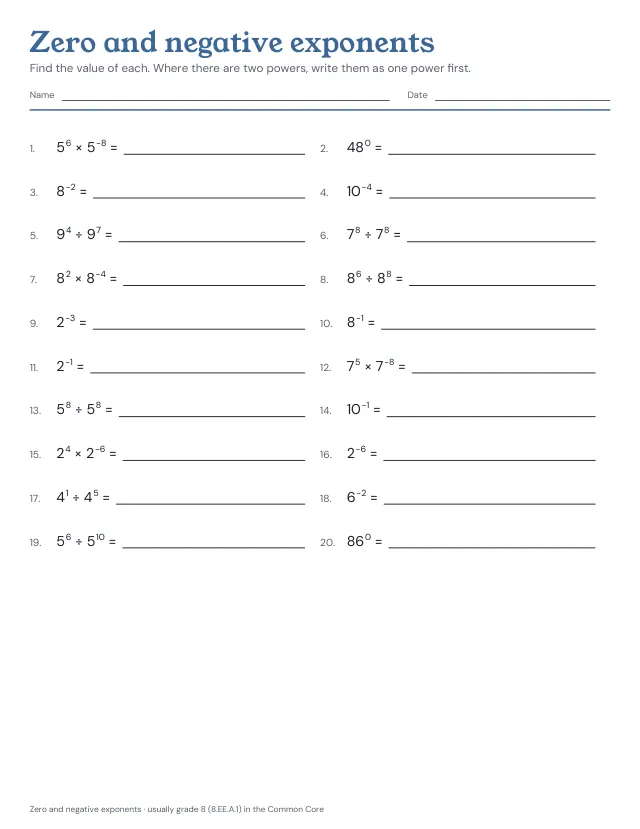
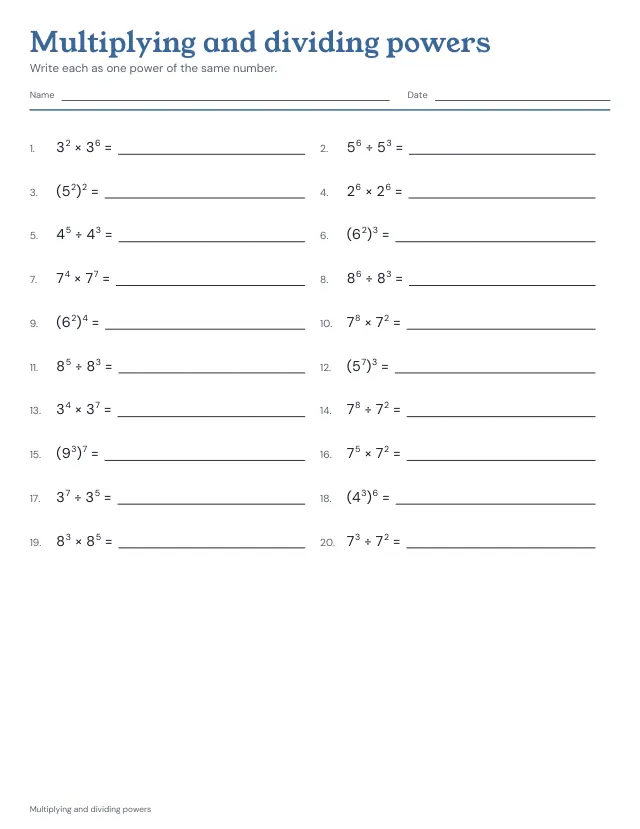
Powers of one number such as 2³ × 2⁴ = 2⁷ and 2⁵ ÷ 2² = 2³.
Common Core 8.EE.A.1
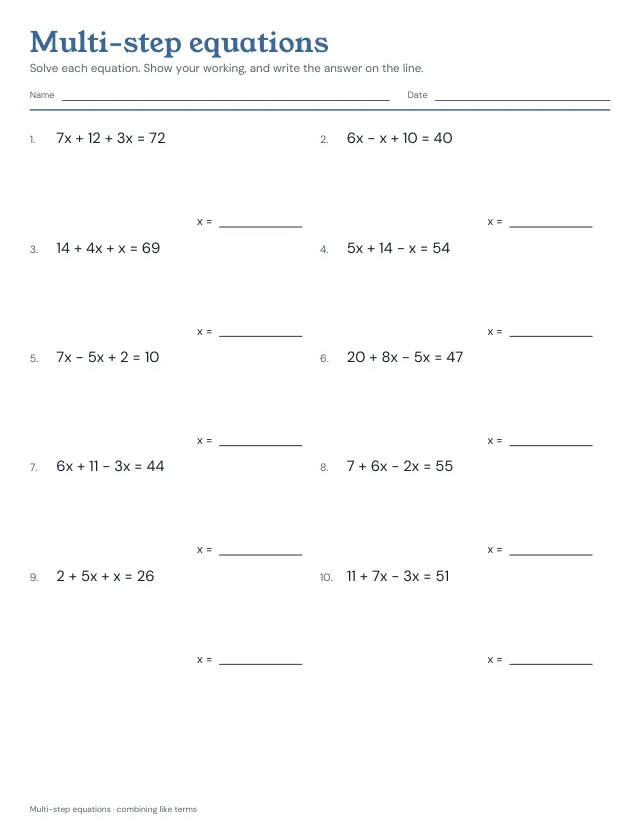
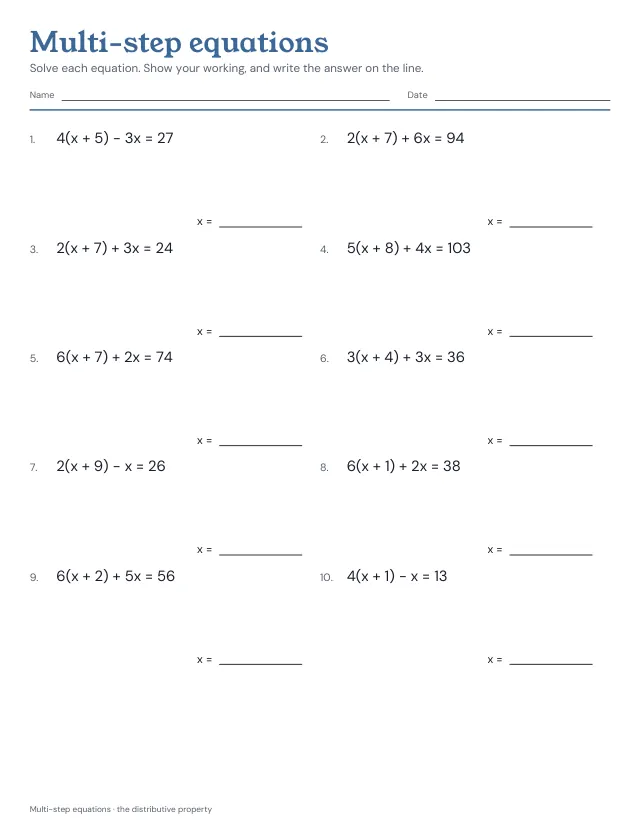
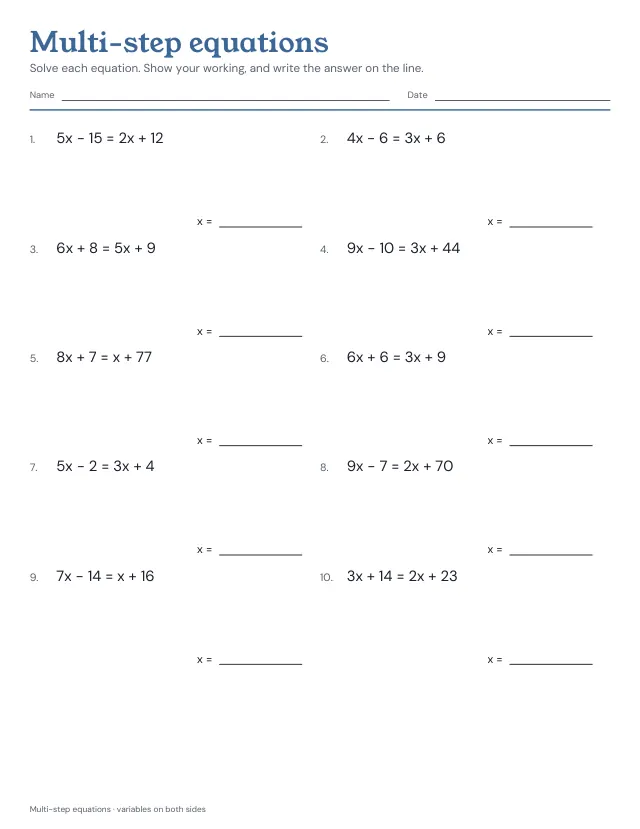
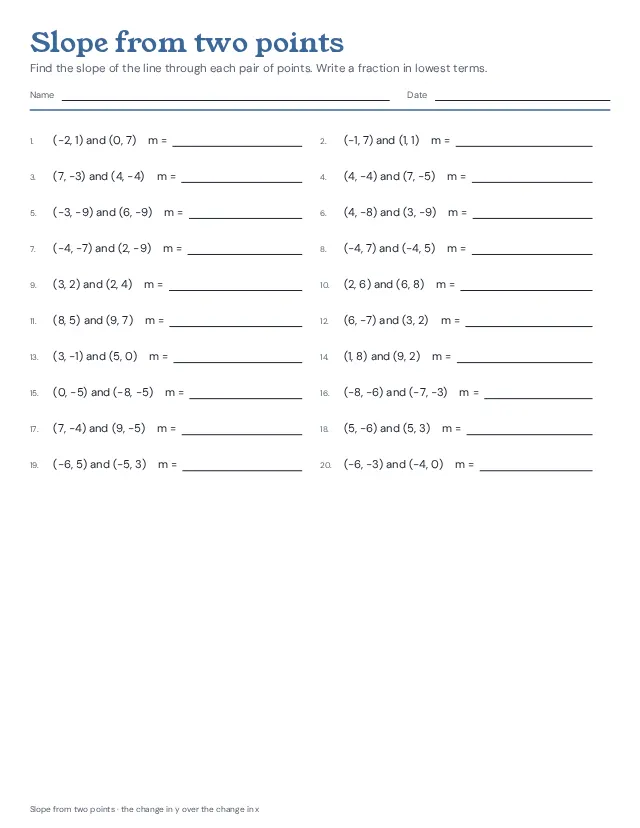
Fifteen sheets for what grade 8 math works on in the Common Core: the exponent rules with zero and negative exponents, scientific notation, equations with like terms, parentheses and the unknown on both sides, slope and the equation of a line, and the Pythagorean theorem. Print one, change it on its own page, or take the whole set as one PDF with the answer keys at the back.
All 15 sheets on this page, after a contents page, with the answer keys together at the back: 31 pages.
15 sheets
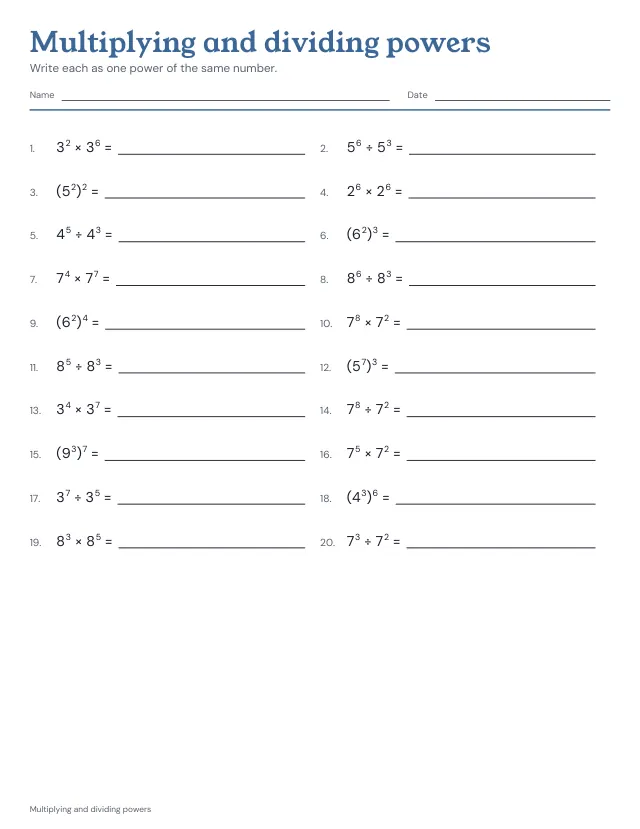
Powers of one number such as 2³ × 2⁴ = 2⁷ and 2⁵ ÷ 2² = 2³.
Common Core 8.EE.A.1
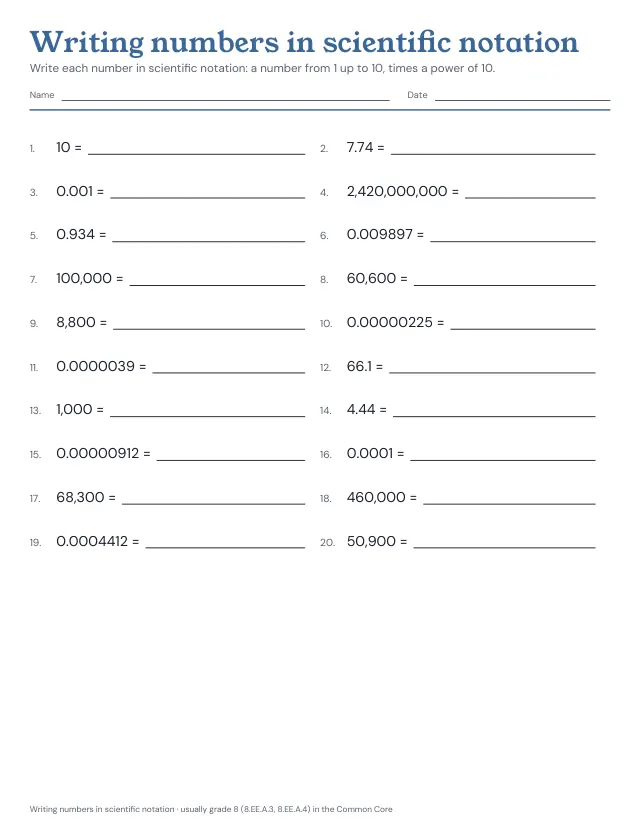
Large and small numbers such as 0.00072 = 7.2 × 10⁻⁴.
Common Core 8.EE.A.3
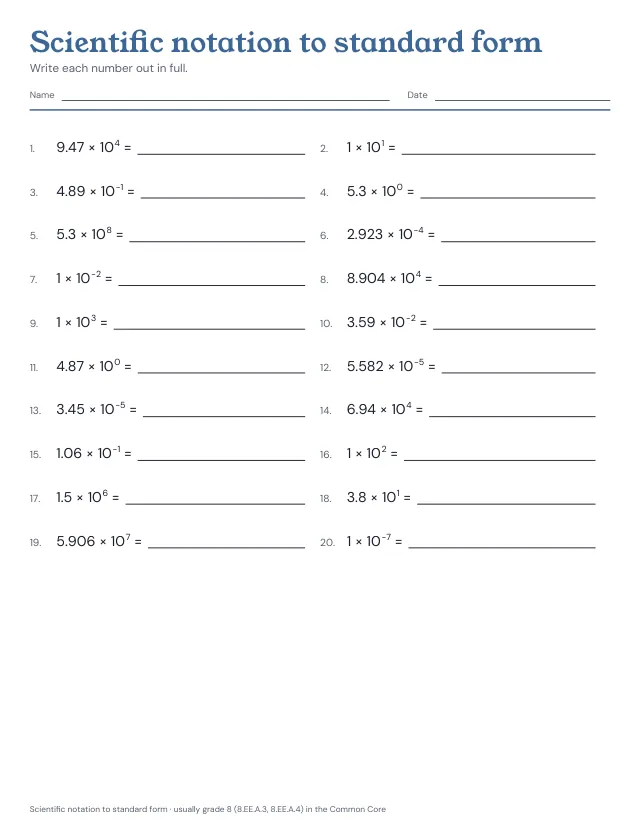
Numbers such as 3.2 × 10⁴ to write out in full.
Common Core 8.EE.A.3
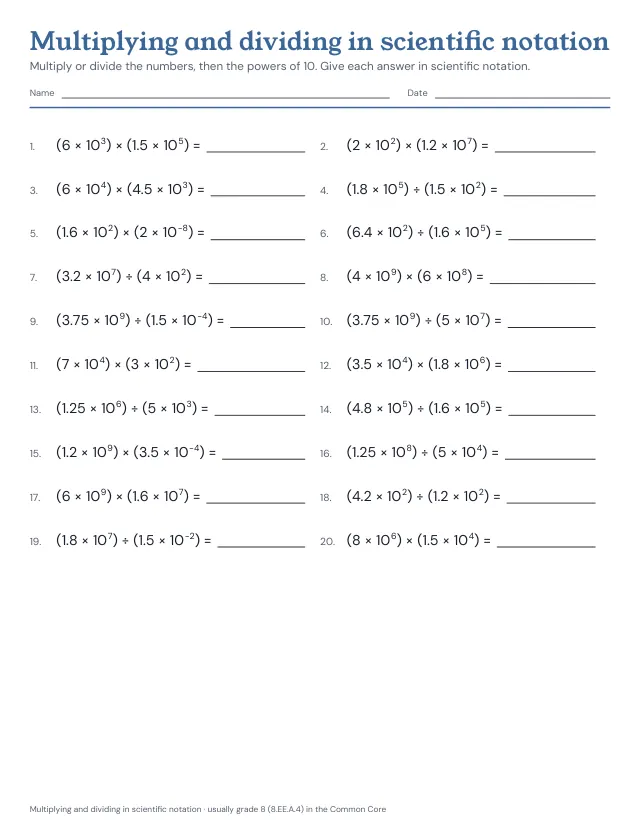
Products and quotients, with the answer put back in scientific notation.
Common Core 8.EE.A.4
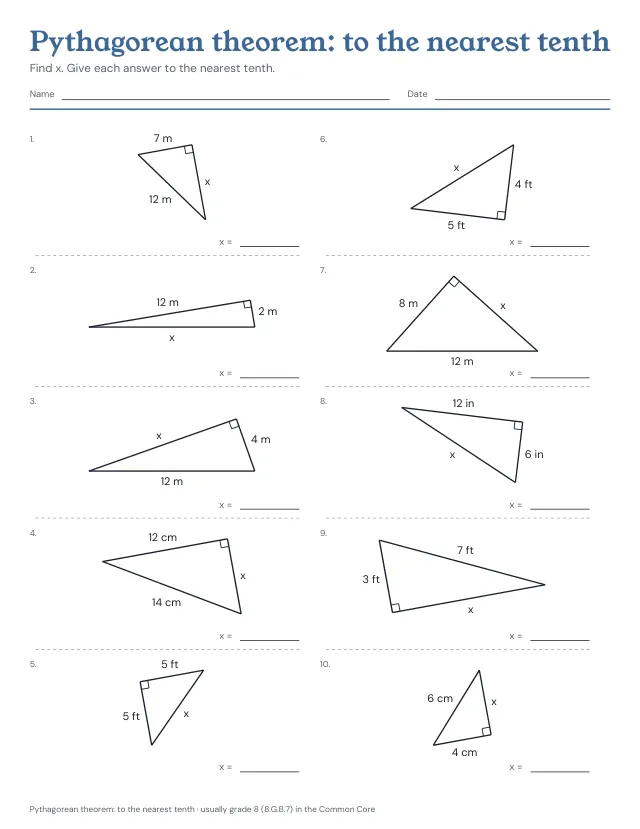
Right triangles whose answers are not whole numbers.
Common Core 8.G.B.7
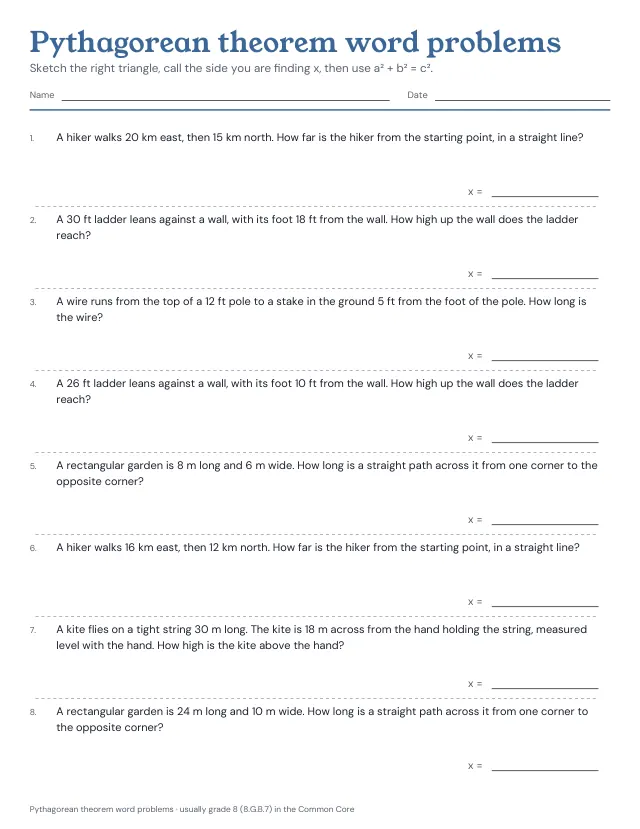
Ladders, diagonals and kites, each a right triangle to sketch.
Common Core 8.G.B.7
No sheets match that. Try a shorter word.
Each sheet sits in the grade whose Common Core standard asks for its skill, and its card names the standard, as 3.OA.C.7 for multiplying and dividing within 100. A school that follows other standards may teach a skill a year earlier or later, so a child who finds a page easy can go on to the next grade’s, and one who needs more practice can go back a grade.
Grade 8 extends the exponent rules to zero and negative exponents: 5⁰ = 1 and 3⁻² = 1/3² = 1/9. Scientific notation writes a number as one digit before the point times a power of 10: 4,500,000 = 4.5 × 10⁶ and 0.00072 = 7.2 × 10⁻⁴. To multiply, multiply the numbers and add the exponents, then move the point if the first number is 10 or more: 6 × 10³ times 4 × 10⁵ is 24 × 10⁸, which is 2.4 × 10⁹.
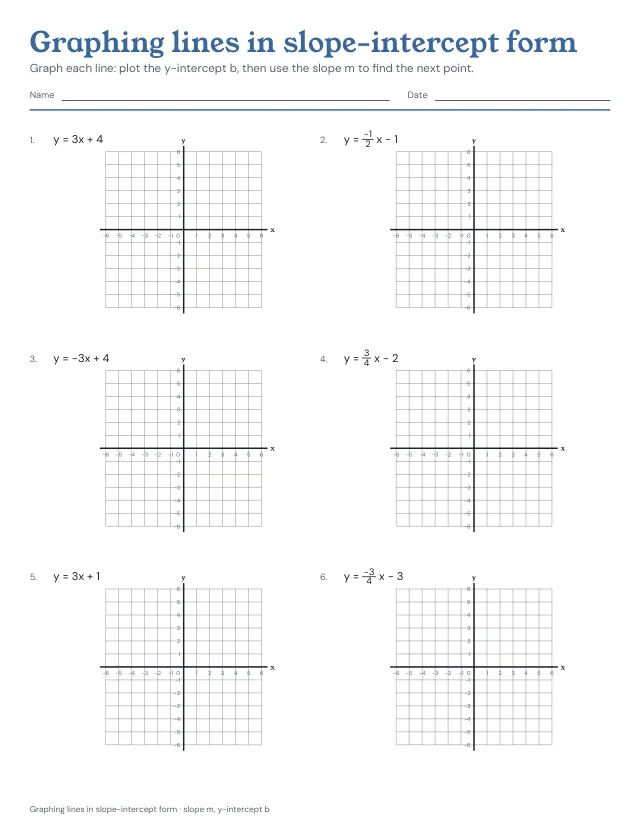
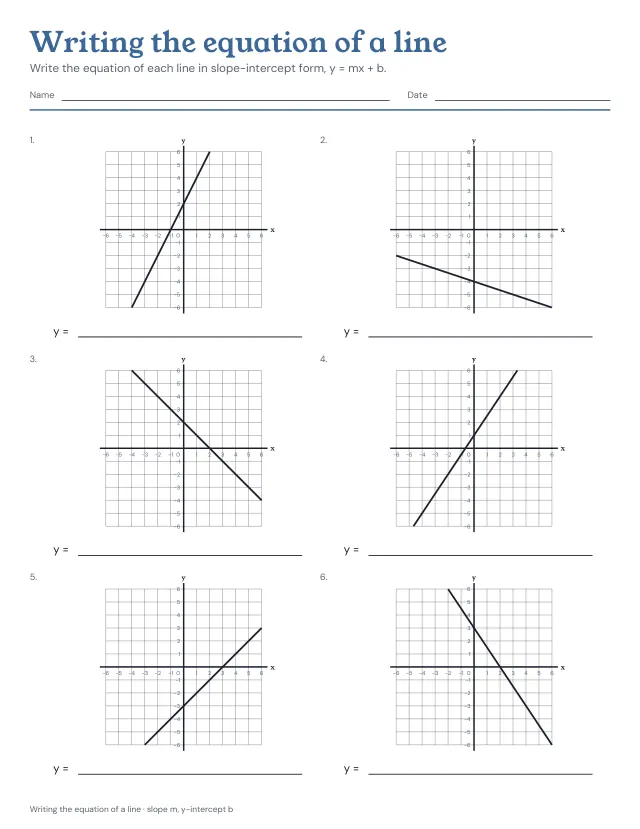
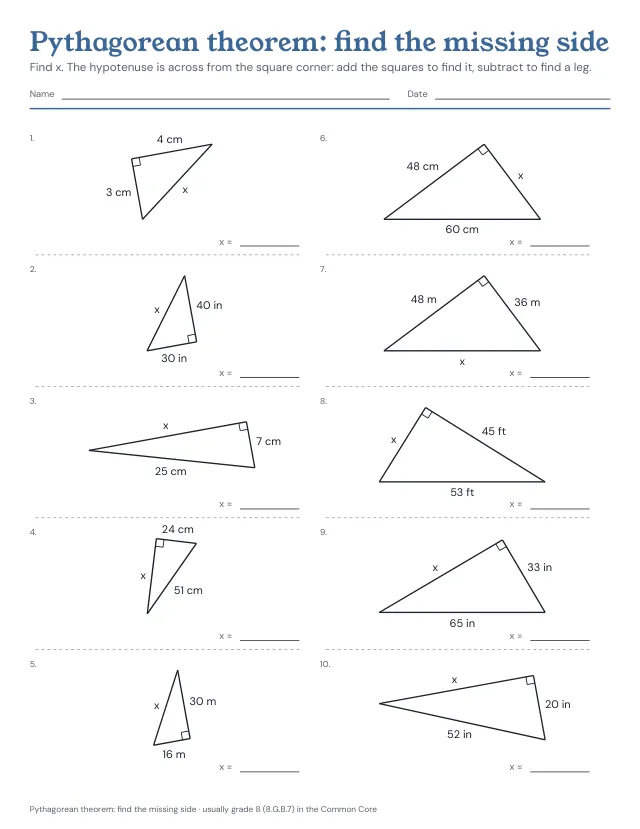
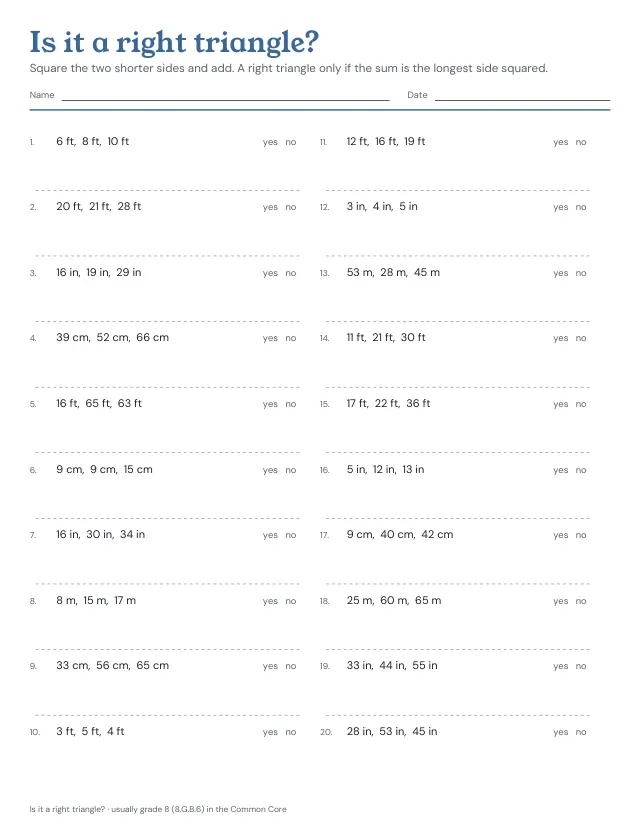
Slope is the rise over the run between two points: from (1, 2) to (3, 8) the line rises 6 and runs 2, so the slope is 3, and y = mx + b is the line with slope m crossing the y-axis at b. In a right triangle the two shorter sides squared add up to the longest side squared: with legs 6 and 8, 36 + 64 = 100, so the hypotenuse is 10.
The set prints every sheet on this page once, in the order shown, after a contents page that lists them with their page numbers. The answer keys come together at the back, so you can print the sheets for the class and keep the keys apart. On its own page, each sheet makes new questions every time and can be changed; the set is one fixed copy, the same each time you download it.