Multiplication chart
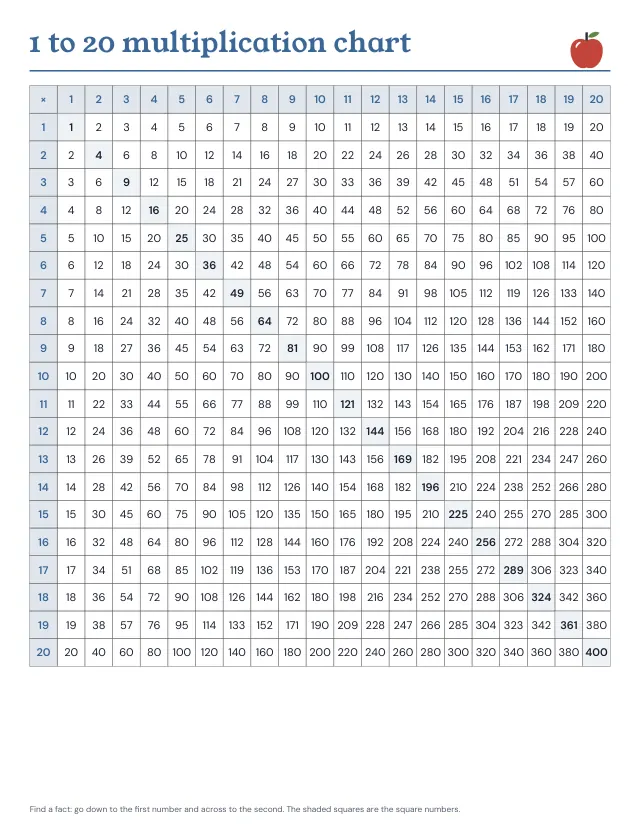
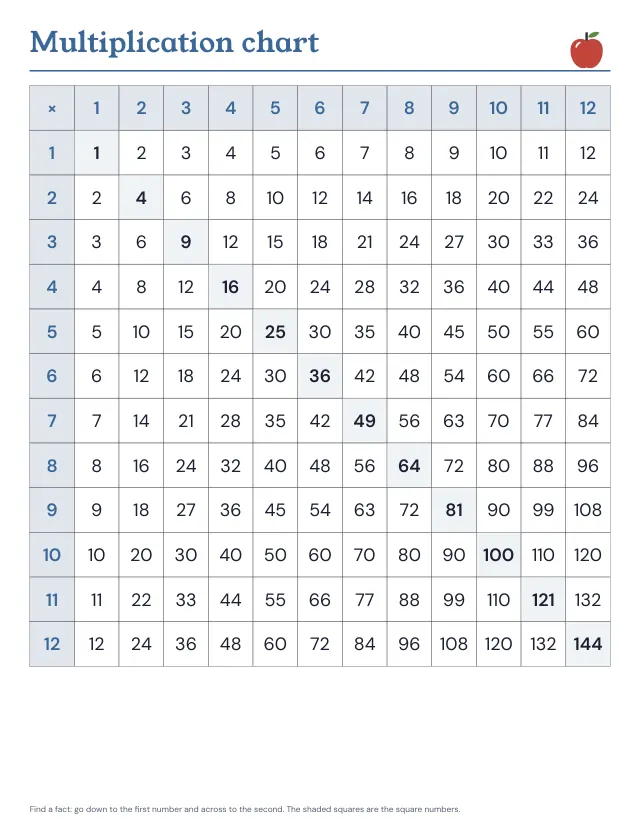
A multiplication chart: find one number down the side and the other across the top.
Multiplication and hundreds charts, math practice with answer keys, letter and name tracing, a ruler, a protractor and homeschool schedules.
156 sheets
A multiplication chart: find one number down the side and the other across the top.
Every multiplication fact from 1 × 1 to 20 × 20 on one page, with shaded headers and the square numbers marked.
A blank 12 × 12 multiplication grid with only the headers printed, for filling in the facts from memory.
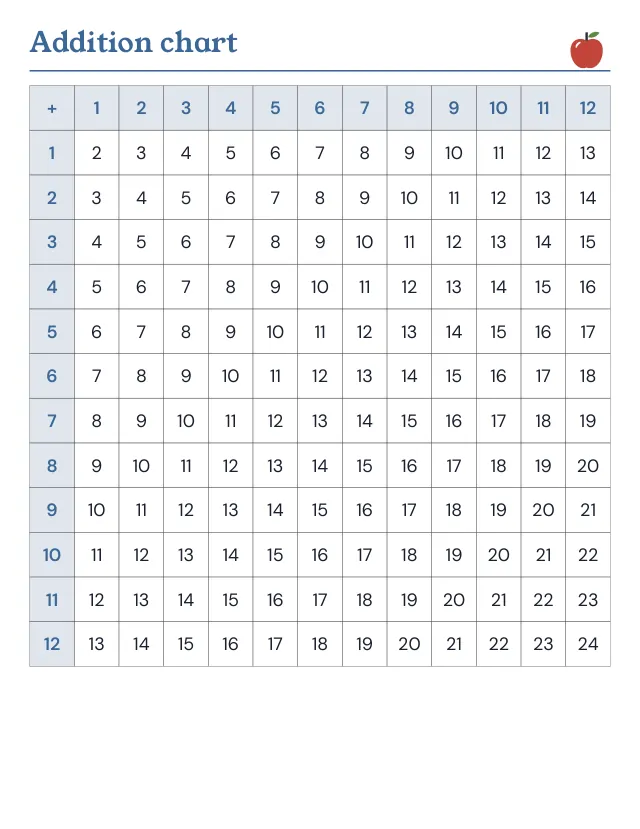
An addition table from 1 + 1 to 12 + 12: find the first number down the side and the second across the top.
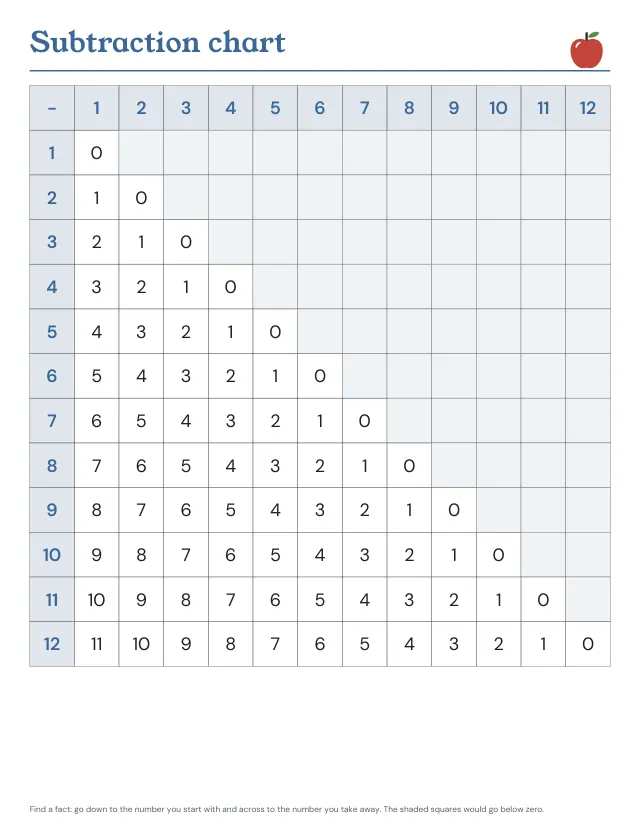
A subtraction table to 12: the number down the side minus the number across the top, with shaded headers. Squares that would go below zero are shaded and left empty.
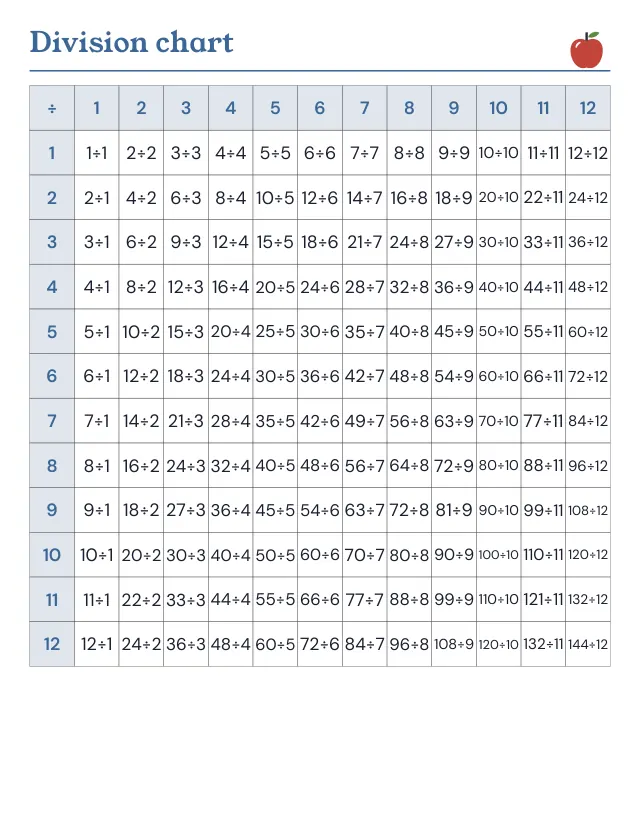
A division chart for the facts to 144 ÷ 12: each row holds the divisions whose answer is the number at its start.
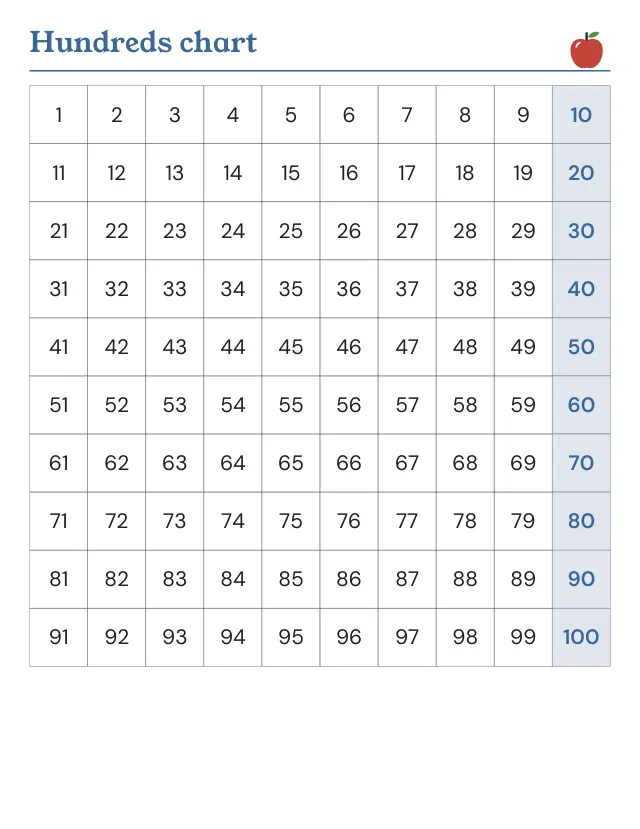
The numbers 1 to 100 in rows of ten, with the tens shaded, for counting and spotting patterns.
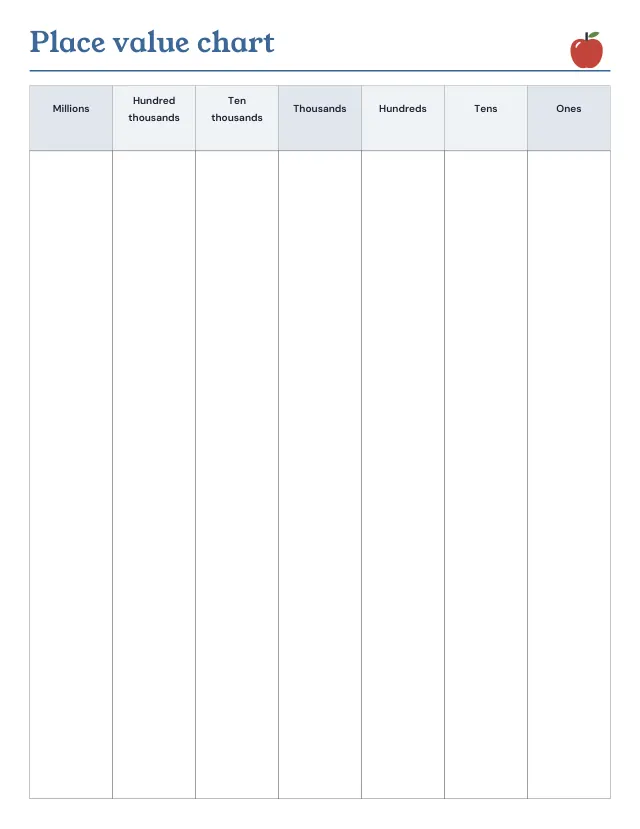
A place value chart from ones to millions, with a column for each place to write the digits in.
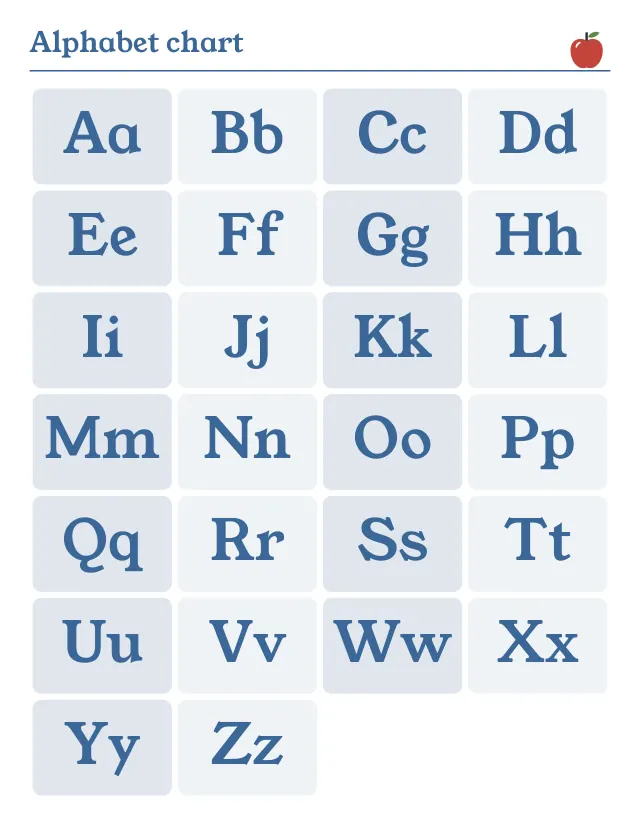
Every capital and small letter, Aa to Zz, in large print for a wall or a desk.
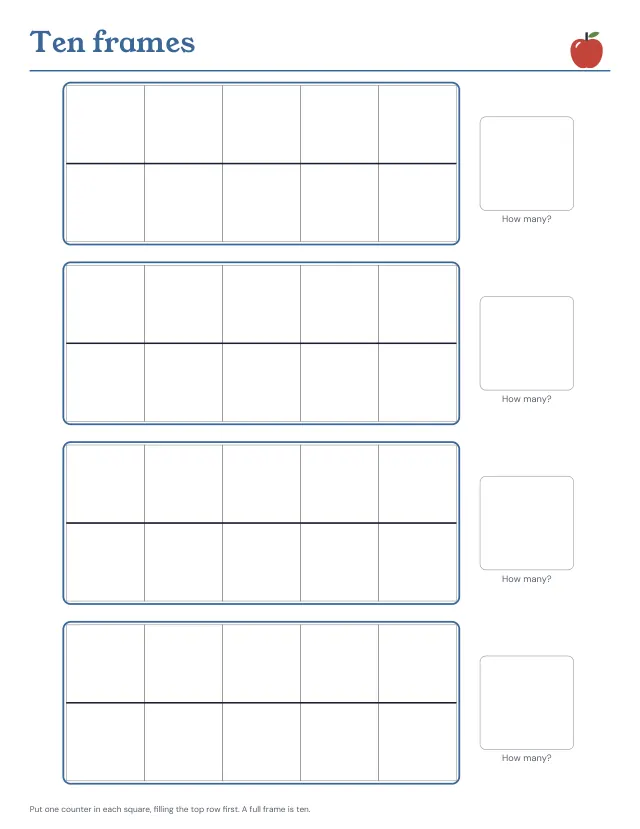
Four empty ten frames, two rows of five squares each, with a box beside each frame to write how many. Put one counter in each square: a full frame is ten. The sheet also prints as five frames, or as double ten frames for numbers to 20.
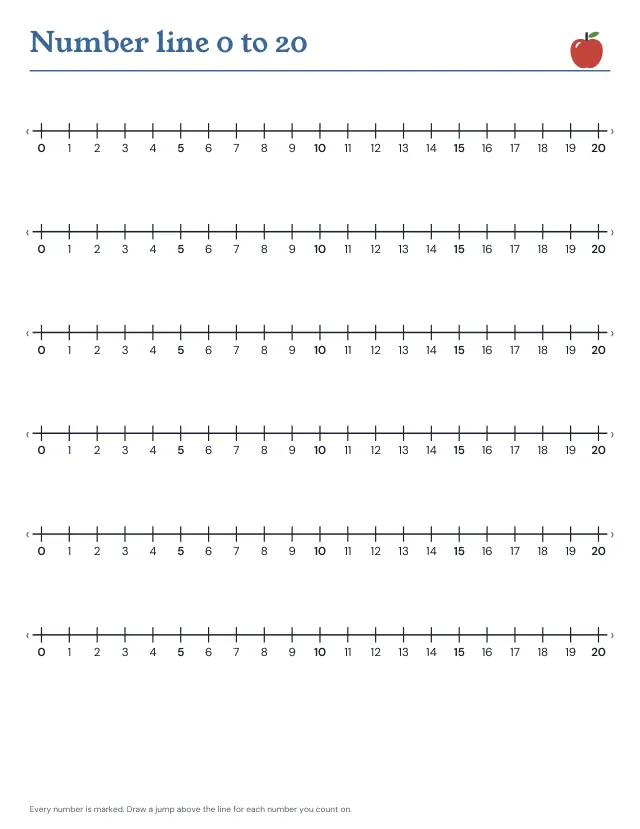
Six number lines from 0 to 20 with every number marked, for counting on, counting back and drawing jumps. Change the end number for lines to 10, 50 or 100.
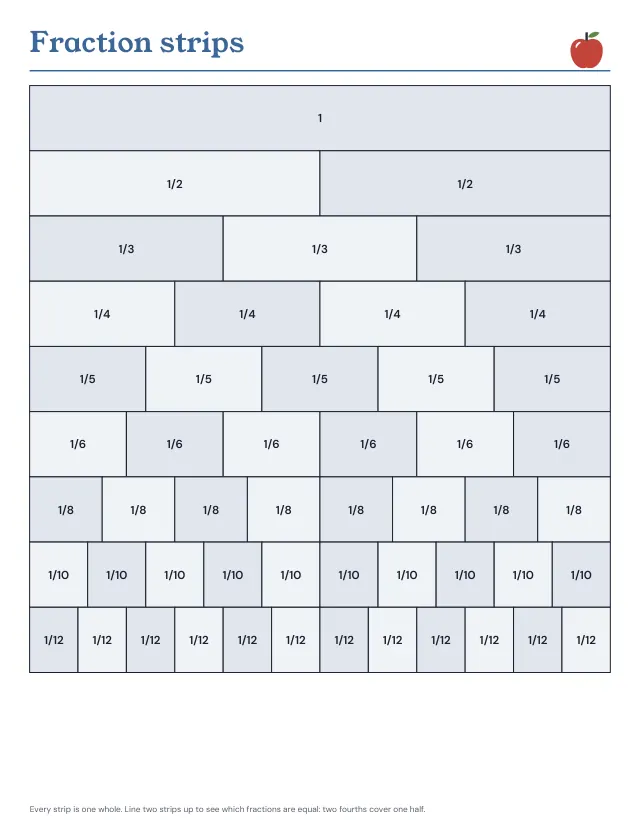
One whole, then halves, thirds, fourths, fifths, sixths, eighths, tenths and twelfths, every strip the same length, so equal fractions line up. Print, color and cut the strips apart.
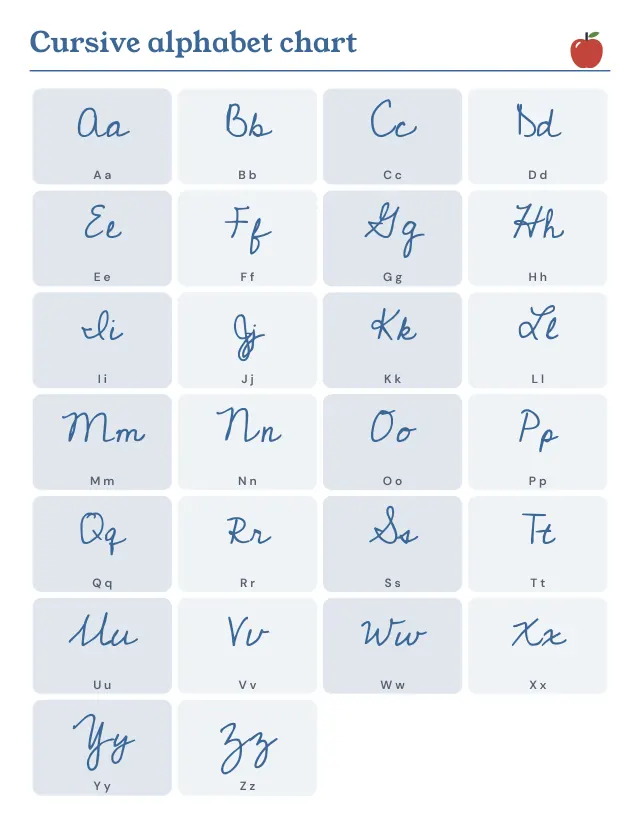
Every capital and small letter in cursive, Aa to Zz, large enough to read from a desk or a wall, with the print letters under each pair to match them.
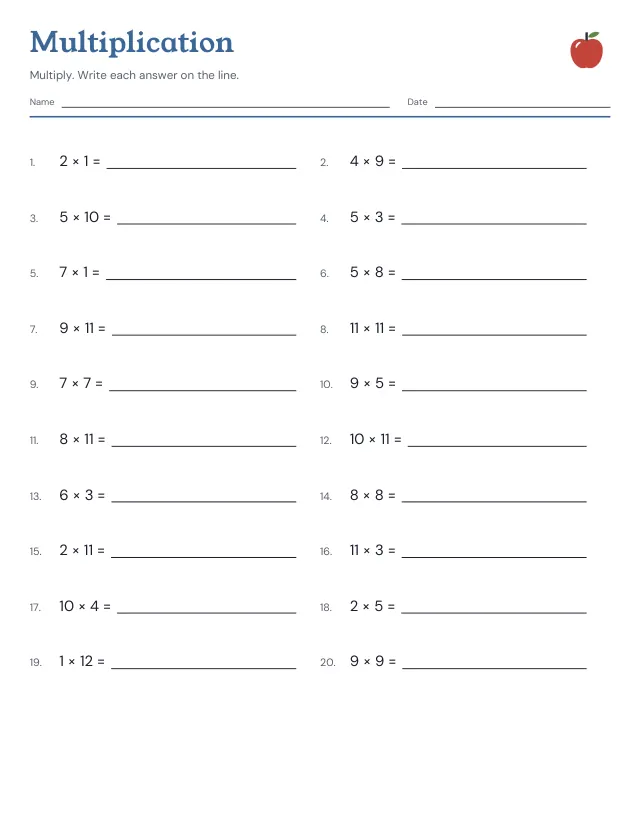
Practice products of two whole numbers from the range you choose. The answer key lists each product.
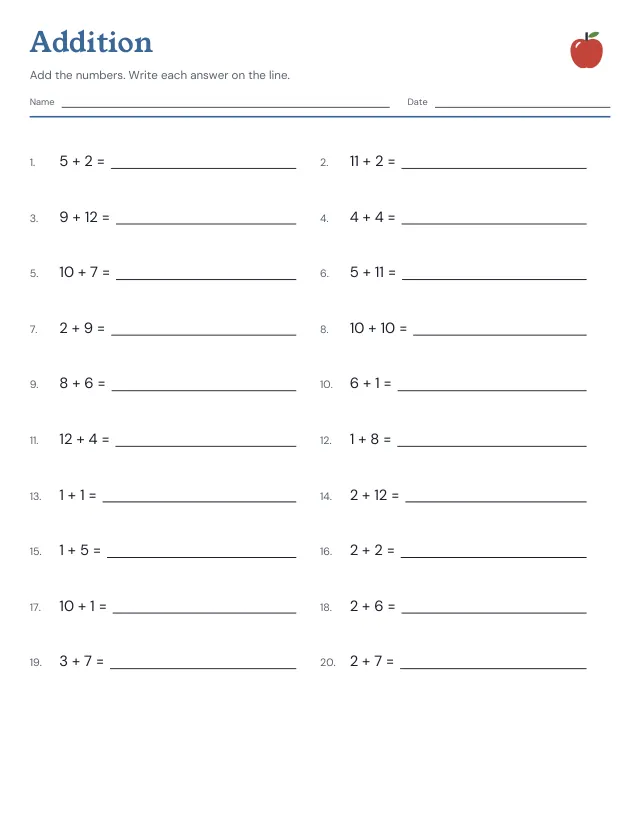
Add pairs of whole numbers from your chosen range. Write each sum in the blank and check it against the answer key.
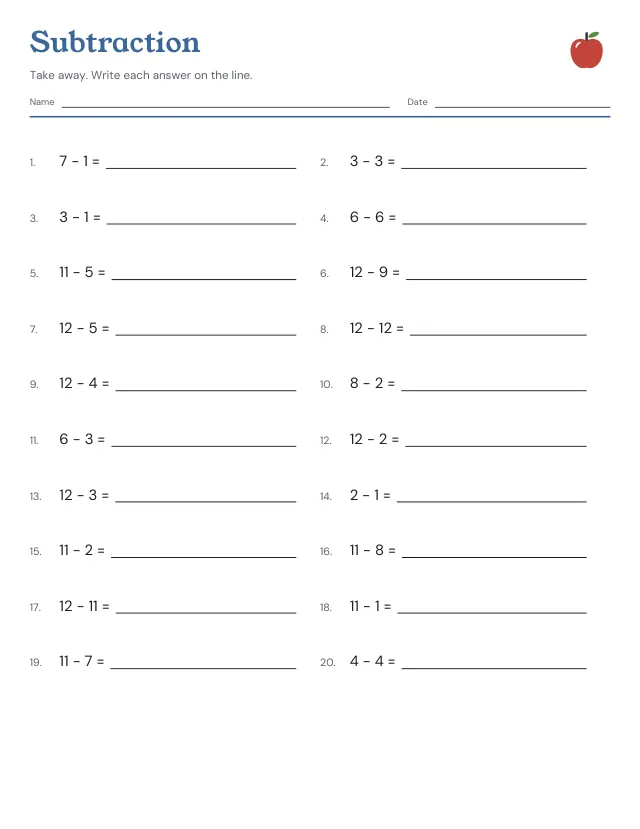
Subtract the smaller whole number from the larger one. Answers are zero or positive, with a separate key for checking.
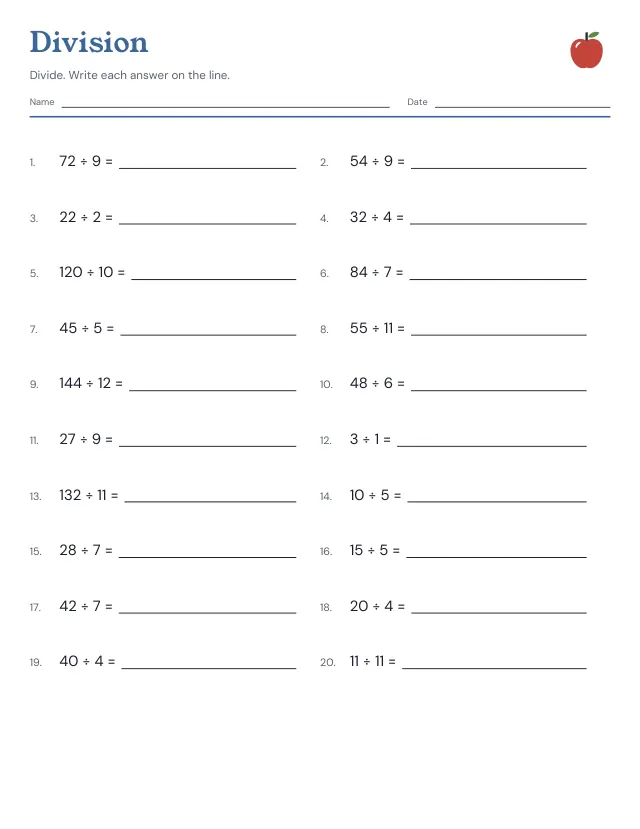
Divide a whole-number product by one of its factors. Every question has a whole-number answer; these sheets do not use remainders.
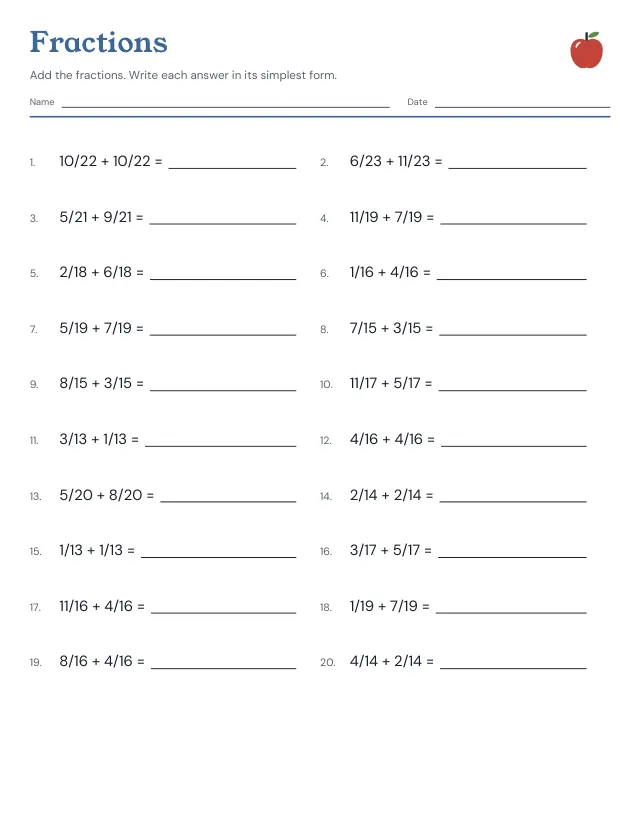
Add two fractions with the same denominator. The answer key reduces each result by its greatest common divisor.
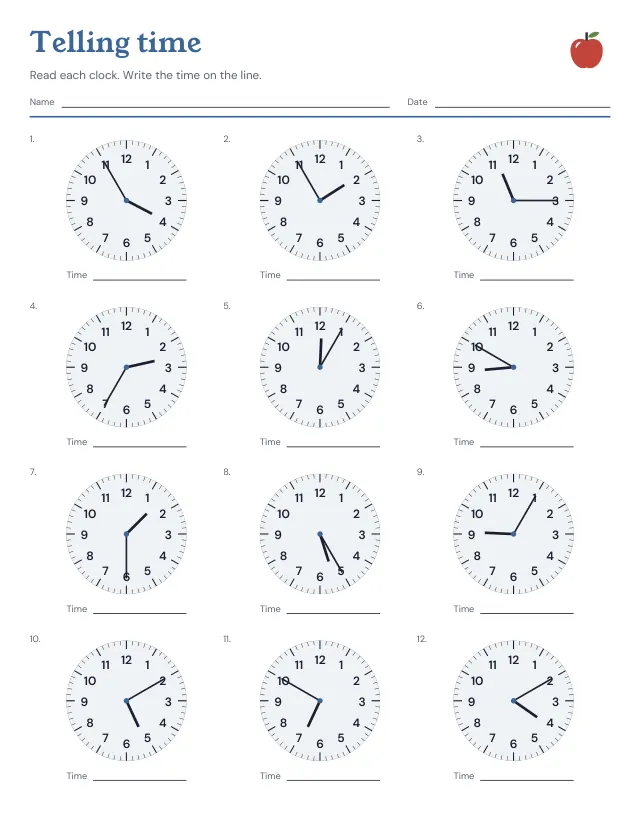
Read an analogue clock and write its time. Questions use five-minute intervals, with the hour and minute in the answer key.
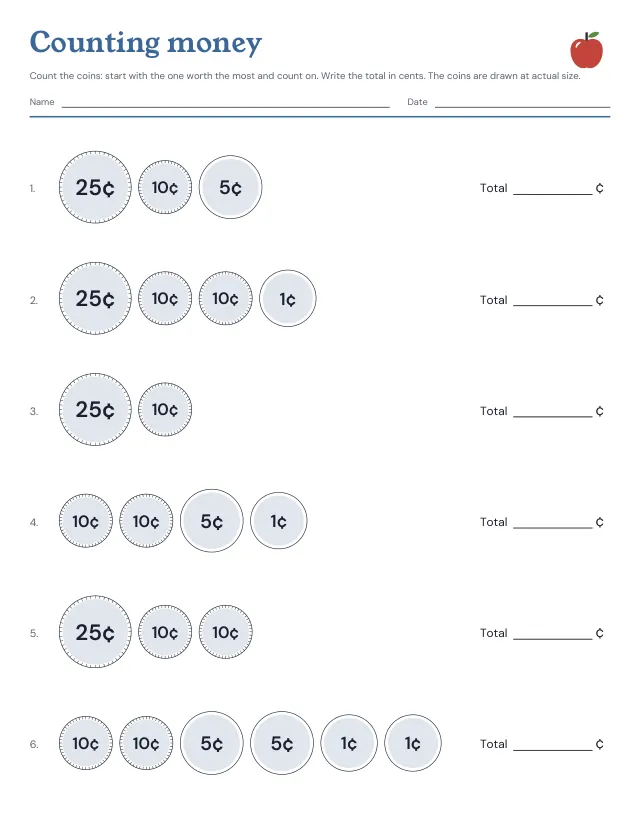
Count the coins and write the total in cents: pennies, nickels, dimes and quarters drawn at their real size, six groups a page, totals under a dollar, with the answers on the key. Leave out the quarters for an easier sheet. New coins each time.
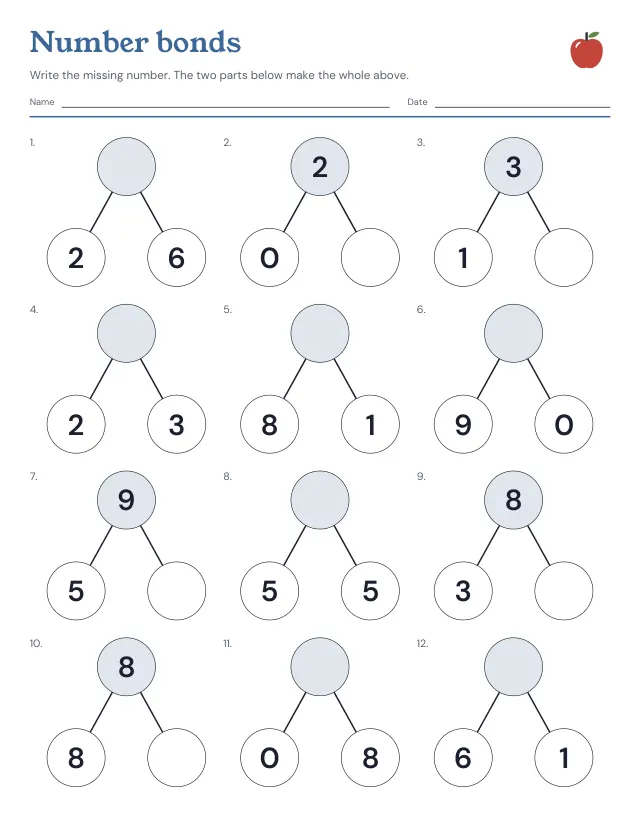
Number bonds to 10: the whole in the top circle, its two parts below, and one of the three left empty to fill in. Choose the largest whole, up to 100, and how many bonds; the answer key is on the last page.
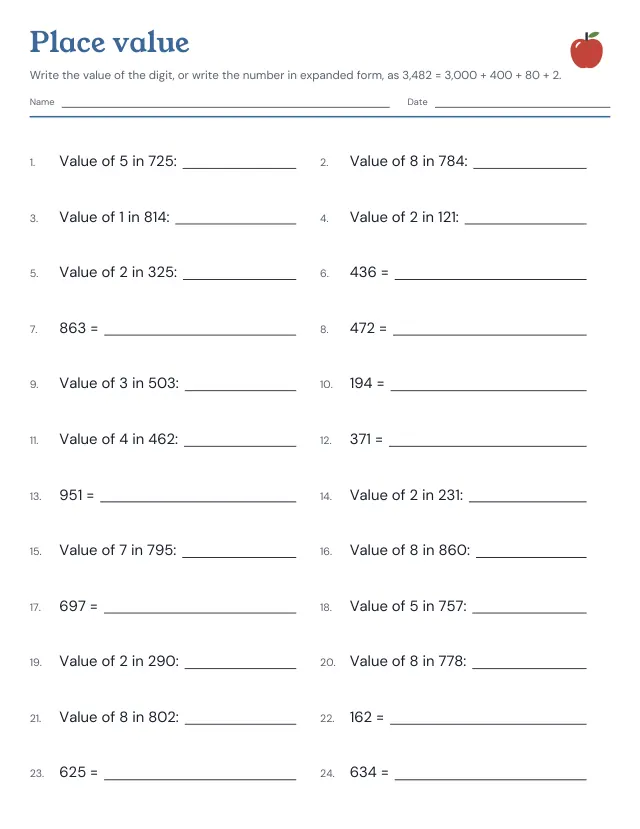
Place value practice with numbers of 2 to 5 digits: half the questions ask what one digit is worth, as the 4 in 3,482 is worth 400, and half ask for the number in expanded form, as 3,000 + 400 + 80 + 2. The answer key is on the last page.
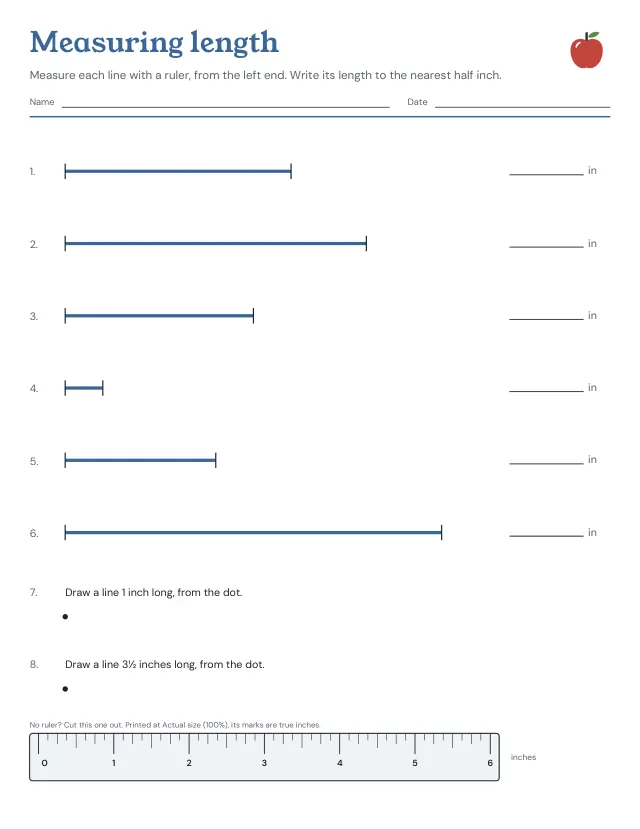
Six lines drawn at their true length, to measure with a ruler from the left end and write down to the nearest half inch, then two lines to draw at a given length, with a ruler to cut out at the foot of the page and the answers on page 2. Choose whole, half, quarter or eighth inches, or whole or half centimetres.
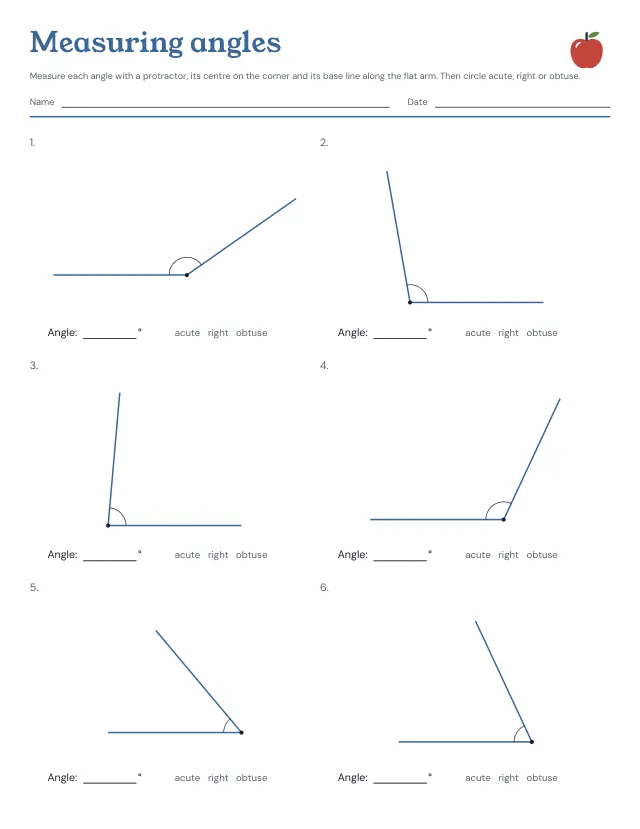
Six angles a page, drawn at their true size from 10 to 170 degrees in steps of 5, to measure with a protractor and circle as acute, right or obtuse, with the answers on the key. One arm lies flat to start, pointing left or right; on the harder sheet both arms turn. New angles each time.
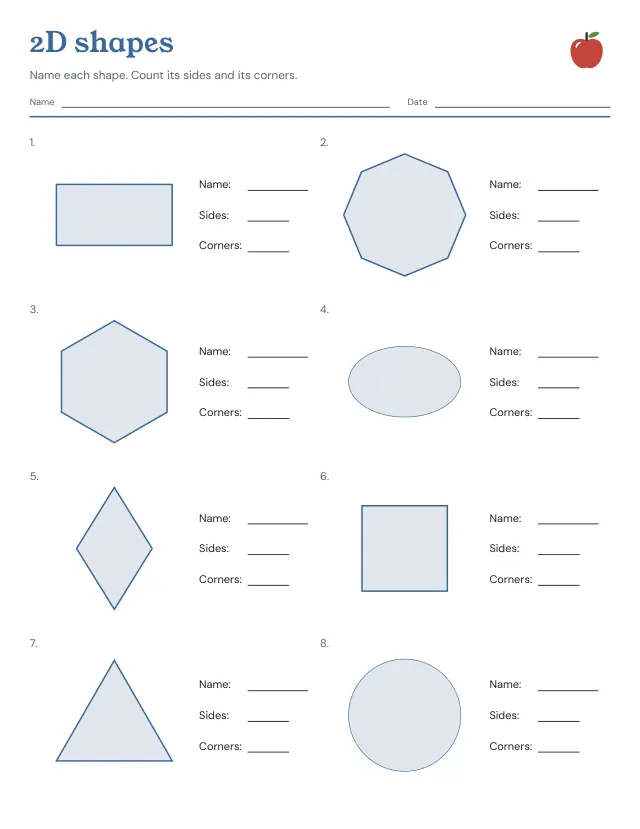
Eight flat shapes a page to name, and to count the sides and corners of: triangle, square, rectangle, rhombus, trapezoid, pentagon, hexagon, octagon, circle and oval, with the answers on the key. On the harder sheet each shape is turned and the triangles and rectangles change shape, so the name rests on the sides. New shapes each time.
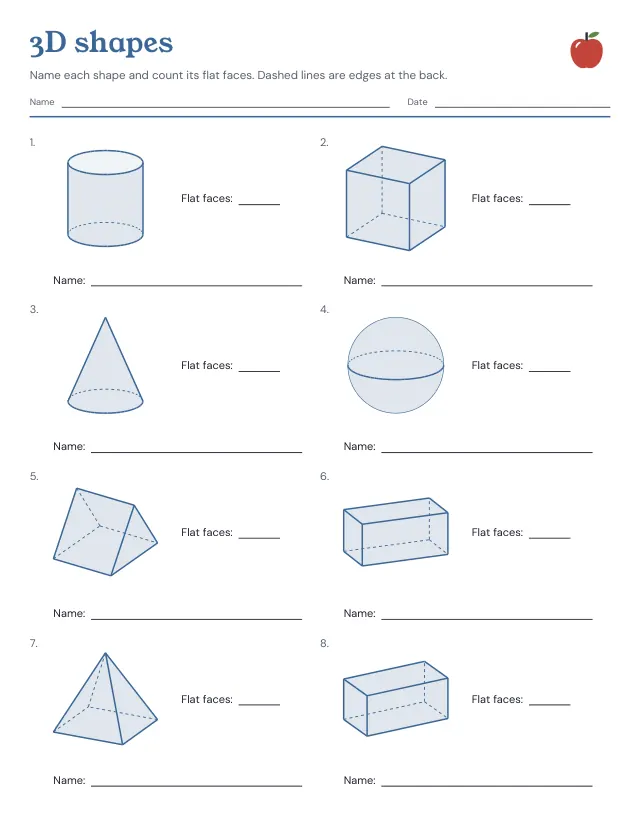
Eight solid shapes a page to name and count the flat faces of: cube, rectangular prism (cuboid), triangular prism, square pyramid, cylinder, cone and sphere, drawn with the edges at the back dashed. On the harder sheet, prisms and pyramids to count the faces, edges and vertices of. Answers on the key; new shapes each time.
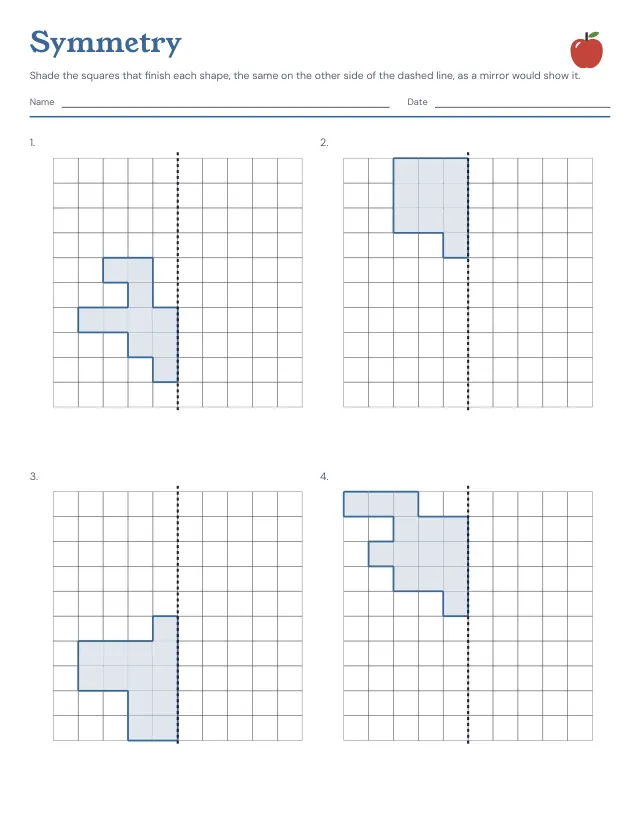
Four shapes a page, each half drawn in squares beside a dashed line of symmetry, to finish by shading the other half as a mirror would show it. The key shows every shape whole. The line stands up to start; on the harder sheet every other line lies across. New shapes each time.
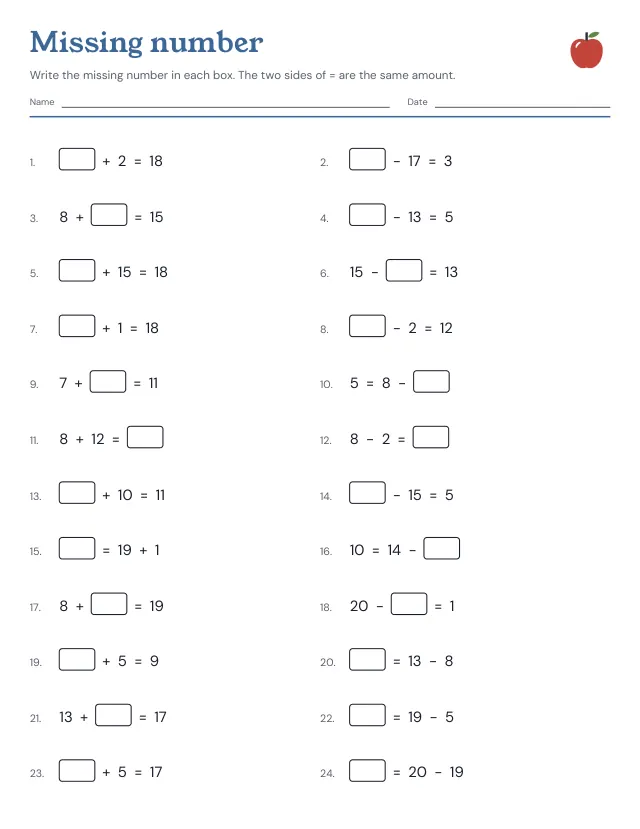
Number sentences with one number missing, as 7 + □ = 12 or □ − 4 = 9, to write in the box, 24 a page with the answers on the key. Some put the equals sign first, as 12 = 7 + □. Adding and taking away to 20 to start; choose larger numbers, or multiplying and dividing facts. New questions each time.
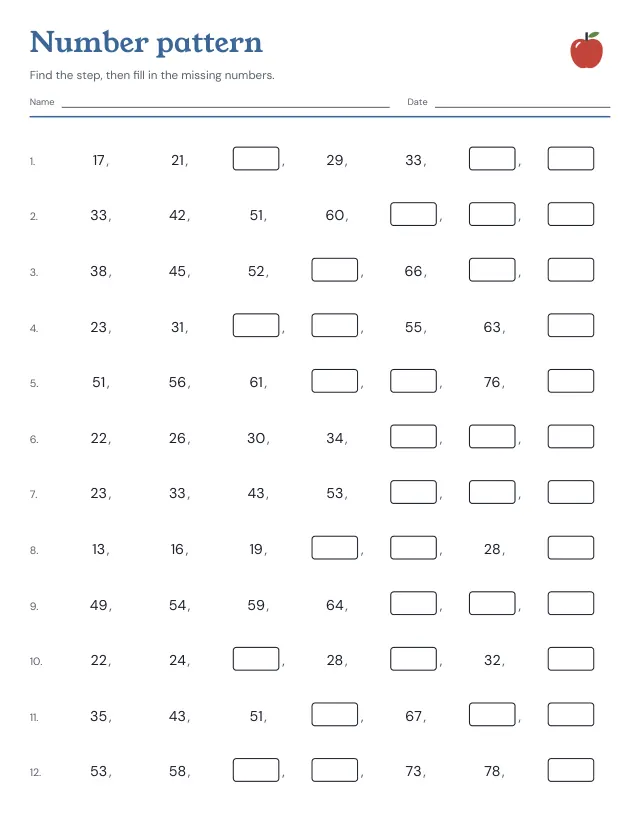
Twelve number patterns a page, seven numbers each counting on in the same step, as 5, 8, 11, 14, with three left as boxes to fill in. Or counting back as well, or tables of numbers in and out with a rule to use or to find. Answers and each rule on the key; new patterns each time.
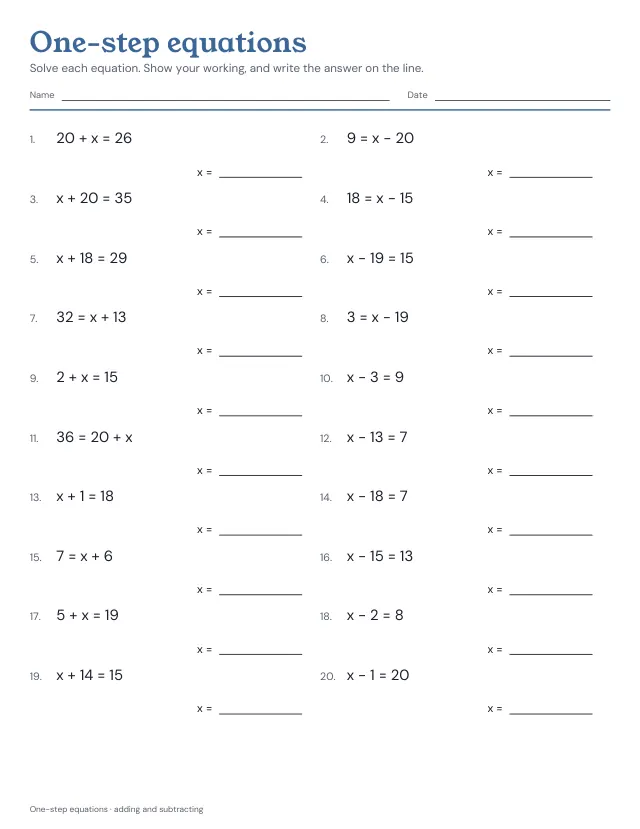
Twenty equations a page to solve in one step, as x + 7 = 15, x − 4 = 9, 4x = 28 or x/5 = 3, each with room to work and a line for the answer. Adding and subtracting, multiplying and dividing, all four mixed, or all four with negative numbers. The answer key works each one and checks it. New equations each time.
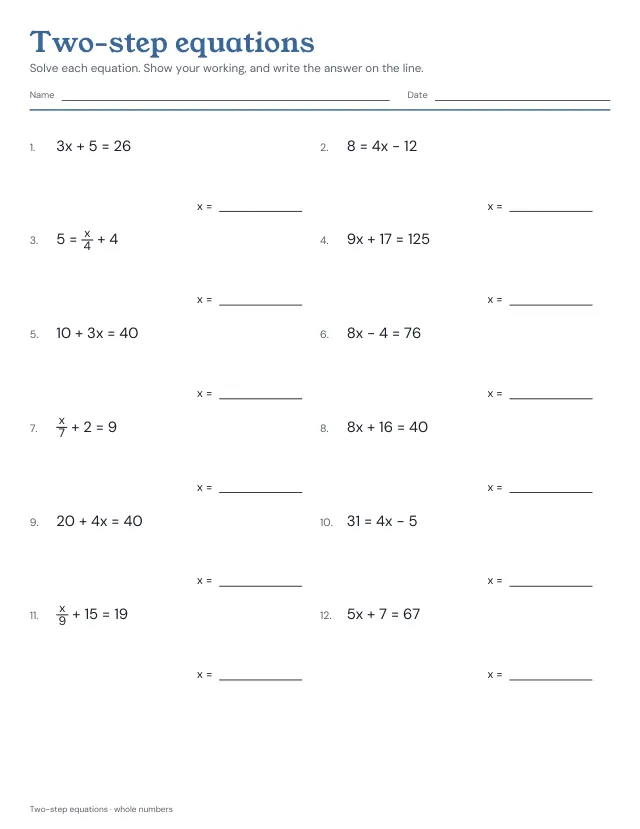
Twelve equations a page to solve in two steps, as 3x + 4 = 19, x/4 − 2 = 3 or 3(x + 2) = 21, each with room to work and a line for the answer. Whole numbers, parentheses, negative numbers, or one-step and two-step mixed. The answer key works each one a step a line and checks it. New equations each time.
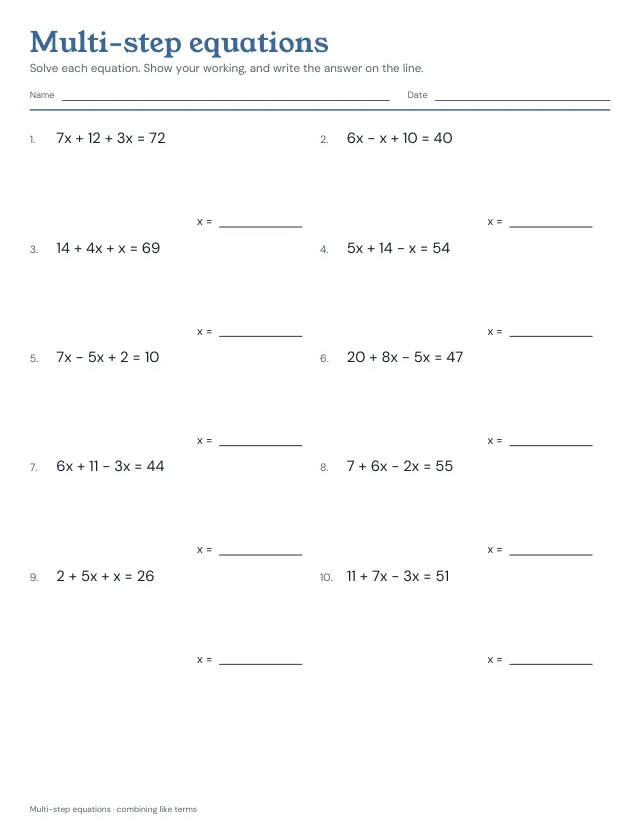
Ten equations a page that take three or four steps: combining like terms, as 4x + 3 − x = 18; the distributive property, as 2(x + 3) + 4x = 30; or variables on both sides, as 5x − 3 = 2x + 9. Each has room to work and a line for the answer. The answer key works each one a step a line and checks it. New equations each time.
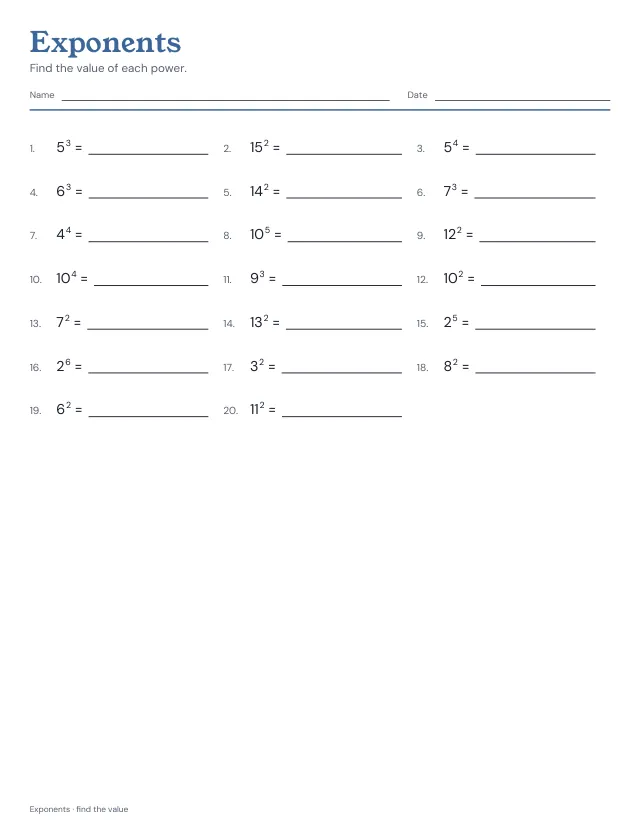
Twenty questions a page: find the value of a power, as 3⁴ = 81; write a multiplication as a power, as 5 × 5 × 5 = 5³; powers of 10, as 4 × 10³ = 4,000; or multiply and divide powers of the same number, as 2³ × 2⁴ = 2⁷. For grade 8, zero and negative exponents, as 3⁻² = 1/9, and scientific notation: writing numbers in it, writing them out in full, and multiplying and dividing them. The answer key works each one out. New questions each time.
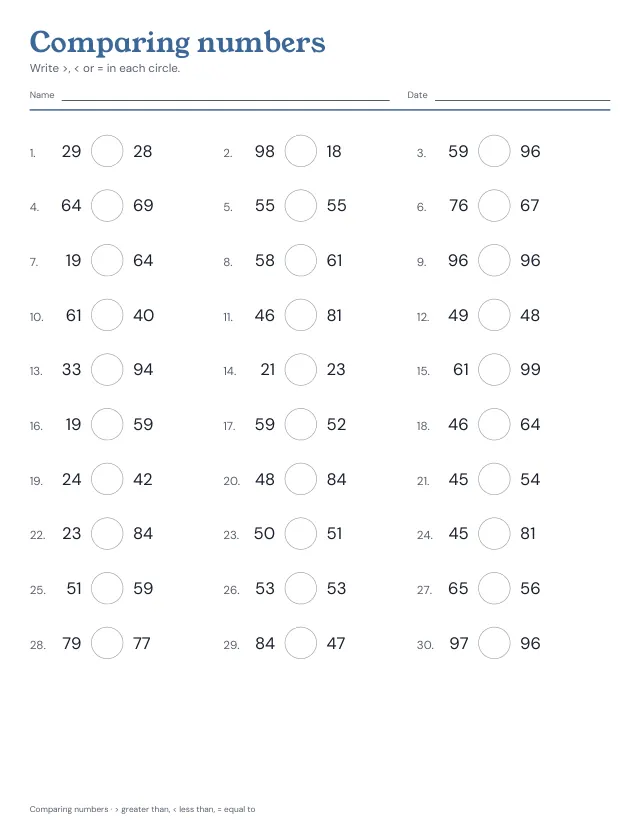
Thirty pairs of numbers a page with a circle between each pair to write >, < or =, as 47 ○ 74. Numbers to 10, to 100, to 1,000 or to 1,000,000; or two groups of pictures to count and compare, for children not yet reading numbers. Answers on the key; new pairs each time.
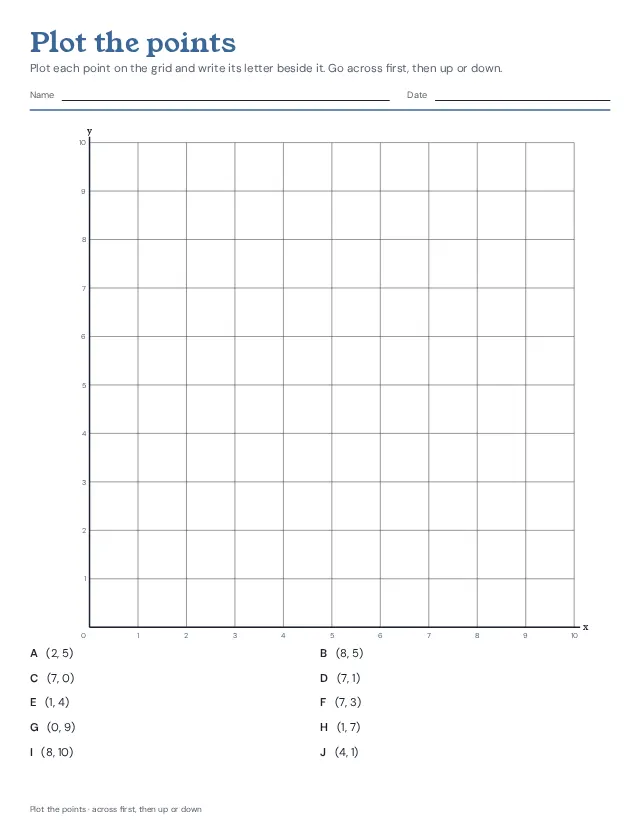
Ten points a page to plot on the grid, or ten plotted points to write the coordinates of, in the first quadrant or all four. Every sheet has a pair and the same pair the other way round, as (2, 5) and (5, 2), and points on the axes. Answer key. New points each time.
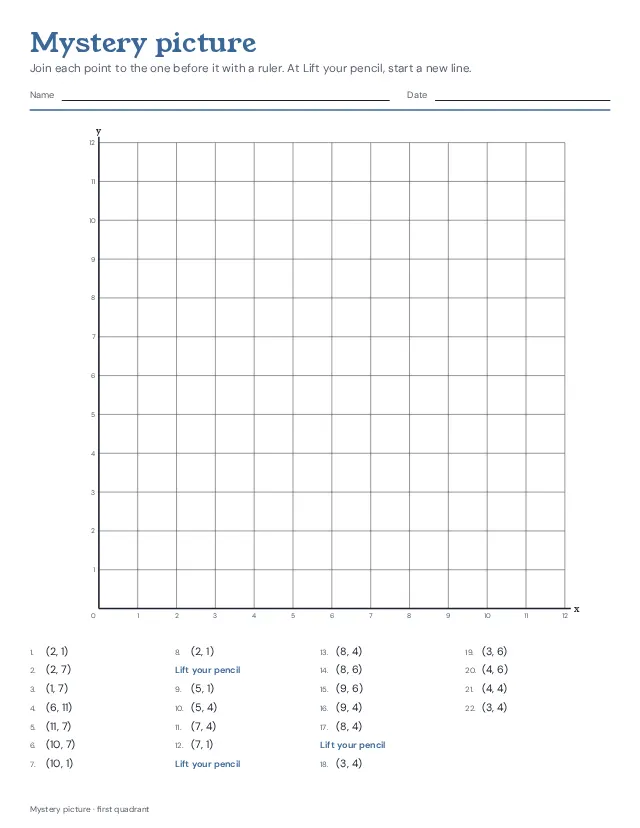
Eight mystery pictures to plot point by point and join with a ruler: four in the first quadrant and four in all four quadrants. The list says when to lift the pencil and start a new line, and the answer key shows the finished picture.
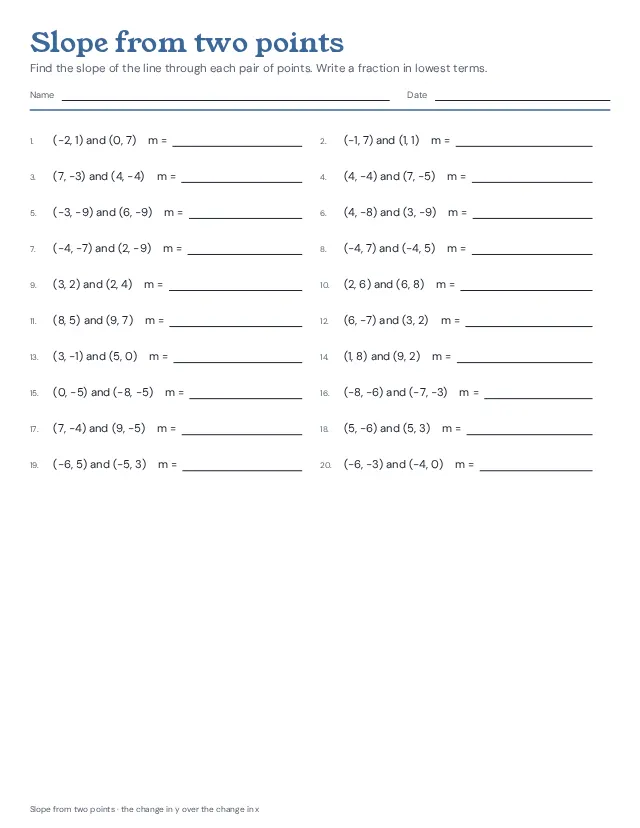
Twenty pairs of points to find the slope between, or six graphs a page: find the slope of each line, graph each line from y = mx + b, or write the equation of each line. Every sheet mixes slopes up and down, whole numbers and fractions. Answer key. New questions each time.
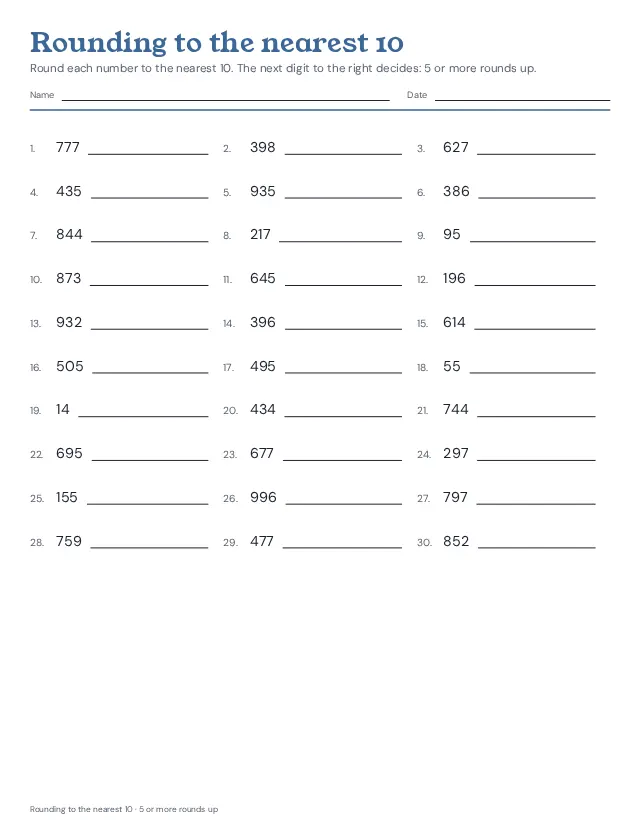
Thirty numbers a page to round to the nearest 10 or the nearest 100, twenty to round to both, or eighteen larger numbers to the place each one names. On the key, each answer comes after the two numbers it lies between. New numbers each time.
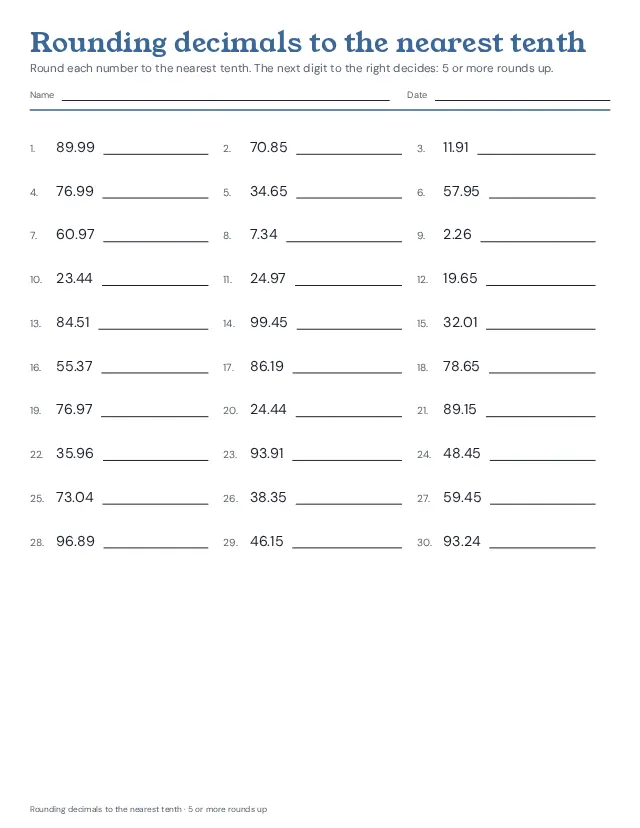
Thirty decimals a page to round to the nearest tenth, the nearest hundredth or the nearest whole number, or eighteen to round to the place each one names. On the key, each answer comes after the two numbers it lies between. New numbers each time.
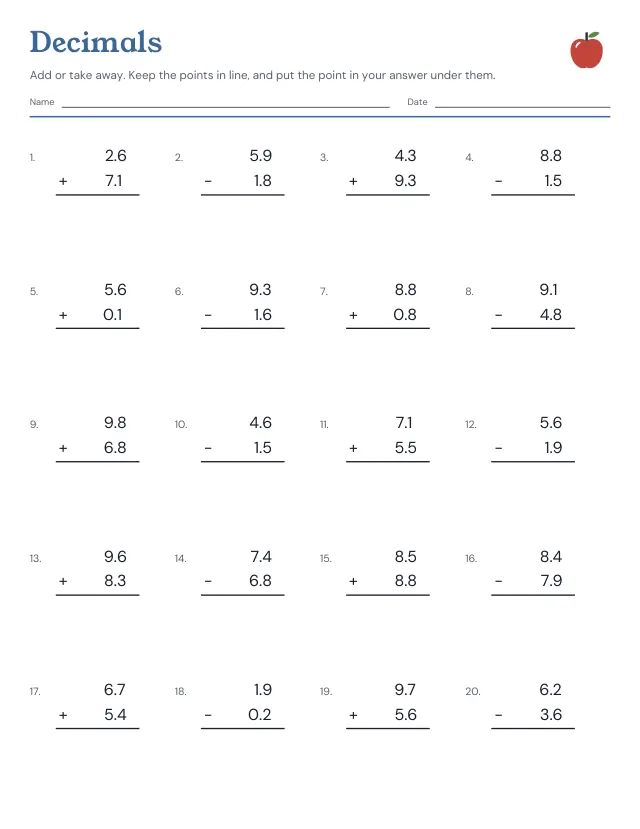
Add and take away decimals in columns, 20 a page with the points lined up and the answers on the key. Tenths to start, as 3.4 + 2.7; then hundredths, or the two mixed, as 3.5 + 1.27, where lining up the points is the skill. Or multiply and divide a decimal by a whole number, as 3.4 × 6 and 8.4 ÷ 4. New questions each time.
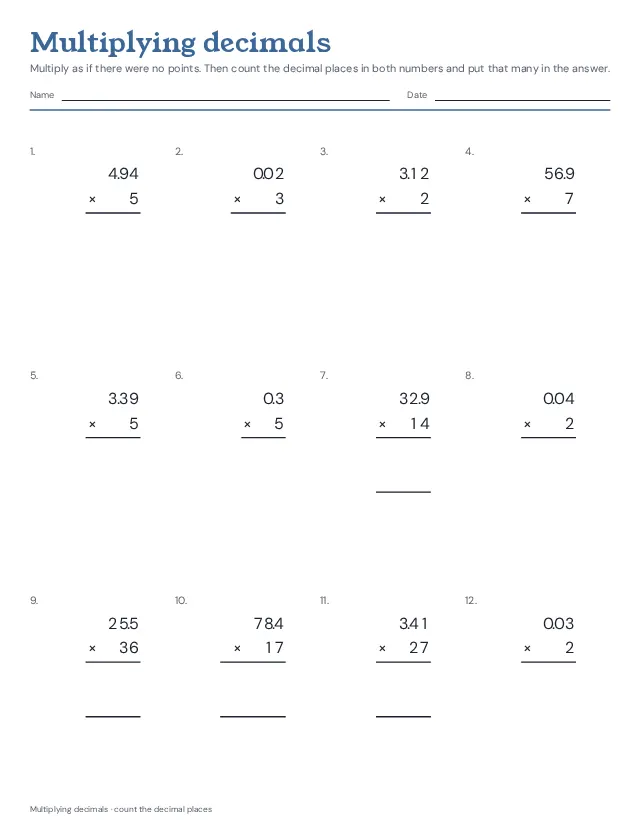
Twelve multiplications a page in columns, with room for the working: a decimal times a whole number, as 4.7 × 23; tenths times tenths, as 2.4 × 1.3; or hundredths times tenths, as 3.25 × 1.4. Or thirty a page to multiply by 10, 100 and 1,000. Every sheet in columns has products that need a 0 in front and products whose last 0 drops. Worked answer key. New questions each time.
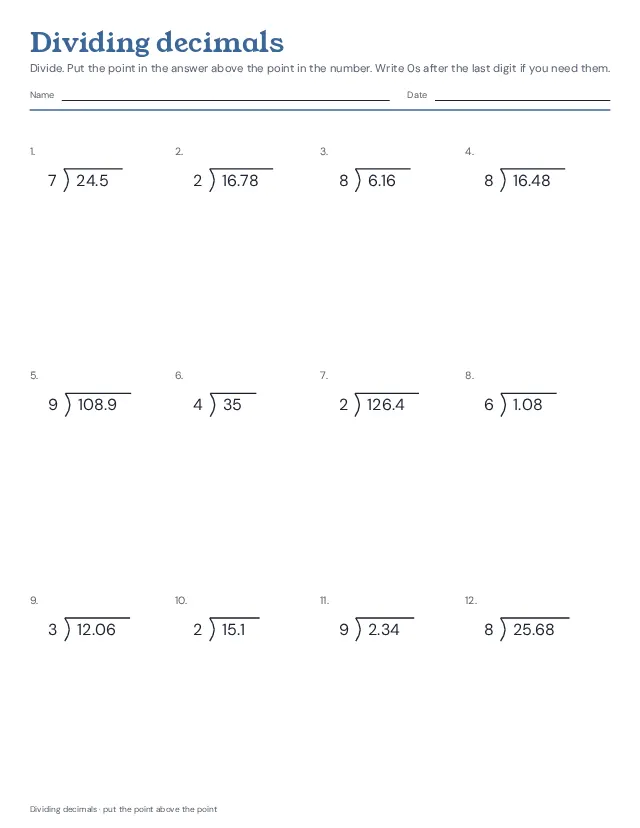
Twelve divisions a page with the bracket drawn and room for the working: a decimal divided by a whole number, as 8.46 ÷ 3; or by tenths, as 4.56 ÷ 0.3, or hundredths, as 1.38 ÷ 0.06, moving the points first. Or thirty a page to divide by 10, 100 and 1,000. Every sheet in columns has answers under 1, answers with a 0 inside and numbers that need a 0 written after them. Worked answer key. New questions each time.
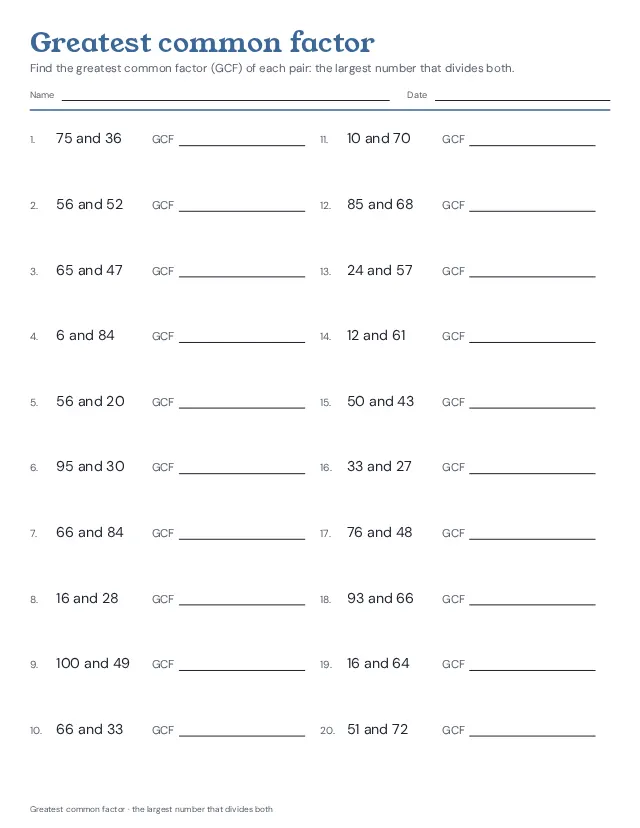
Twenty pairs of numbers a page: find the greatest common factor, the least common multiple, or both; or six pairs to break into prime factors with a factor tree, then find both. Every sheet has a number that divides the other, two numbers with no common factor but 1, and pairs whose LCM is less than the two multiplied. The answer key lists the factors, multiples or primes each answer comes from. New pairs each time.
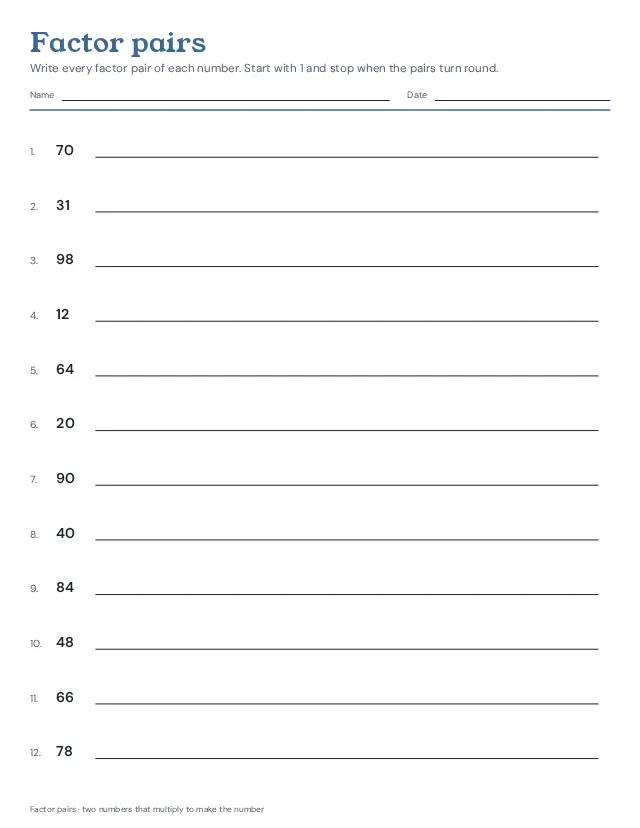
Twelve numbers a page to write every factor pair of, or the first ten multiples of; twenty questions such as “Is 56 a multiple of 7?”; or thirty numbers to 100 to circle as prime or composite. The sheets hold the numbers that catch children out: a square number and a prime among the factor pairs, near misses among the multiples to check, and odd numbers that look prime. Answer key. New numbers each time.
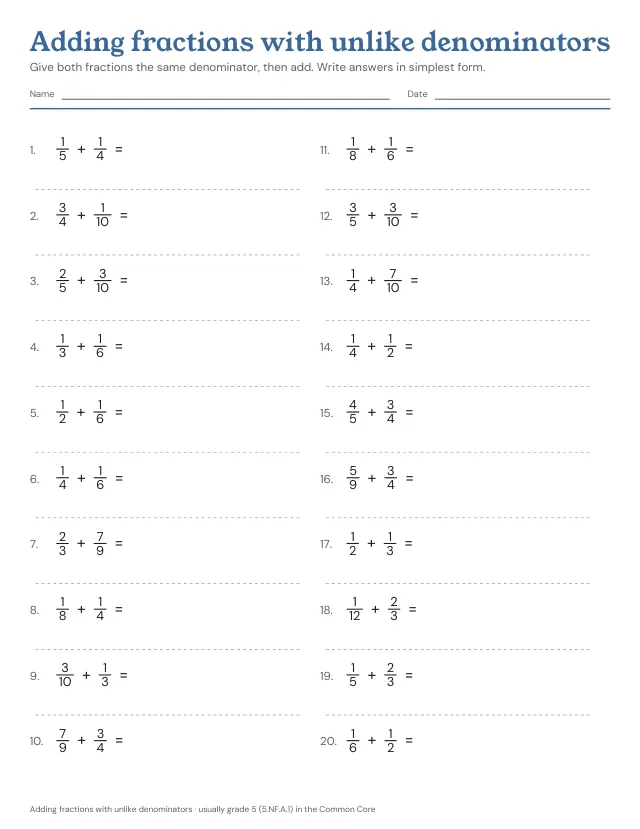
Twenty questions a page, the fractions written one above the other as a child writes them: like denominators, adding or subtracting with unlike denominators, both mixed, or mixed numbers with like or unlike denominators. Every sheet has the answers that catch children out: sums more than 1 to write as a mixed number, answers to simplify, and denominators whose common denominator is smaller than the two multiplied. The answer key shows the common denominator and every step. New questions each time.
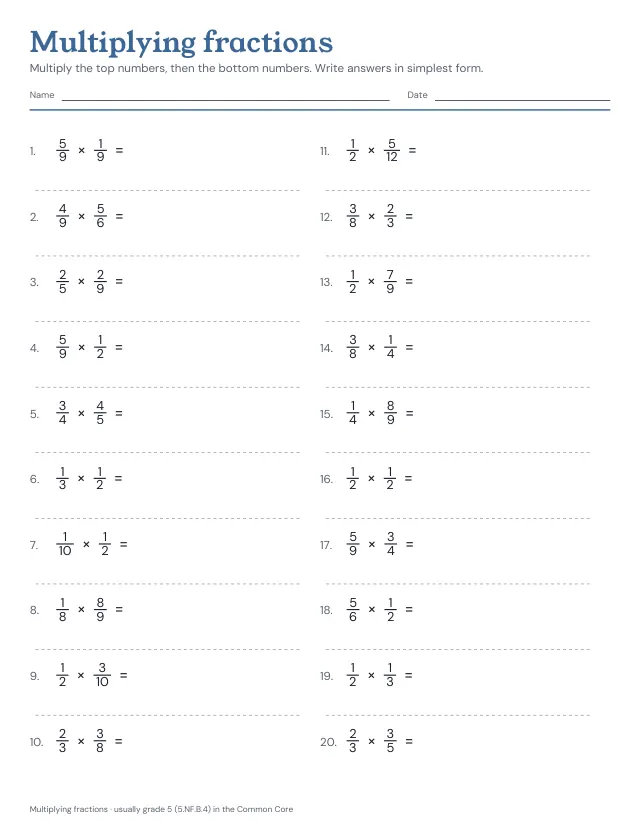
Twenty questions a page, the fractions written one above the other: a fraction times a whole number, a fraction times a fraction, mixed numbers, or multiplying and dividing fractions on one sheet. Every sheet mixes products more than 1, answers that simplify, and whole-number answers. The answer key shows the product before and after it is simplified, and each mixed number written as a fraction. New questions each time.
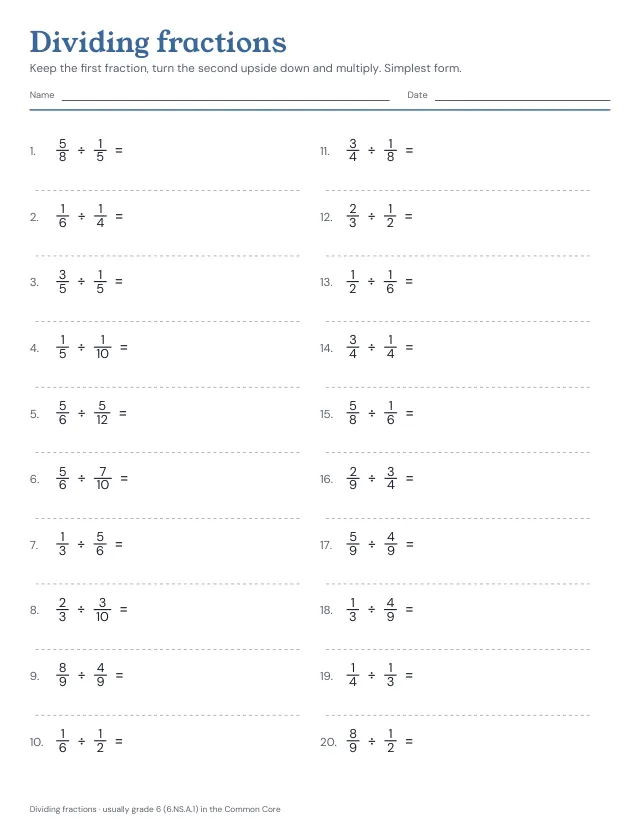
Twenty questions a page, the fractions written one above the other: a unit fraction divided by a whole number and a whole number by a unit fraction, a fraction divided by a fraction, or mixed numbers. Every sheet mixes answers more than 1, answers less than 1 and whole-number answers. The answer key shows the second number turned upside down, the multiplication and the simplest form. New questions each time.
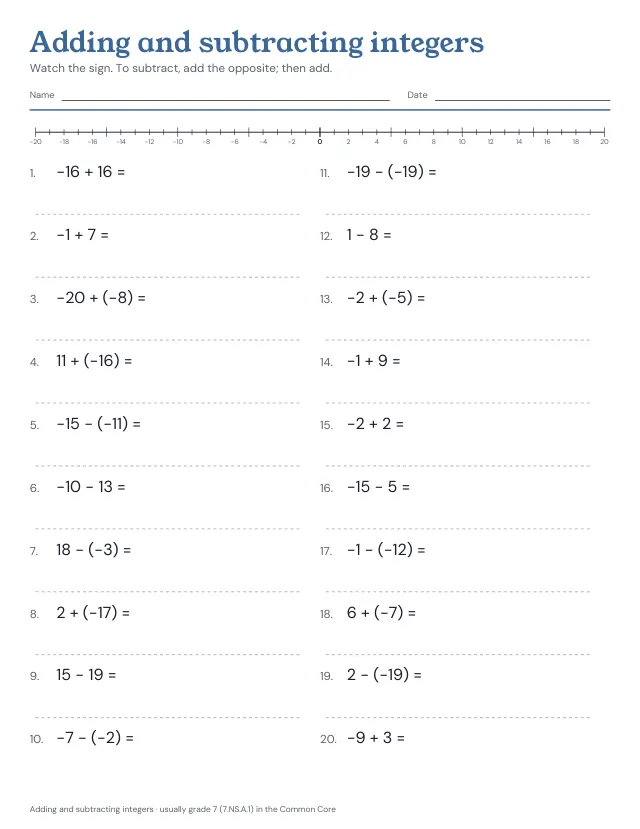
Twenty questions a page with positive and negative numbers: adding, subtracting or both mixed, with numbers from −20 to 20; multiplying and dividing, with the times tables to 12; or all four. Every sheet holds the sign cases that catch children out, such as two negatives, signs that differ, taking away a negative, and a number and its opposite that make 0. The adding and subtracting sheets have a number line across the top to count along. The answer key rewrites each question the way the rule says before the answer. New questions each time.
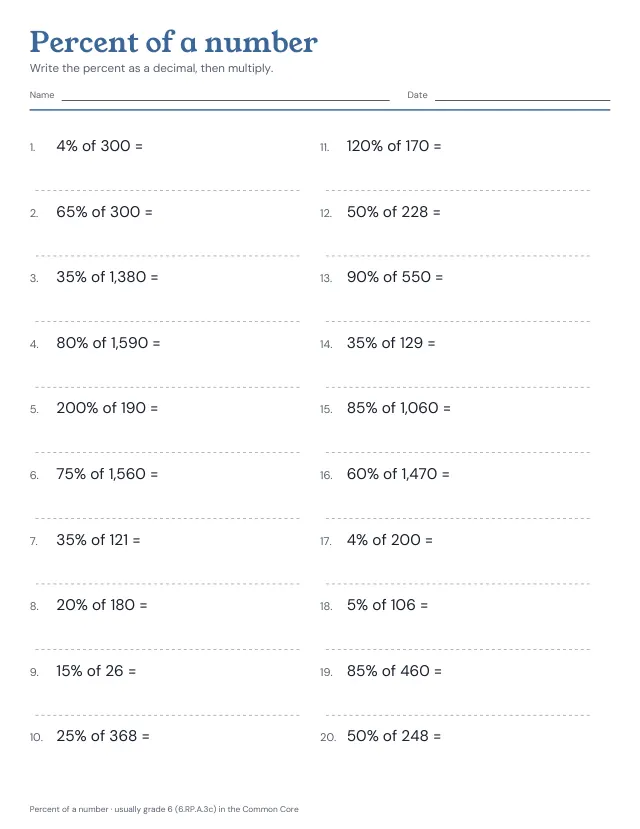
Twenty questions a page: a percent of a number, what percent one number is of another, the whole from a part and its percent, or all three mixed; percent increase and decrease; ten word problems on discounts, sales tax, tips, markups and commission; or fractions, decimals and percents to convert. Every answer comes out exact, and the answer key shows the percent written as a decimal and each step. New questions each time.
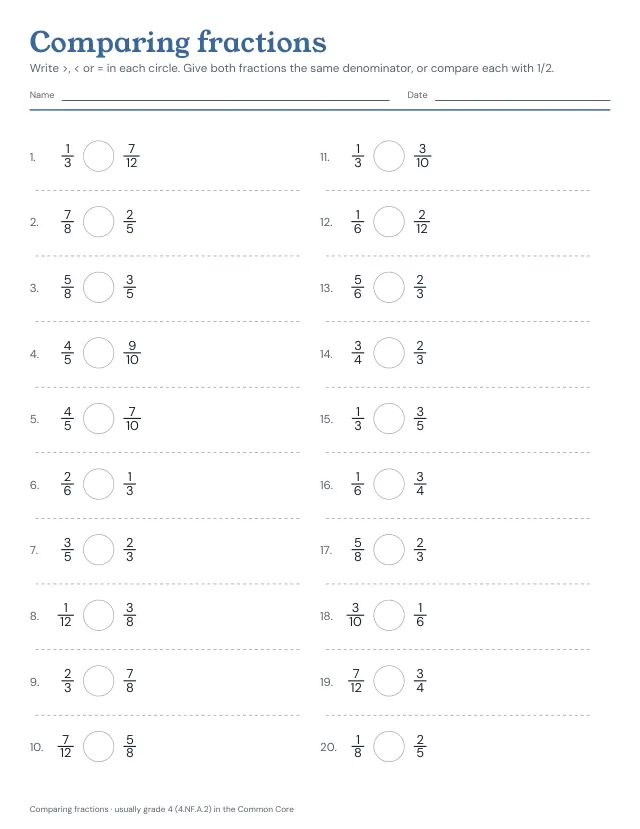
Twenty pairs of fractions a page, written one above the other, with a circle between each pair for >, < or =: different tops and bottoms, the same denominator or the same numerator. Or eight pairs of fraction bars to shade first, or ten lists of three or four fractions to put in order. Every sheet holds the pairs that catch children out, and the answer key shows how each was decided. New fractions each time.
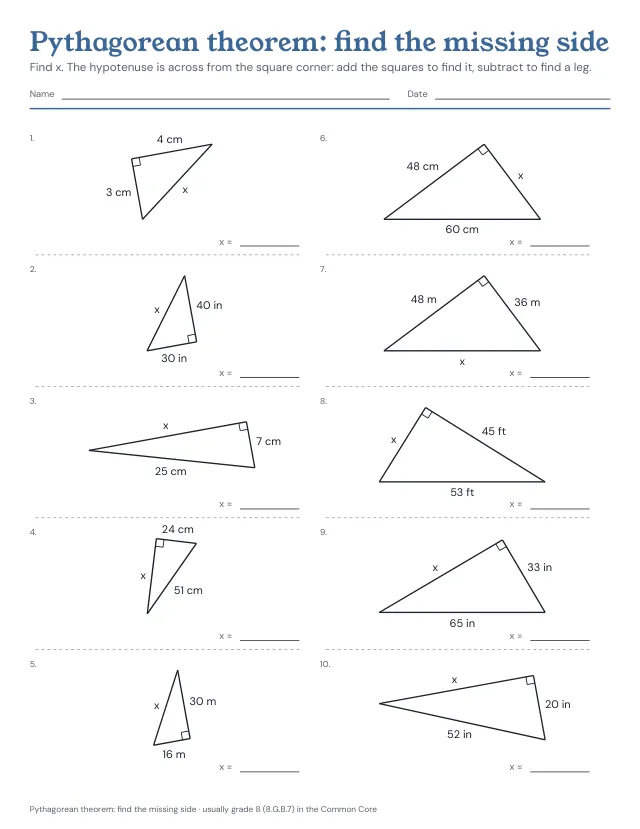
Ten right triangles a page, each drawn to its own shape and turned a different way, with two sides given and x on the side to find: the hypotenuse, a leg, or either. Or answers to the nearest tenth, three lengths to test for a right triangle, or word problems. The answer key works each one through a² + b² = c². New triangles each time.
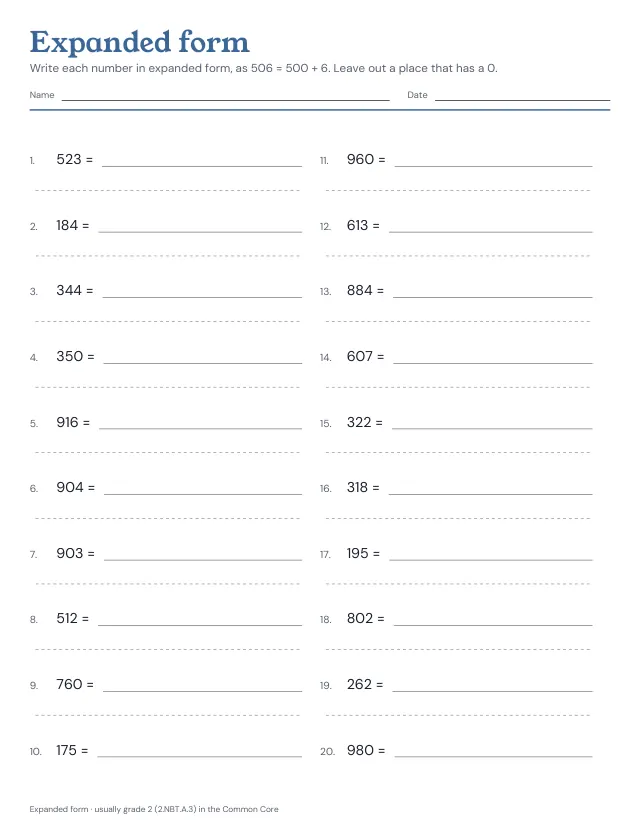
Twenty numbers a page to write in expanded form, as 506 = 500 + 6, or the other way, as 400 + 7 = 407. Larger numbers to a million, expanded form with multiplication, a sheet that moves between standard, expanded and word form, and decimals written as the Common Core writes them. Every sheet has the numbers that catch children out: a 0 inside, a place left out, parts given out of order. The answer key is on the last page. New numbers each time.
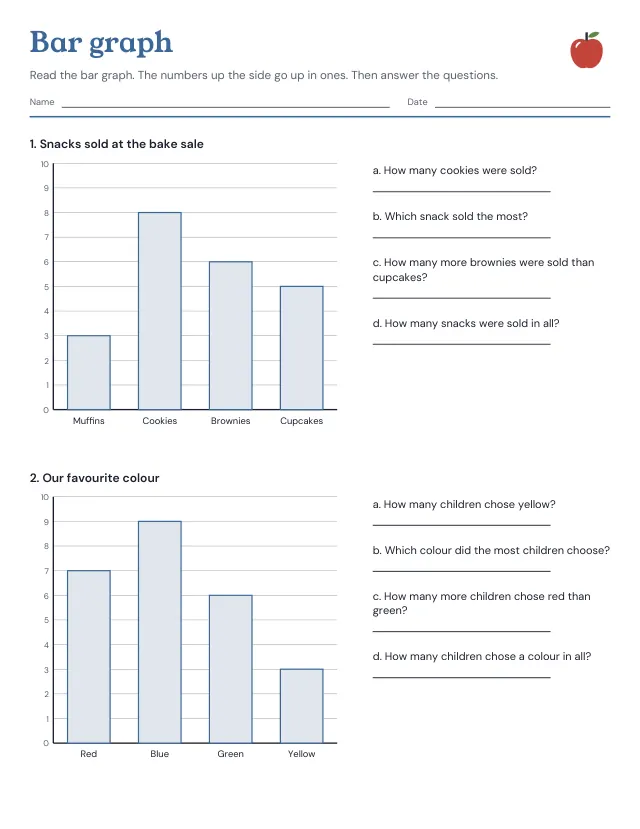
Two bar graphs a page, each of four things counted with a scale of 1, and four questions to read it: how many, which is most, how many more, and how many in all. Or the sheet to draw: the counts in a table and an empty graph for the bars. On the harder sheets the scale goes up in 2s or 5s. Answers on the key; new graphs each time.
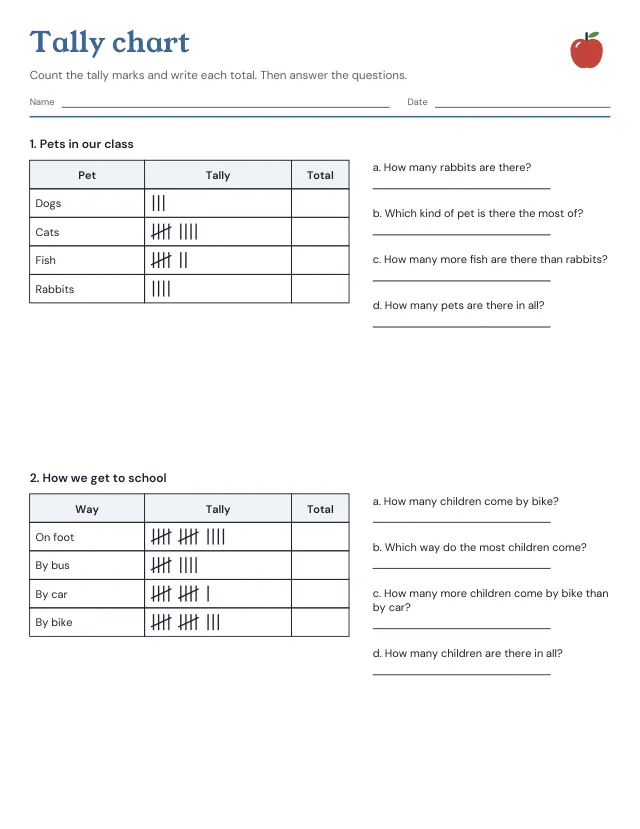
Two tally charts a page, each of four things counted in tally marks, to total and answer four questions about: how many, which is most, how many more, and how many in all. Or the sheet to make: a box of circles, squares, triangles and stars to count, mark in a tally chart and total. Answers on the key; new charts each time.
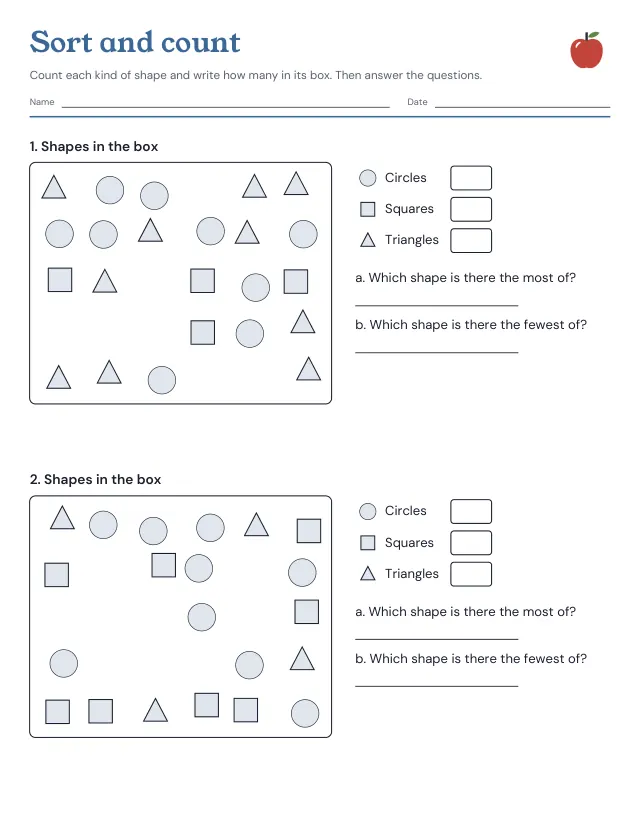
Two boxes a page of mixed circles, squares and triangles to sort and count, up to 10 of each, with a box beside each kind for how many, then which kind there is most and fewest of. The harder sheet adds stars and asks for the kinds in order, from most to fewest. Answers on the key; new boxes each time.
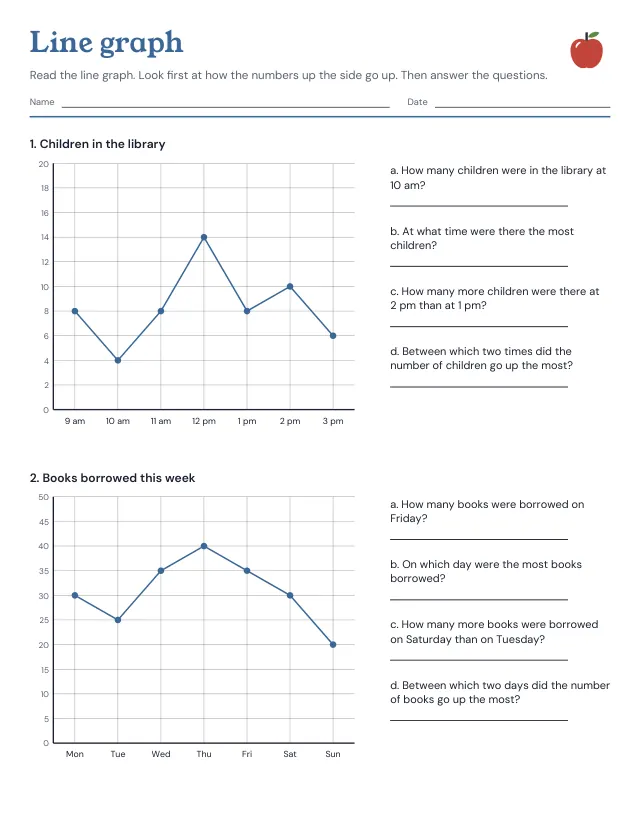
Two line graphs a page, each a count taken seven times through a school day or a week, as children in the library or ice creams sold, with four questions: how many at a given time, when it was most, how many more, and when it went up the most. Or the sheet to make: the counts in a table and an empty grid to plot them on. The numbers up the side go up in 2s or 5s. Answers on the key; new graphs each time.
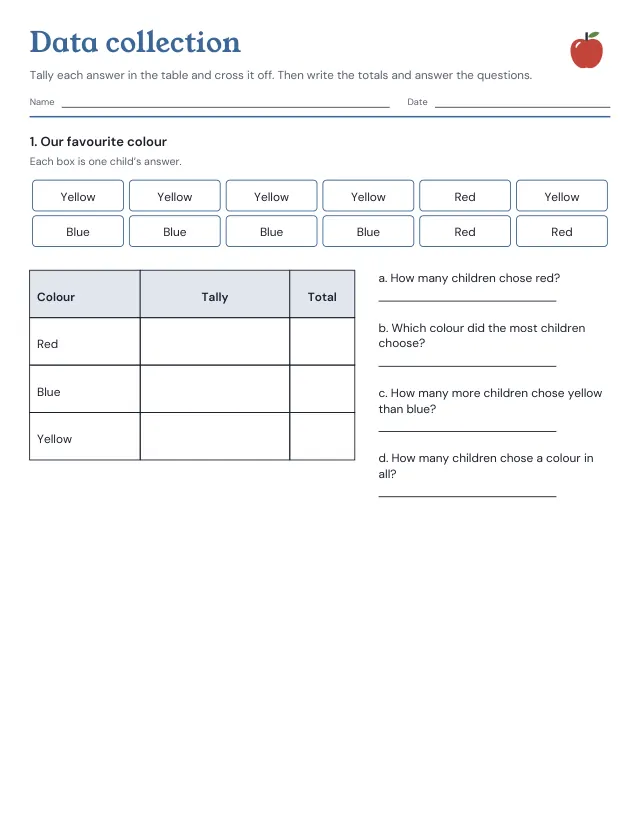
A class’s answers to one question, such as their favourite fruit or how they get to school, one answer a box, to sort into a table: a tally mark for each answer, then a total for each kind. Four questions follow: how many gave one answer, which was most, how many more, and how many in all. Three kinds of answer, or four on the harder sheet. Answers on the key; new lists each time. Or print the blank survey: write your own question and up to six answers, ask your class or your family, tally and total, then answer the same four questions.
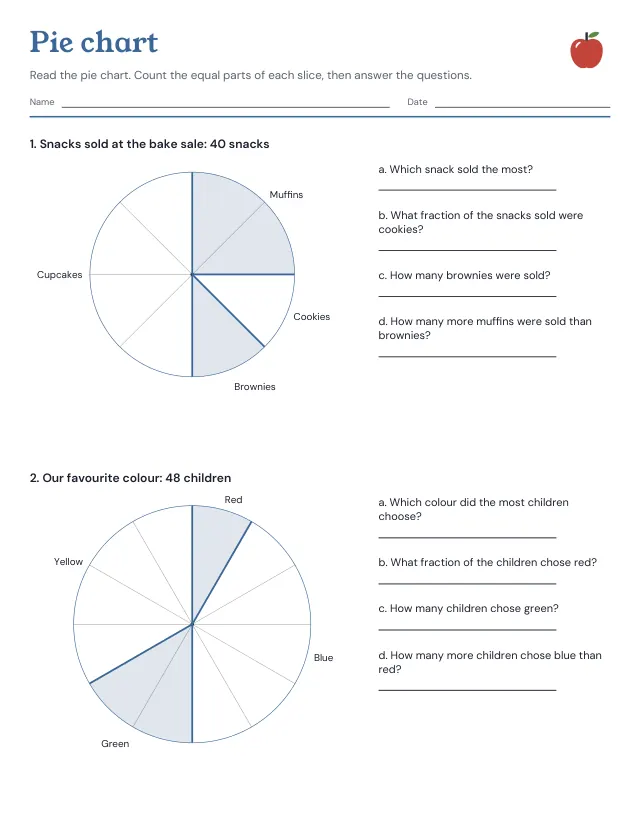
Two pie charts a page, each a circle cut into 8 or 12 equal parts, showing four things such as favourite fruits or how children get to school, with the total under the title. Four questions: which is most, what fraction one slice is, how many it stands for, and how many more. The harder sheet asks for percentages, and the sheet to make gives a table and a circle marked in twelfths to draw the slices on. Answers on the key; new charts each time.
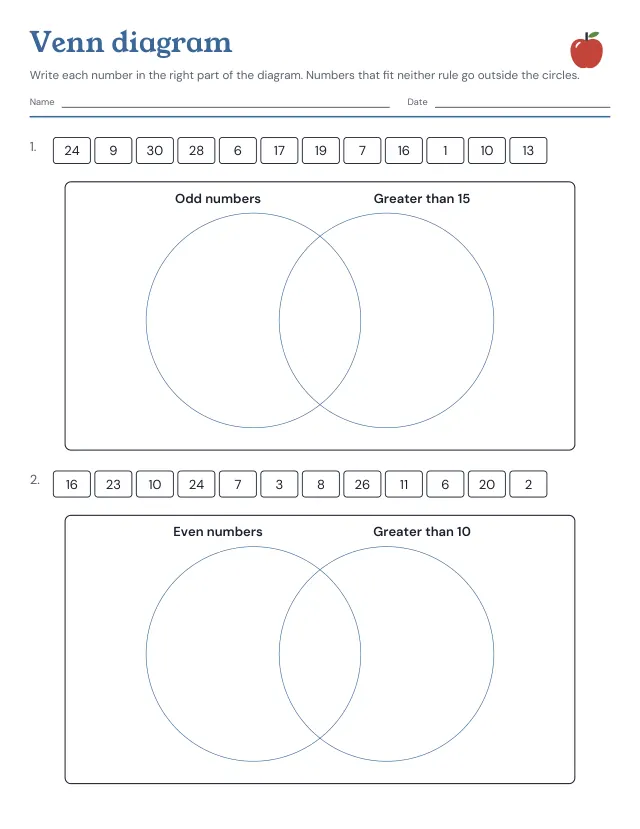
Two Venn diagrams a page, each with twelve numbers to write in two overlapping circles, one rule to a circle, such as even numbers and greater than 15: the overlap for numbers that fit both and the space outside for numbers that fit neither. Numbers to 30, or to 50 with multiples of 2, 3, 4 and 5 on the harder sheet. Or read a diagram already filled in and answer four questions about it. Answers on the key; new diagrams each time.
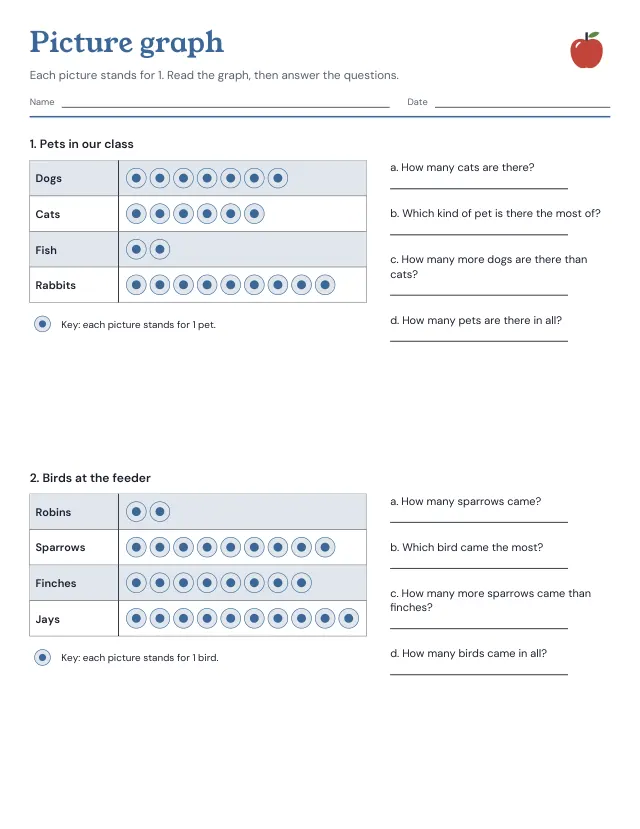
Two picture graphs a page, each of four things in rows of pictures, with four questions: how many, which is most, how many more, and how many in all. Each picture stands for 1; on the harder sheet each stands for 2, and half a picture for 1. Answers on the key; new graphs each time.
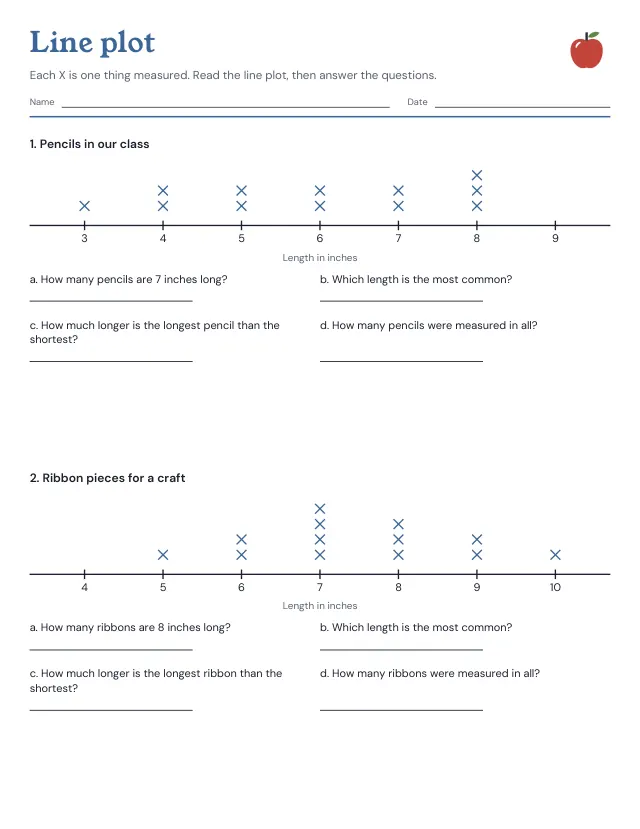
Two line plots a page, each of 10 to 14 things a class measured, as pencils, leaves or bean plants, with an X for each length above a number line, and four questions: how many, which length is most common, how much longer, and how many in all. Or the sheet to make: the lengths in a list and an empty line to mark them on. Whole inches, or to the half or quarter inch on the harder sheets. Answers on the key; new plots each time.
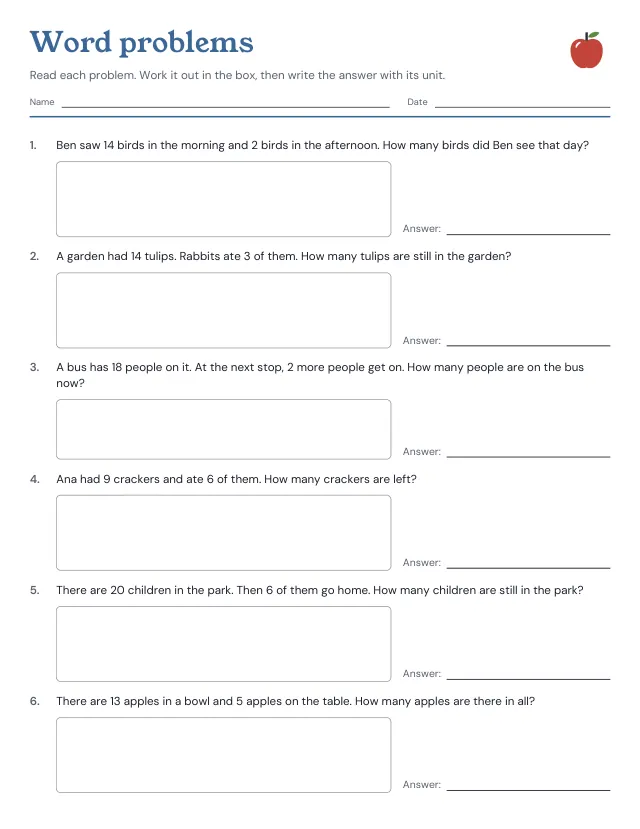
Six short story problems a page, each with a box to work it out and a line for the answer, and the number sentences on the answer key. Adding and taking away to 20 to start; choose larger numbers, multiplying and dividing, or all four mixed. New problems each time.
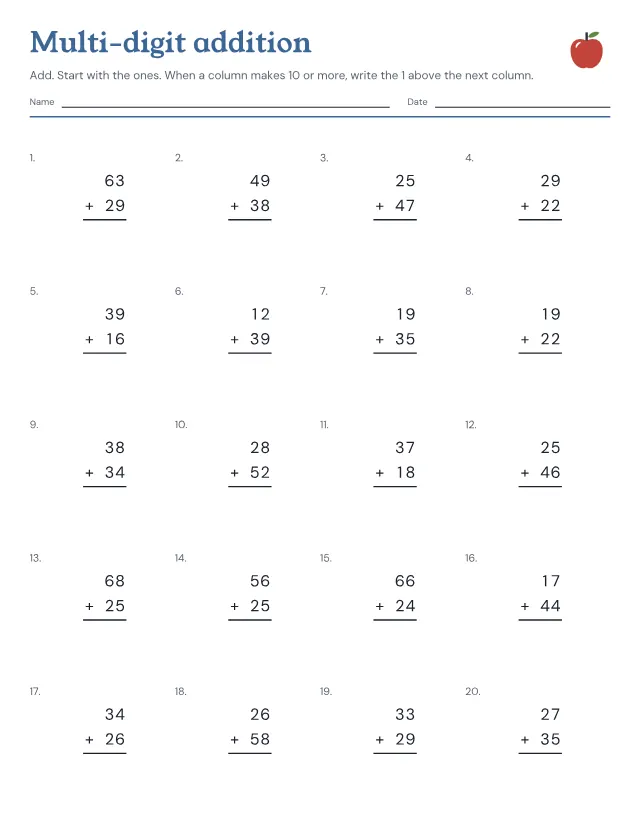
Add 2-digit to 5-digit numbers written in columns, 20 a page with the answers on the key. Choose sums with regrouping, where a column makes 10 or more and the ten is carried, sums without it, or the two mixed. It opens on 2-digit sums with regrouping, as 47 + 38. New questions each time.
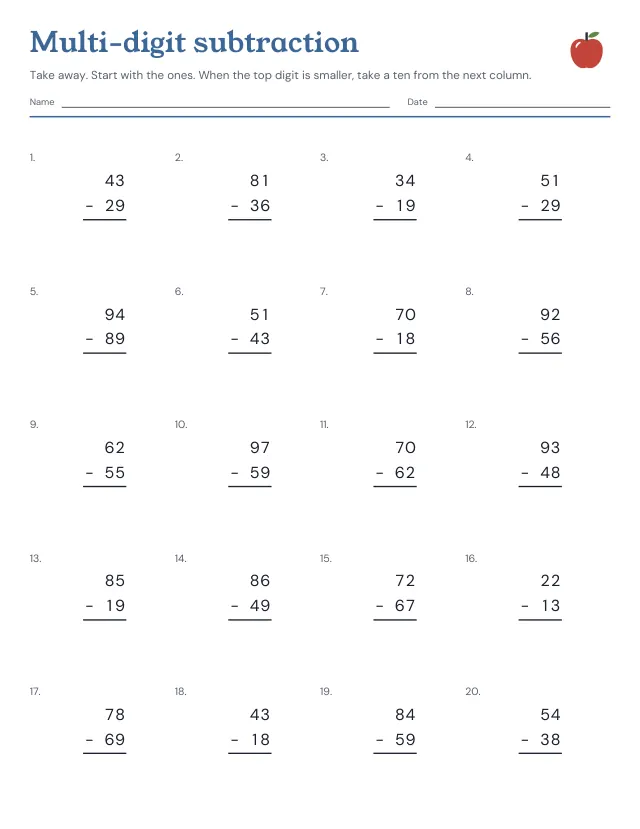
Take away 2-digit to 5-digit numbers written in columns, 20 a page with the answers on the key. Choose problems with regrouping, where a top digit is smaller and a ten is taken from the next column, problems without it, or the two mixed. It opens on 2-digit problems with regrouping, as 52 − 27. New questions each time.
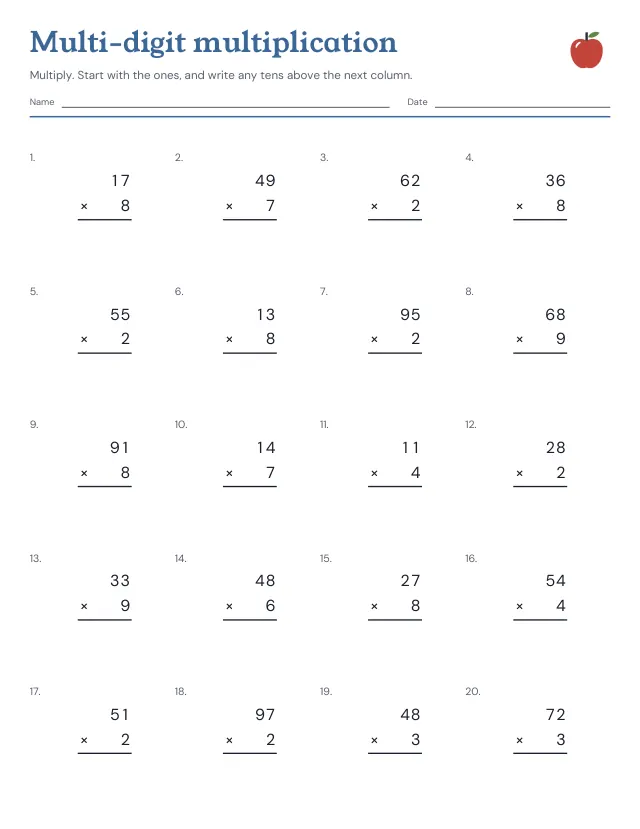
Multiply in columns: a 2-, 3- or 4-digit number by a one-digit number, or a 2- or 3-digit number by a two-digit number, with room for the working and the answers on the key. It opens on 2-digit by 1-digit, as 47 × 6, 20 a page. New questions each time.
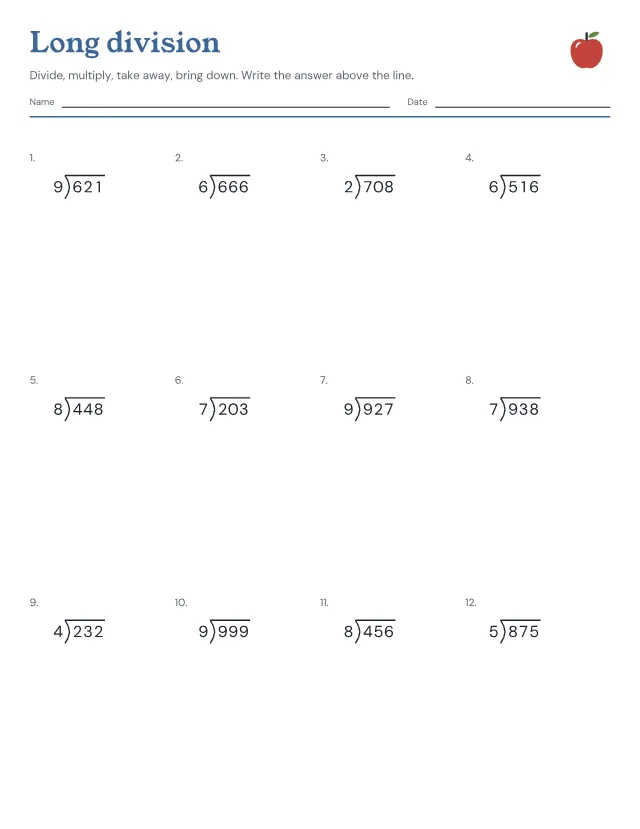
Long division with the bracket drawn and room under each problem for the working: 2-, 3- or 4-digit numbers divided by a one-digit number, with or without remainders, or by a two-digit number. It opens on 3-digit numbers divided by a one-digit number with nothing left over, as 852 ÷ 6. Answers on the key; new questions each time.
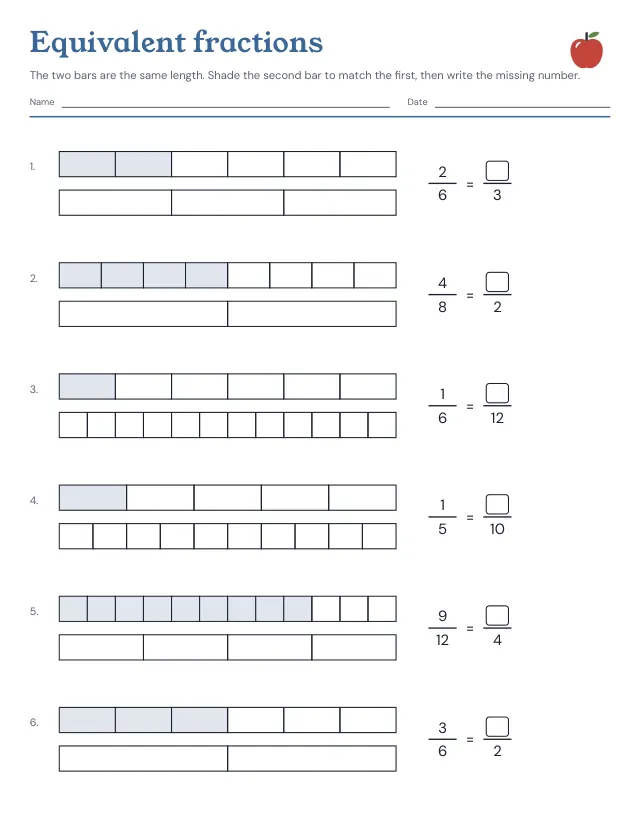
Equivalent fractions three ways: two fraction bars of the same length to shade and name, as 1/2 and 2/4; a missing top or bottom number, as 2/3 = □/12; or a fraction to write in its simplest form, as 6/8 = 3/4. It opens on the fraction bars, six a page, with the answers on the key. New questions each time.
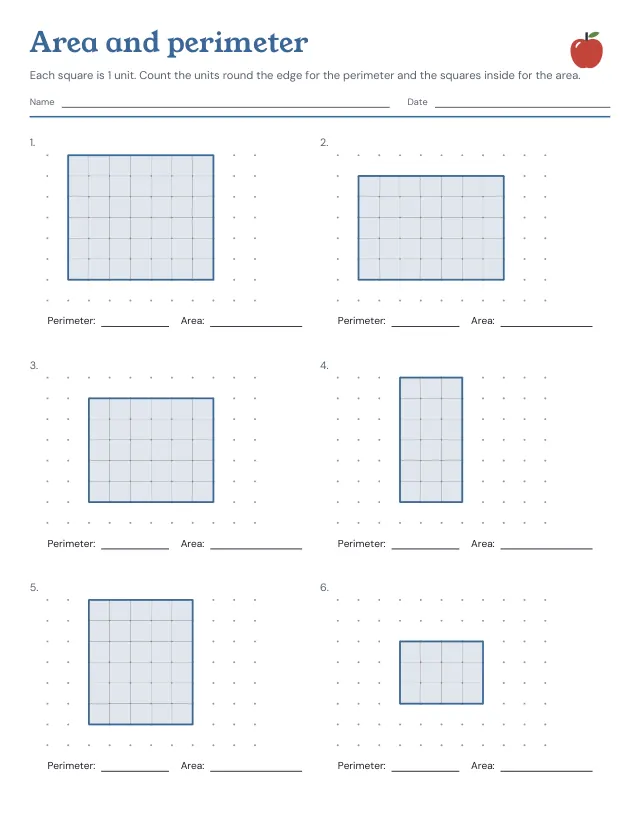
Six shapes on a grid of squares, each square 1 unit: count round the edge for the perimeter and the squares inside for the area, and check on the answer key. Rectangles first, then L shapes for a harder sheet.
Type a name to repeat it in pale letters between writing guides.
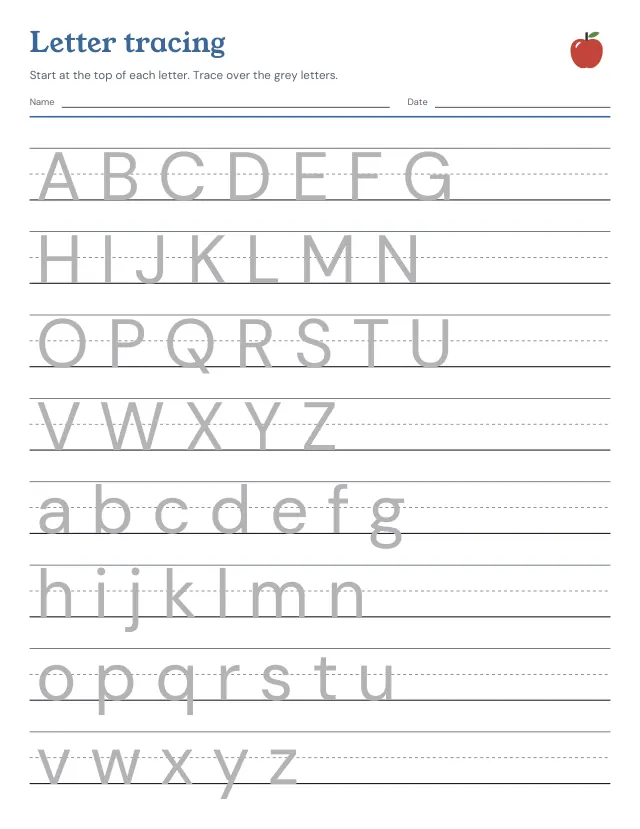
Trace pale uppercase and lowercase letters, A to Z and a to z, on eight rows of handwriting guide lines, starting at the top of each letter. Or print one letter a page: the letter to look at, rows to trace, then rows to write it alone.
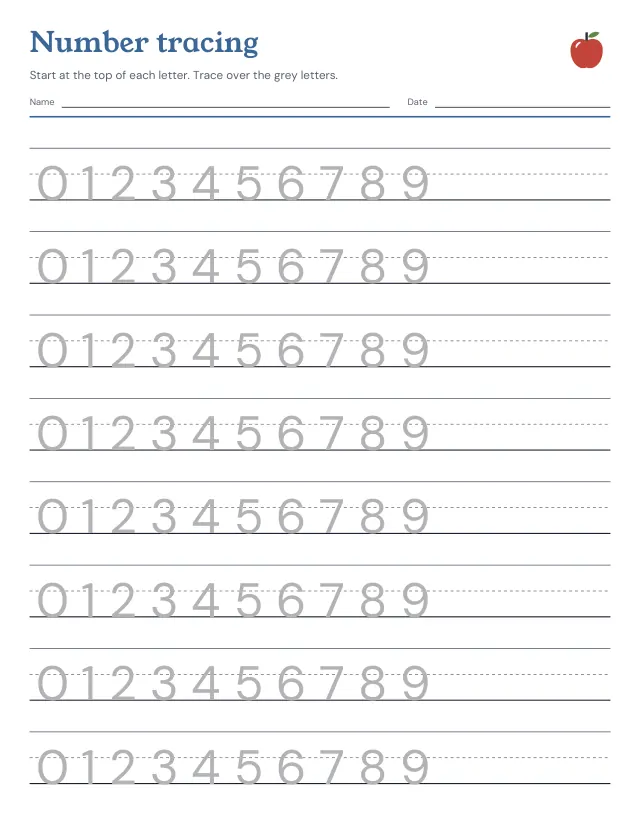
Trace the digits 0 to 9, a full row of them on each of eight rows of handwriting guide lines. Or print one number a page, 0 to 20: the number and its word to look at, counters to count, rows to trace, then rows to write it alone.
Type one question and answer per line, separated by a vertical bar. Cut out the cards to study.
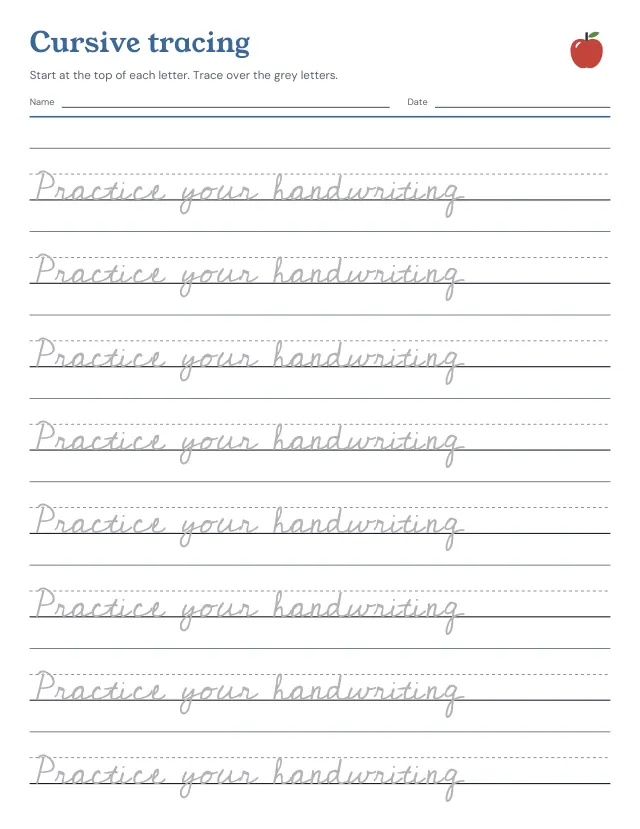
Type the words you want to practice. Pale cursive letters sit between writing guides.
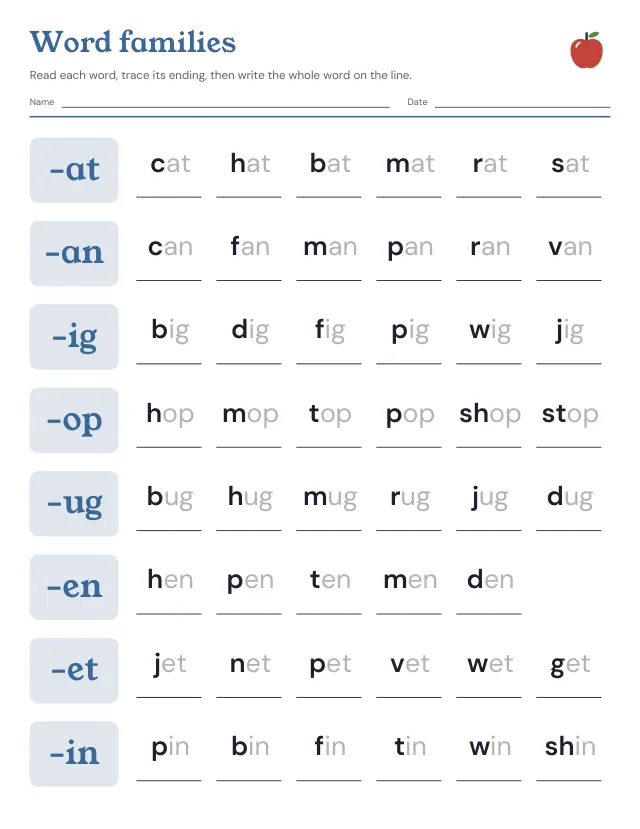
Eight short-vowel word families on one sheet, from -at and -an to -et and -in: each word has its first letters printed and its ending pale to trace, with a line below to write the whole word. Type your own endings and first letters to make another sheet.
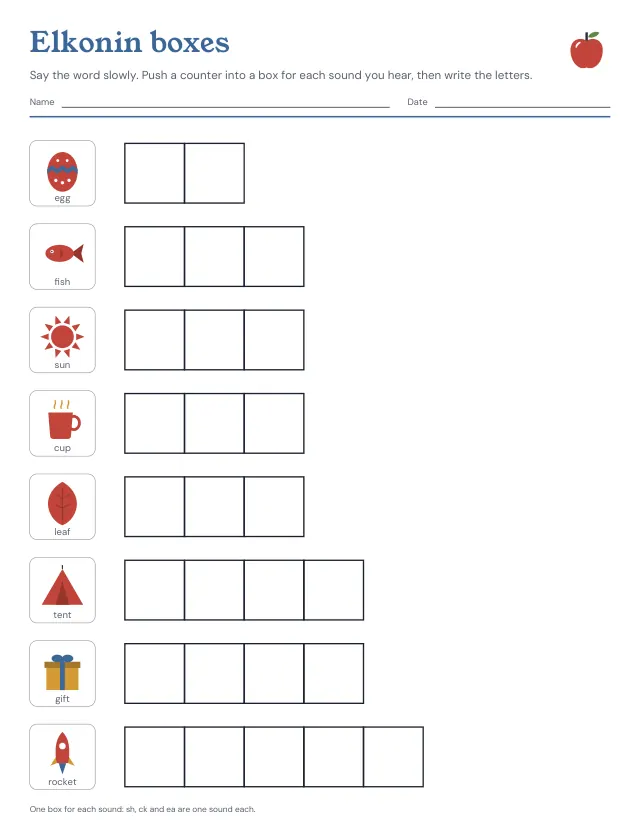
Elkonin boxes, or sound boxes: eight pictures to name, each with a box for every sound in its word, from egg with two sounds to rocket with five. Type your own words and how many sounds each has to make your own sheet.
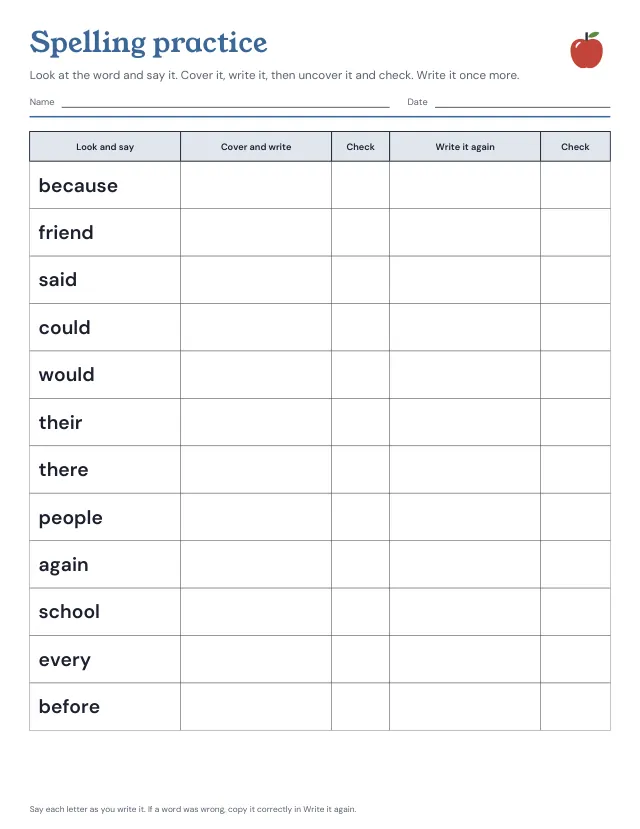
Look, say, cover, write, check: each word in the first column to read aloud, then columns to write it from memory, check it and write it again. Type this week’s spelling words, up to 15 a sheet, or print the twelve everyday words it opens on.
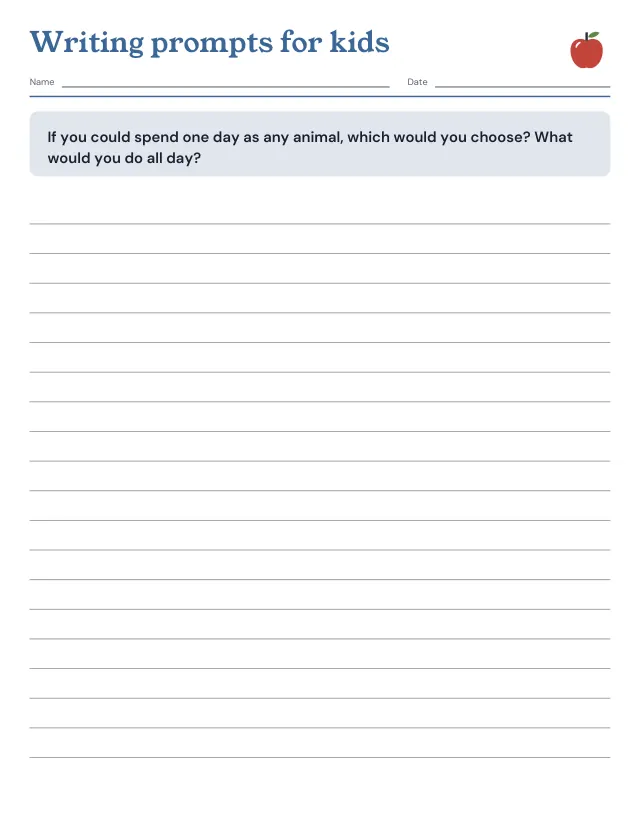
Ten writing prompts for children, one a page, each in a box at the top with ruled lines below to write on: a door that was never there, a pet that talks for a day, a new holiday to invent. Add a space to draw for younger writers, or type your own prompts.
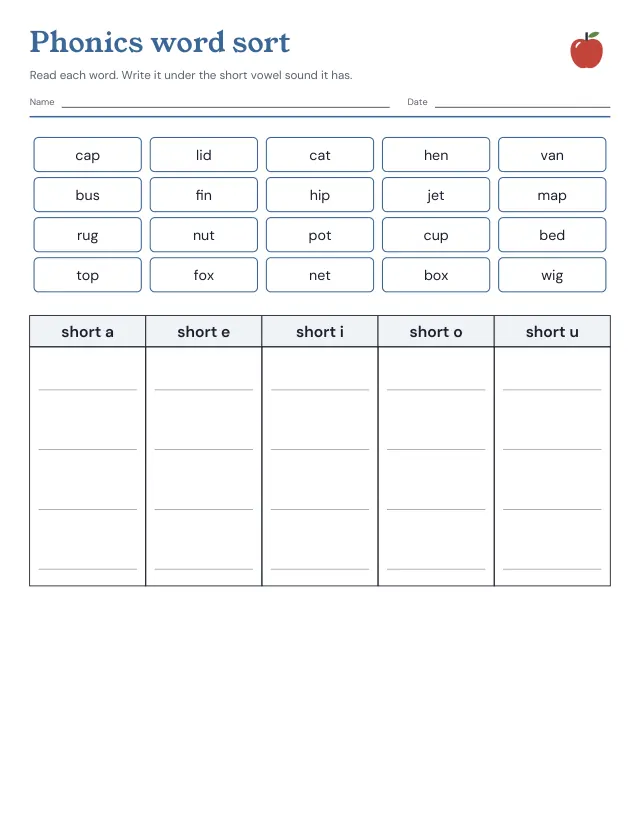
A bank of words to read and sort, four for each sound, and a column for each sound to write them in: short vowels (cat, bed, pig, dog, sun), the digraphs sh, ch, th and wh, the blends bl, cr, st and fl, or long vowel spellings (cake, tree, bike, bone, cube). The key fills in the columns. New words each time.
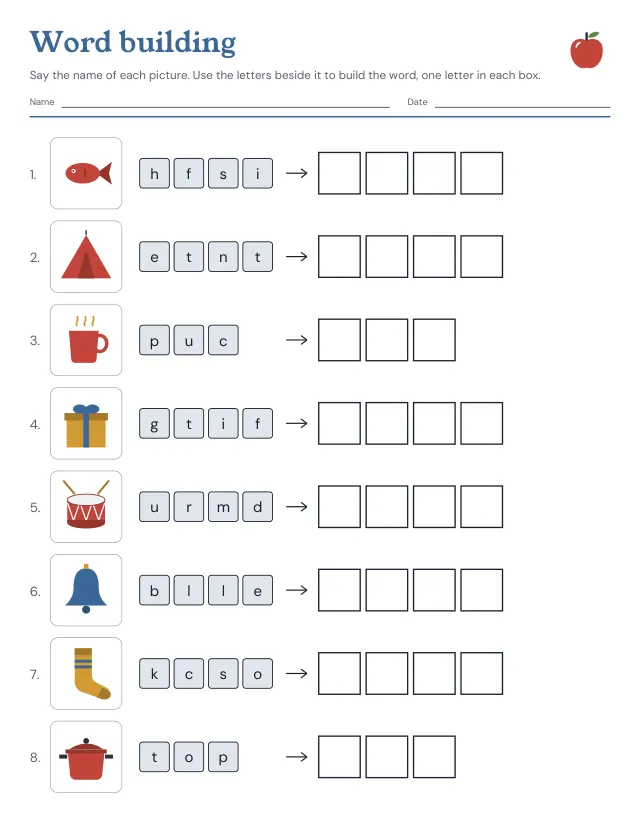
Eight pictures a page, each with its letters jumbled in tiles beside it and a box for each letter: say the name of the picture, then build the word from the tiles. Short vowel words such as sun, cup and fish, or on the harder sheet words with ee, oo, ea, ar and ir, such as tree, moon and bird. The key gives the words. Each sheet draws eight of sixteen words, so the words, their order and the tiles change each time.
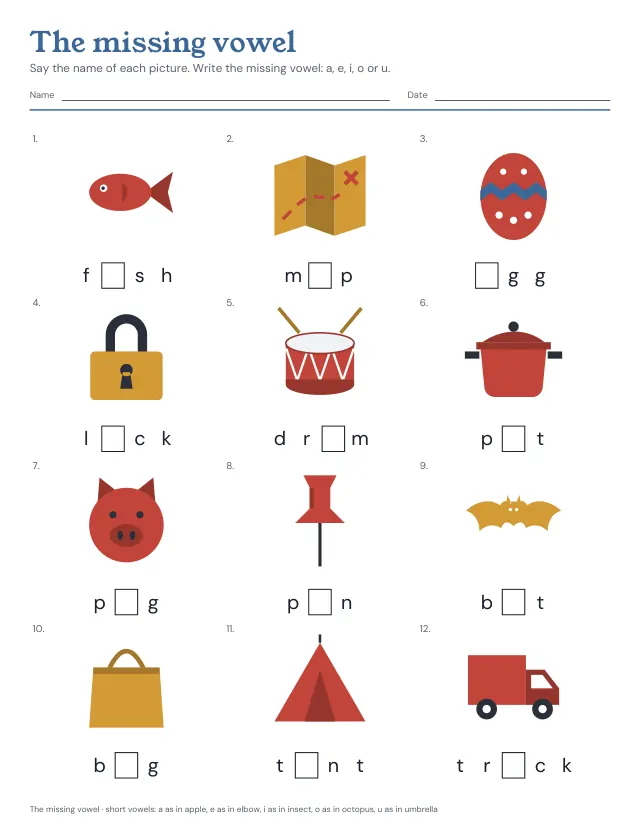
Twelve pictures a page, each a short word with a short vowel: write the missing vowel under each picture, circle the vowel sound you hear, or find the pictures with one vowel’s sound, a, e, i, o or u. The answer key follows. Each copy draws new pictures.
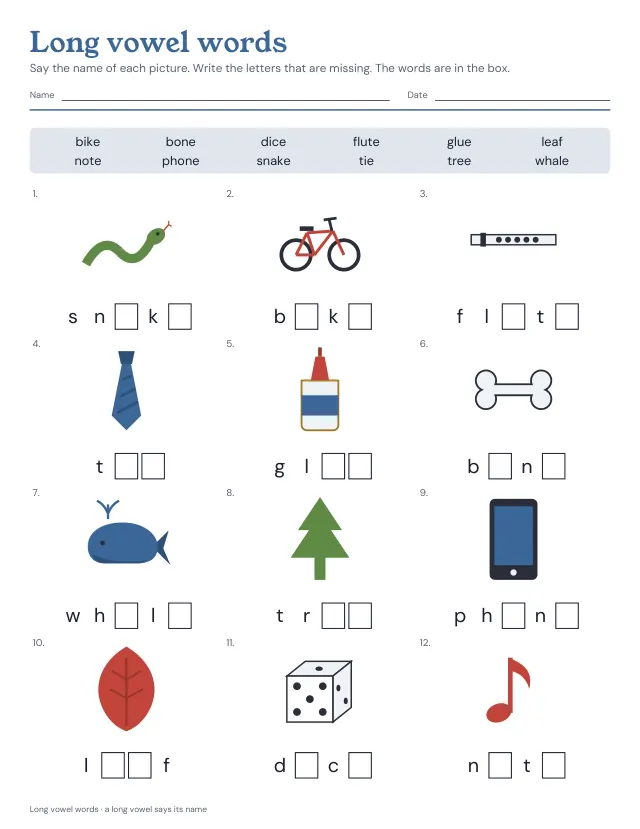
Twelve pictures a page, each a word with a long vowel, one that says its name: write the missing letters from a word bank, circle long or short for each picture, or find the pictures with one long vowel among others. The answer key follows. Each copy draws new pictures.
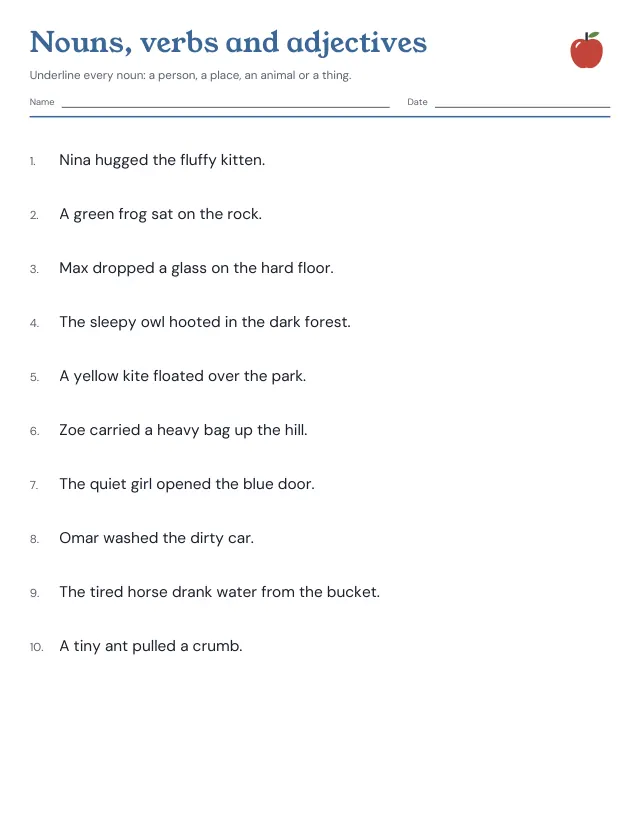
Ten short sentences a page, written for this site, to find the nouns in, the verb, or the adjectives, or all three: underline the nouns, circle the verb and draw a box around each adjective. Every sentence has one verb and no tricky words, and the key lists the words in each. New sentences each time.
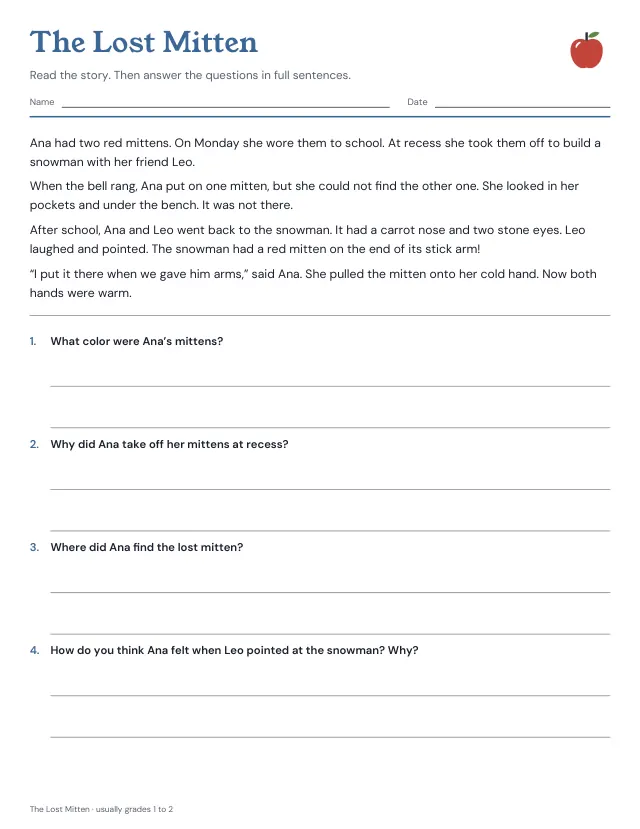
17 short stories written for this site, from a lost mitten for grade 1 to a robot team for grades 6 and 7, and 66 fact passages on space, the Earth and its weather, animals and plants, and American places and history. Each prints with four questions, lines to answer on and an answer key.
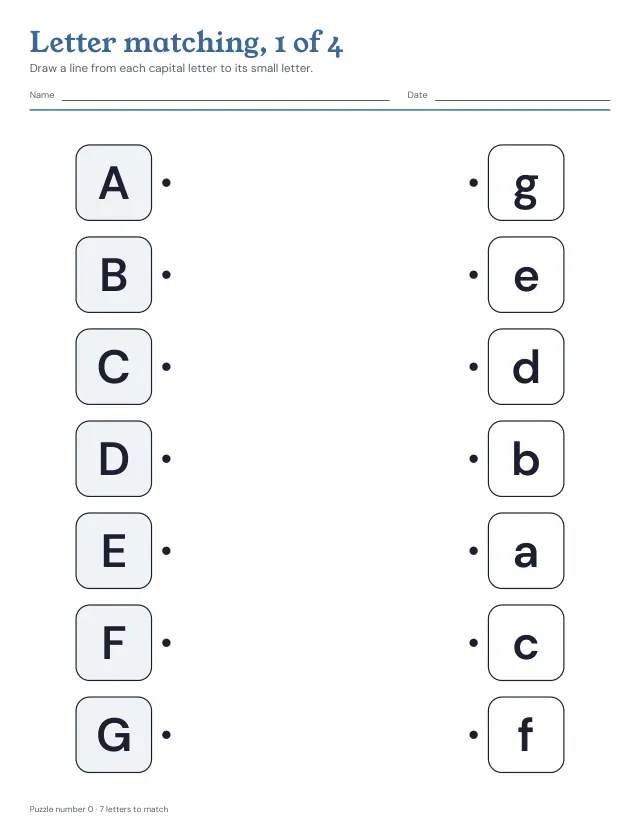
Capital letters down one side and small letters down the other, in a shuffled order, to join with a line. Choose the letters, A to Z or just the ones a child is learning, and which way round; seven pairs fit on a page and the answer key follows.
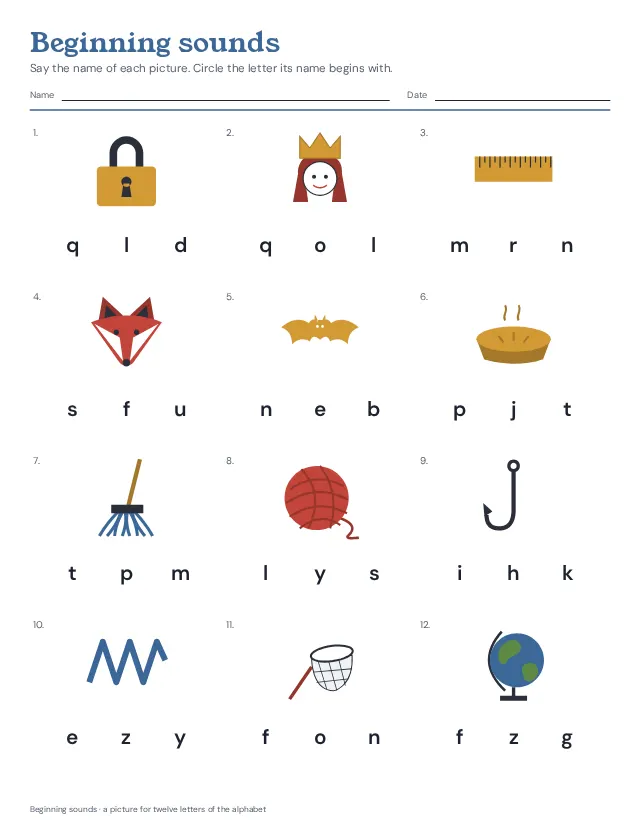
Five sheets for the whole alphabet: circle the letter each of twelve pictures begins with, find each letter among letters that look like it, fill in the missing capital or small letters in runs of the alphabet, or write the letters before and after. The answer keys follow, and each copy is new.
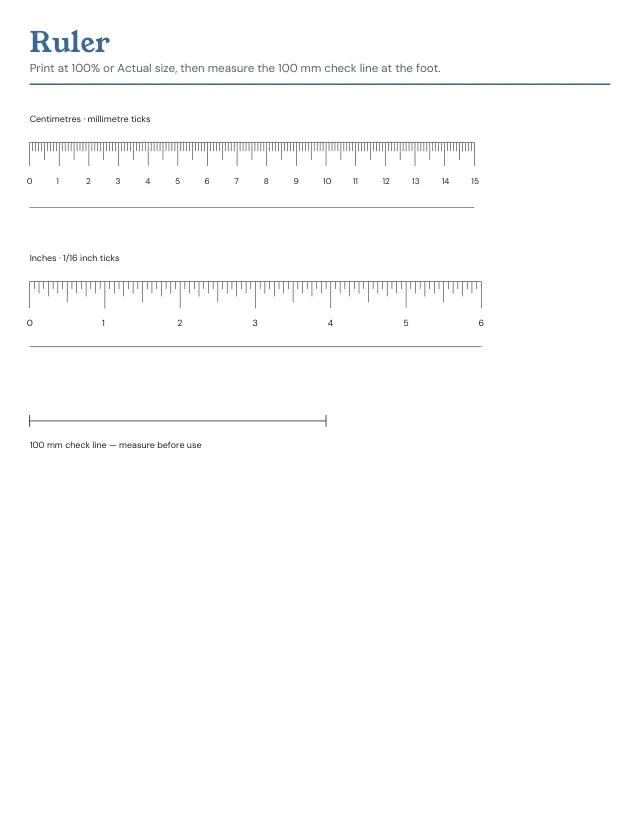
Print a ruler with millimetre and inch markings. Choose the scale and length before downloading.
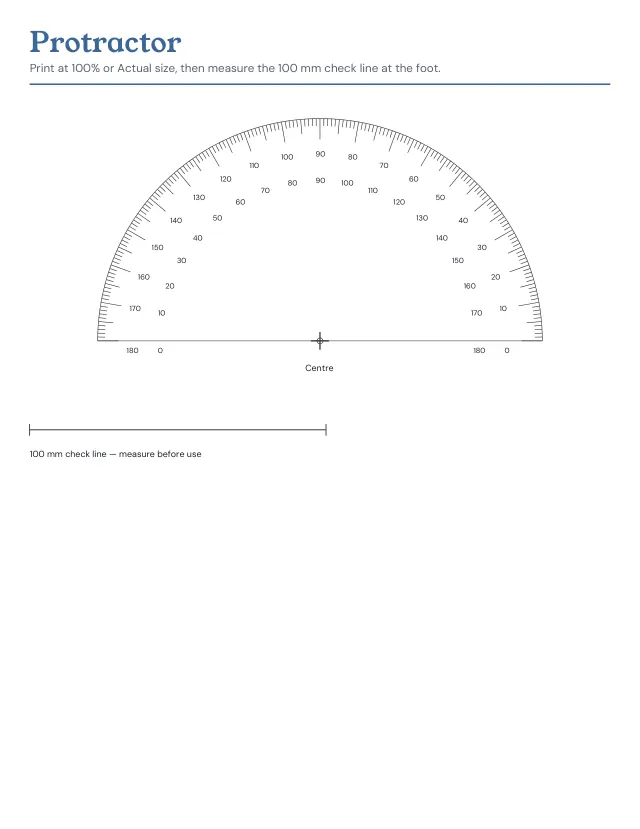
Print a 180-degree protractor with scales running in both directions. Place its centre mark on the angle’s vertex and line up the baseline with one side.
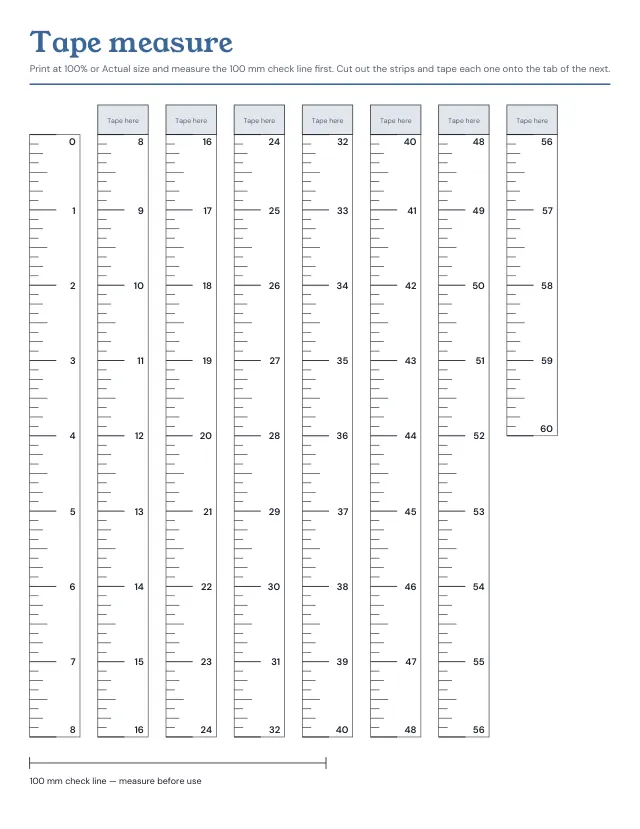
A paper tape measure to cut out and tape together, for a waist, a head, a wrist or a parcel: 60 inches with eighth-inch marks, or 150 cm with millimetre marks. Print at Actual size and check the 100 mm line first.
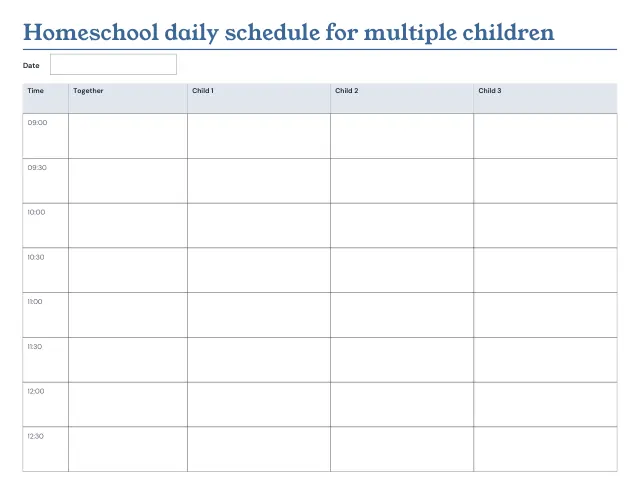
Plan shared lessons beside each child’s own work on one sheet. Start with three child columns and eight half-hour blocks from 09:00 to 12:30, then change the names, times and activities.
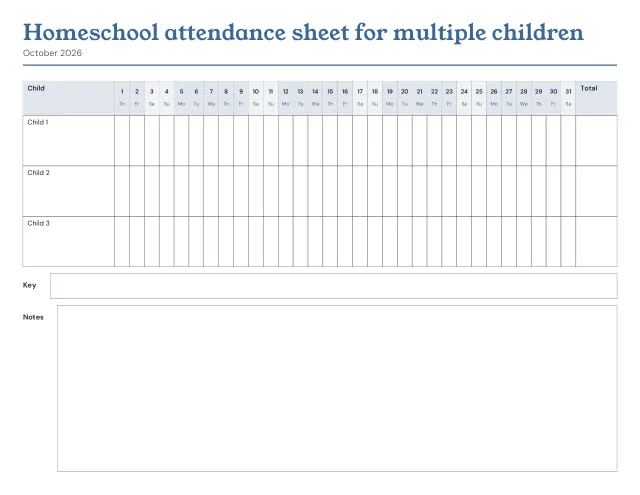
Record each child’s attendance on a separate row across the month. Choose the month and names; the sheet prints every date, its weekday and a blank total for each child.
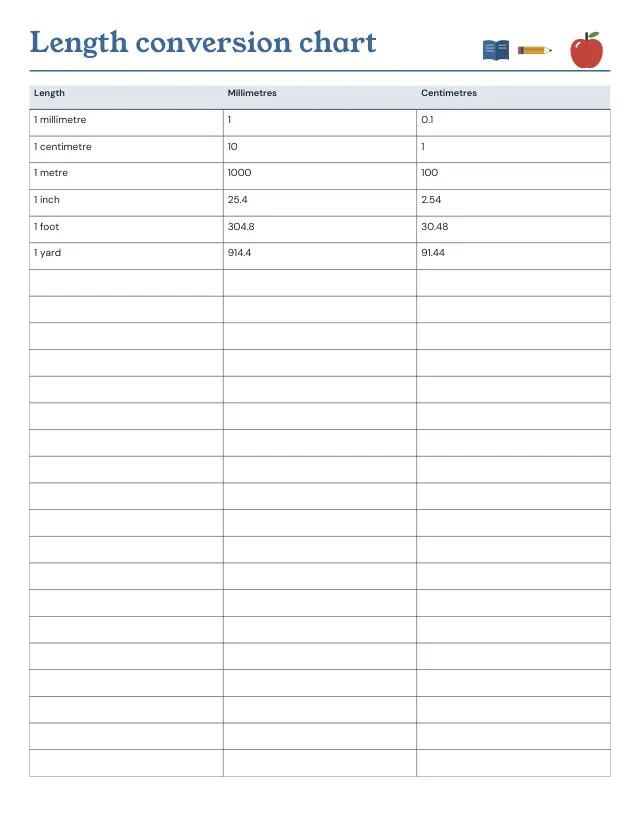
Compare millimetres, centimetres, inches, feet and yards. The sheet uses the international foot.
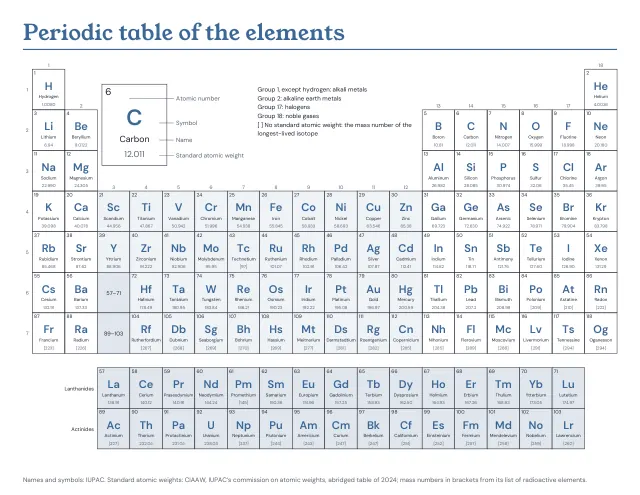
All 118 elements on one landscape page, each with its atomic number, symbol, name and atomic weight, the weights as IUPAC’s commission on atomic weights gives them. Print it in full, without the weights, or with only the numbers to fill in, and the full table after it as the answer key.
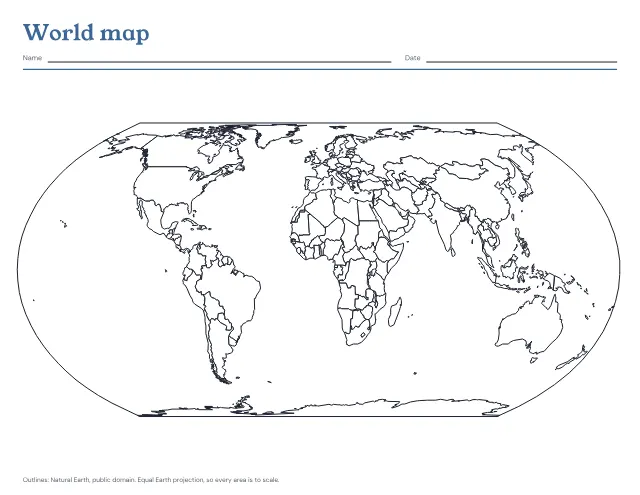
The world’s countries in outline on one landscape page, blank to fill in or with the seven continents and five oceans named. Print a blank map and the named one after it as the answer key.
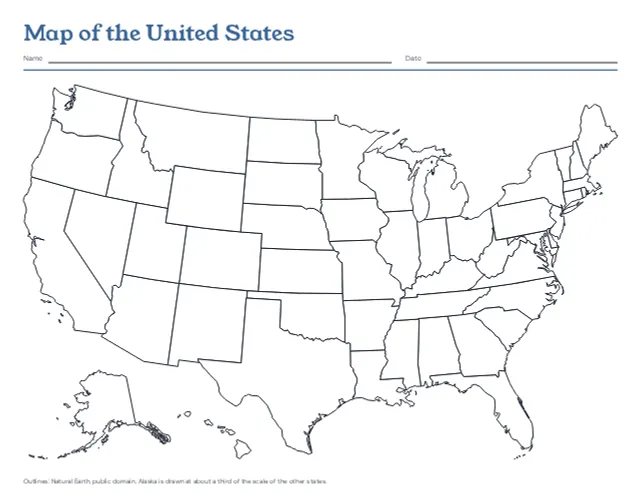
The 50 states in outline on one landscape page, with Alaska and Hawaii set in at the lower left, blank or with every state named. Print a blank map and the named one after it as the answer key.
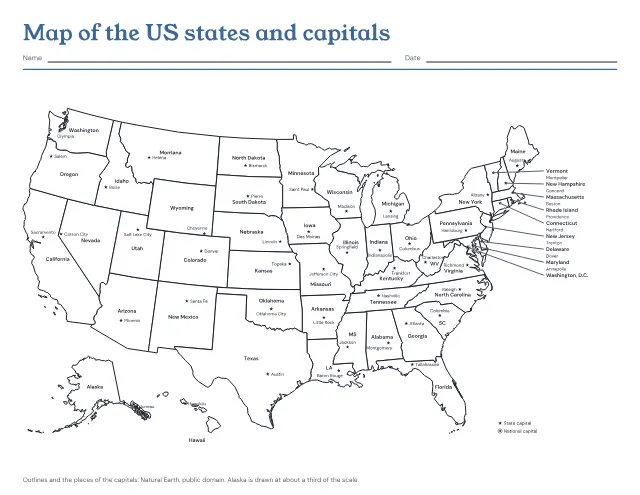
The 50 states in outline with a star at each capital, and each state and capital named. Print it named, with the capitals left to write in, or with only the stars; the named map comes after the one to fill in as its answer key.
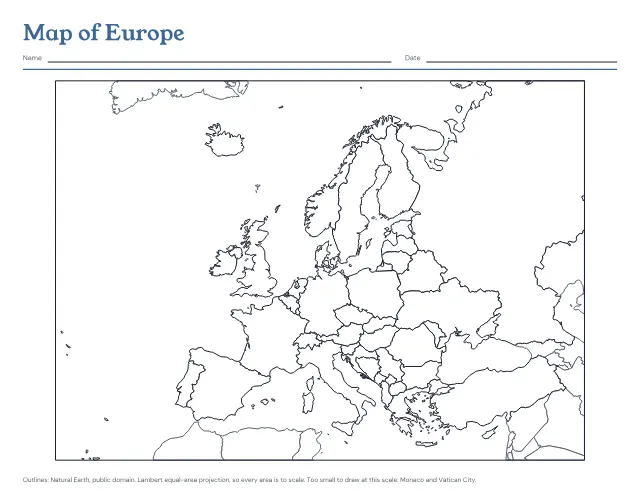
The countries of Europe in outline on one landscape page, blank to fill in or with every country named. Print a blank map and the named one after it as the answer key.
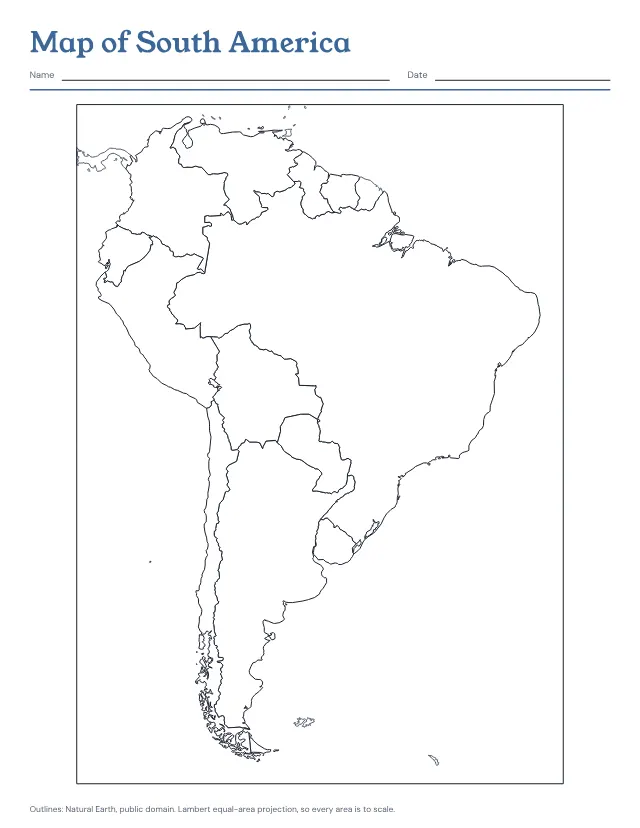
The countries of South America in outline on one page, blank to fill in or with every country named. Print a blank map and the named one after it as the answer key.
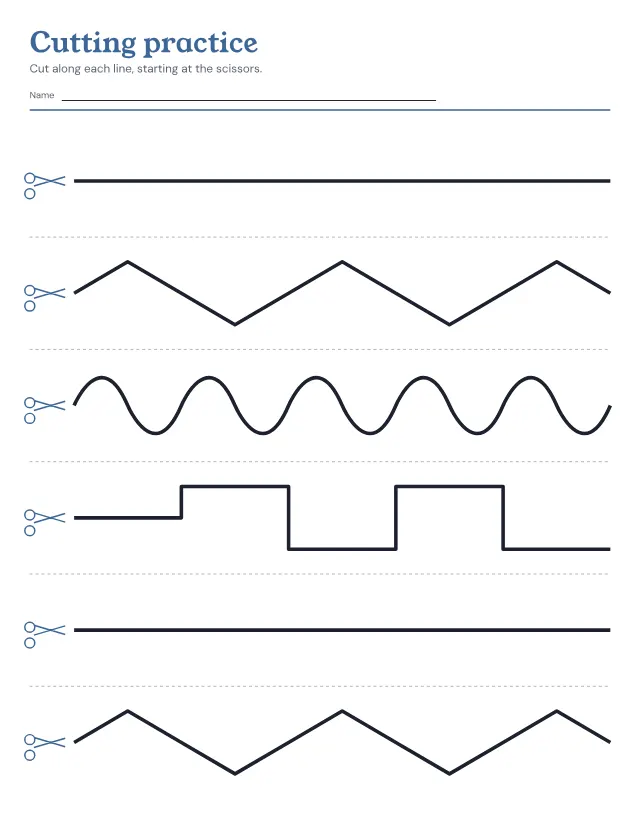
Strips of thick lines to cut along: straight lines first, then zigzags, waves and steps. Each strip starts at a pair of scissors, so a child knows where to begin.
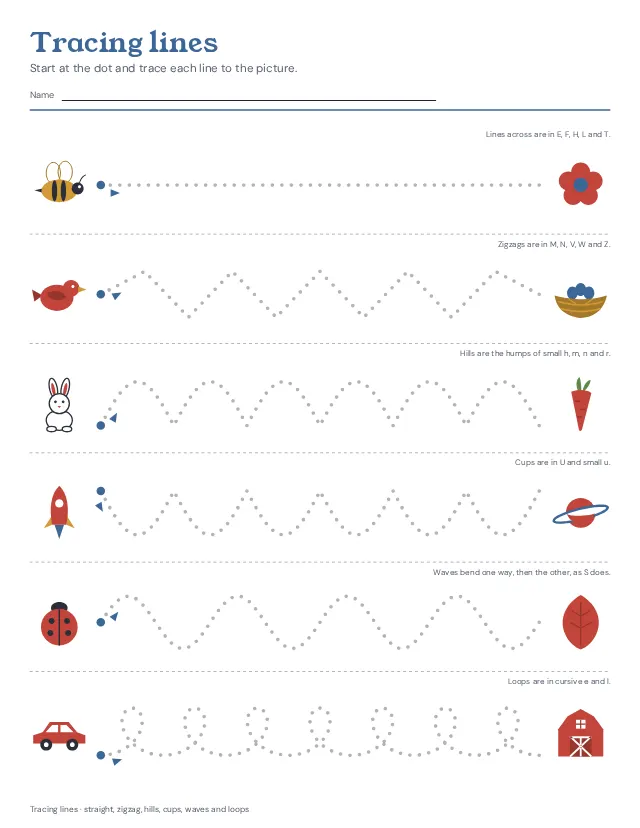
Dotted lines to trace with a pencil, each from a starting dot beside a picture to the picture at its end: the bee to the flower, the bird to its nest. Straight lines across and down come first, then zigzags, curves and loops. Beside each line, the letters it is in.
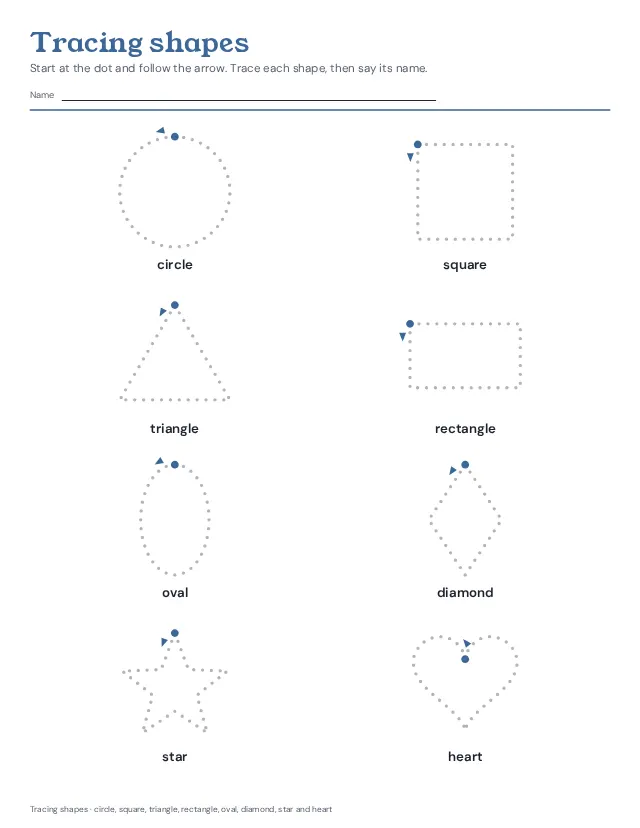
Eight shapes to trace and name on one sheet: circle, square, triangle, rectangle, oval, diamond, star and heart. Or one shape a page: the shape to look at, two rows to trace, and a row with only the starting dots, to draw it alone. Every shape starts at a dot, with an arrow for the way to go.
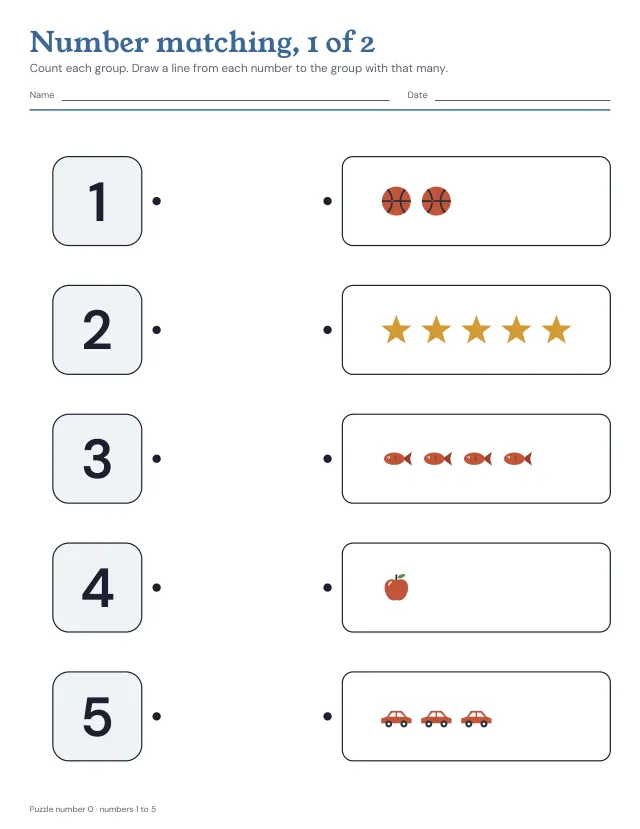
Numbers down one side and groups of pictures down the other, in a shuffled order: count each group and draw a line to its number. The pictures sit in rows of five, as on a ten frame, so seven reads as five and two. Choose the numbers, 1 to 10 or fewer, and the pictures; the answer key follows.
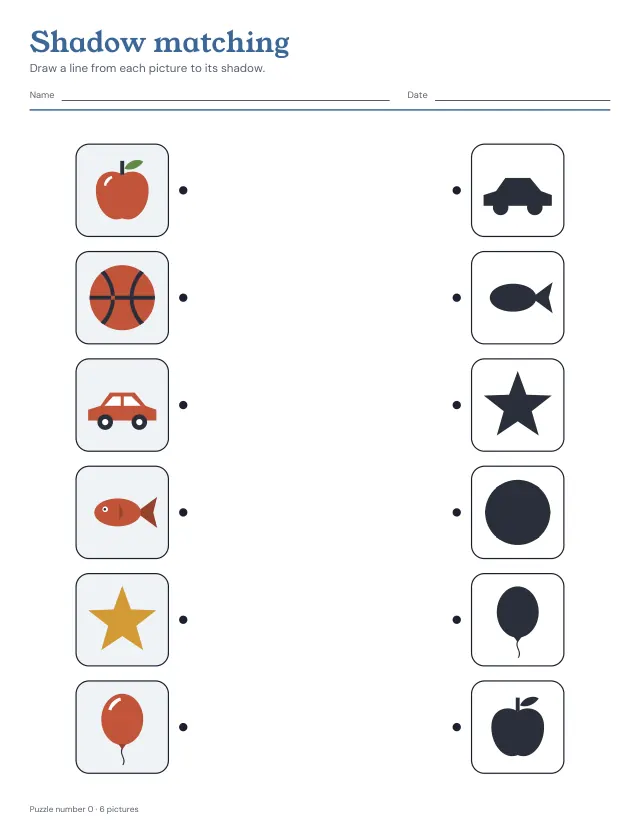
Six pictures down one side and their shadows down the other, in a shuffled order, to join with a line; or the shadows on the page and the pictures to cut out and glue on them. Choose everyday things, Halloween, Christmas, spring or Easter pictures; the answer key follows.
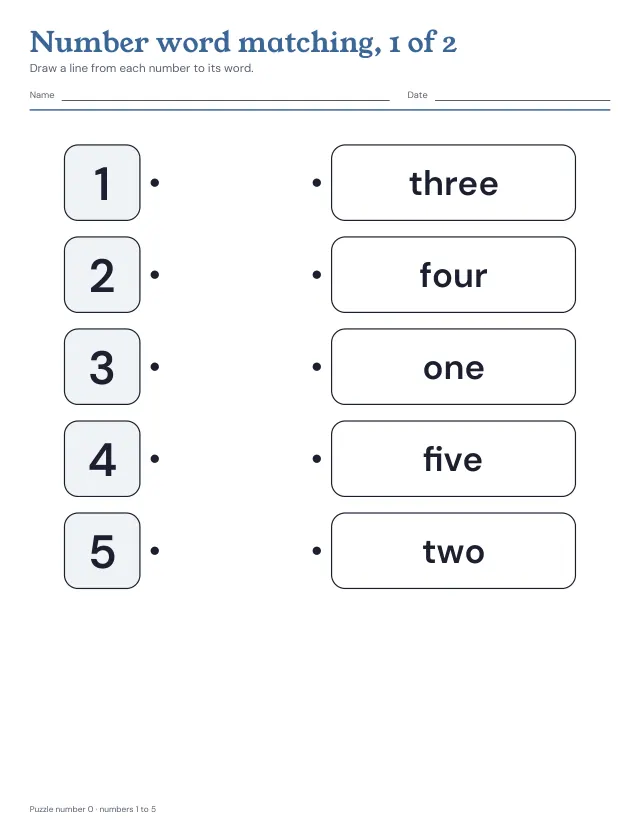
Numbers down one side and their words down the other, in a shuffled order, to join with a line: 3 to three, 15 to fifteen. Choose the numbers, 1 to 10, the teens or any run from 0 to 20, and which way round; seven pairs fit on a page and the answer key follows.
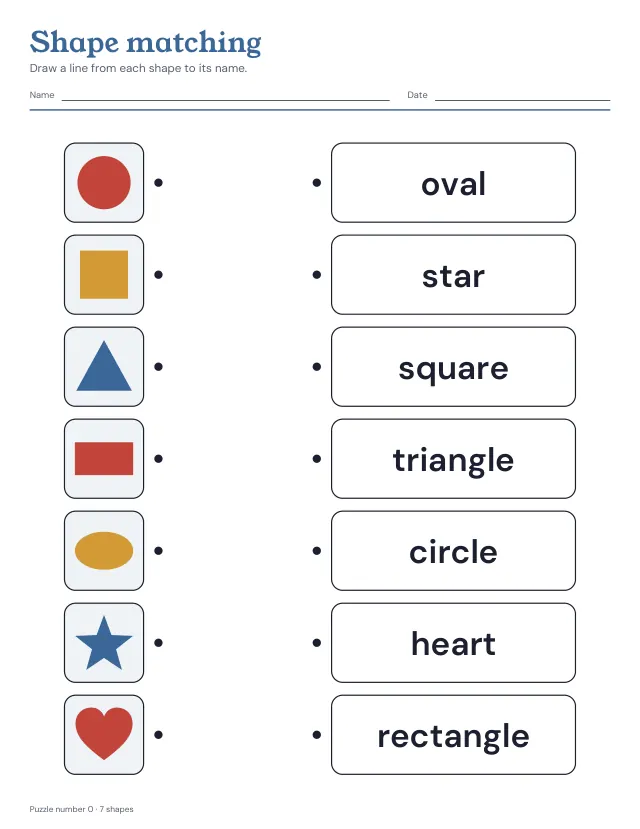
Seven shapes in colour down one side and, in a shuffled order, their names or their outlines down the other, to join with a line. The first shapes: circle, square, triangle, rectangle, oval, star and heart; then hexagon, pentagon, octagon, rhombus, trapezoid, semicircle and crescent. The answer key follows.
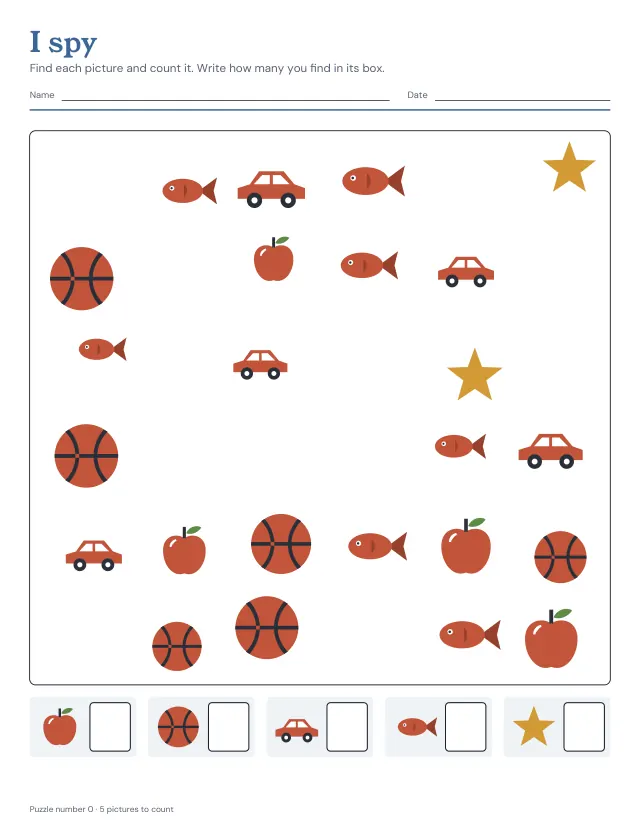
Pictures scattered over the page to find and count, with a box beside each picture at the foot to write how many. Choose everyday things, Halloween, Christmas, spring or Easter pictures and how many to count; the answer key follows, and New pictures makes a fresh sheet.
Pumpkins, bats, ghosts, moons, candy and spider webs scattered over the page to find and count, with a box at the foot to write how many of each. Print a different sheet for every child, with the answer keys after the sheets.
Christmas trees, presents, stars, bells, snowmen and snowflakes scattered over the page to find and count, with a box at the foot to write how many of each. Print a different sheet for every child, with the answer keys after the sheets.
Easter eggs, bunnies, chicks, baskets, flowers and bees scattered over the page to find and count, with a box at the foot to write how many of each. Print a different sheet for every child, with the answer keys after the sheets.
A page crowded with drawings in black outline, and a row of pictures at the foot to find among them, each hidden there once. Choose everyday things, Halloween, Christmas, spring and Easter, or school pictures, and how hard: the harder sheets hide more pictures among more drawings that overlap and slant. The answer key circles every one.
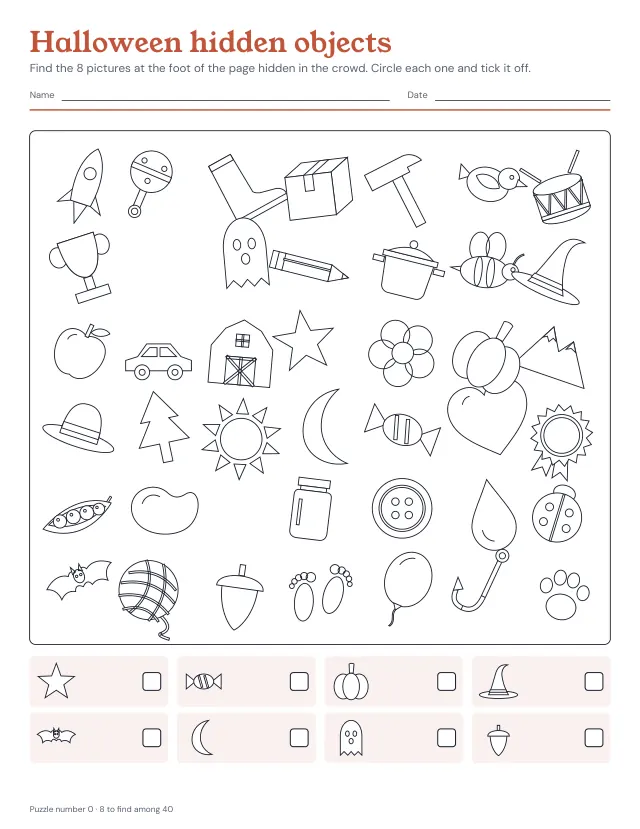
Pumpkins, bats, ghosts, a witch’s hat and a spider web hidden among dozens of drawings in black outline, each once, to find from the row at the foot of the page. Print a different sheet for every child, with the answer keys after the sheets.
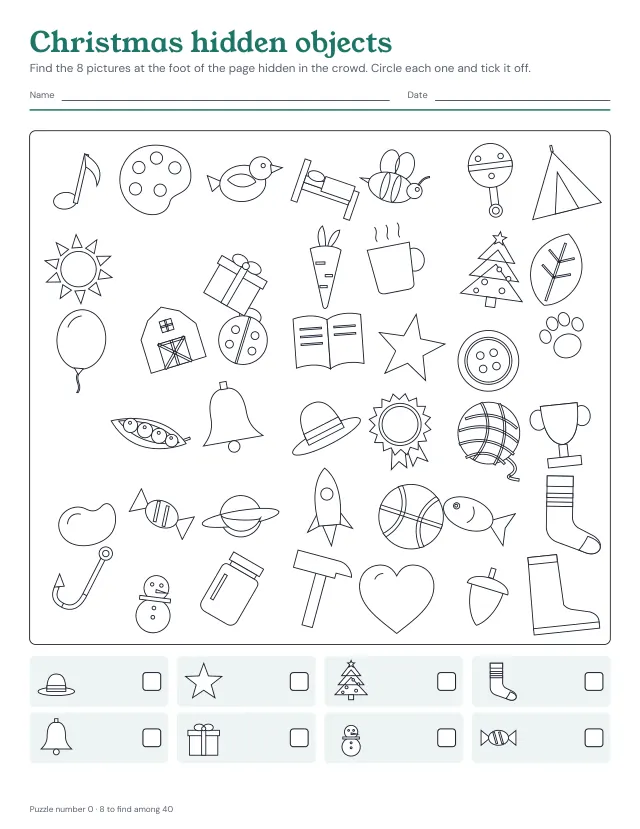
A Christmas tree, presents, bells, a snowman and a stocking hidden among dozens of drawings in black outline, each once, to find from the row at the foot of the page. Print a different sheet for every child, with the answer keys after the sheets.
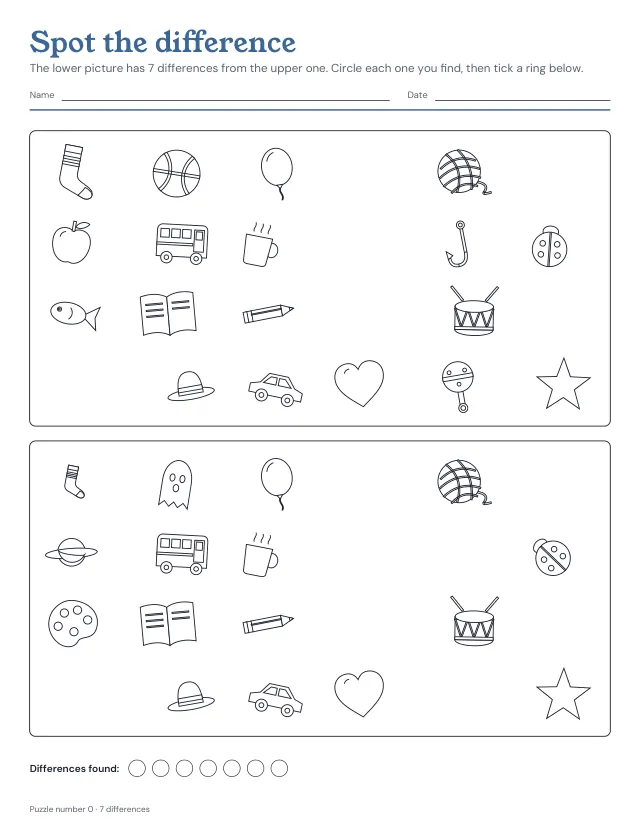
The same picture twice, one above the other, and the lower one is not quite the same: a drawing gone, another in its place, one turned, one smaller. Circle each difference and tick a ring at the foot. Choose 5, 7 or 10 differences and the pictures; the answer key circles every one.
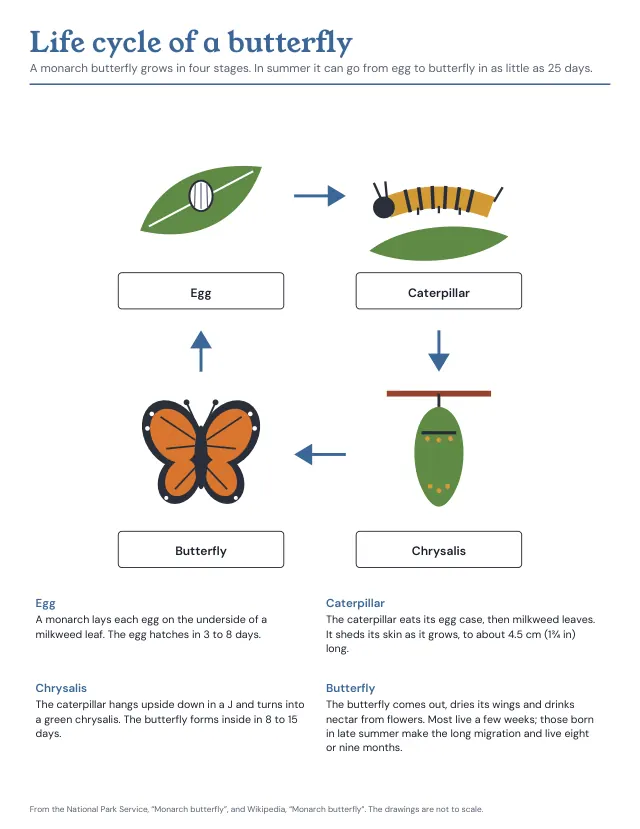
The four stages of a monarch butterfly drawn in a cycle, egg, caterpillar, chrysalis and butterfly, with an arrow from each to the next and what happens at each stage. Print it labelled, to label with a word bank, or with the four pictures to cut out and glue in order; the answer key follows.
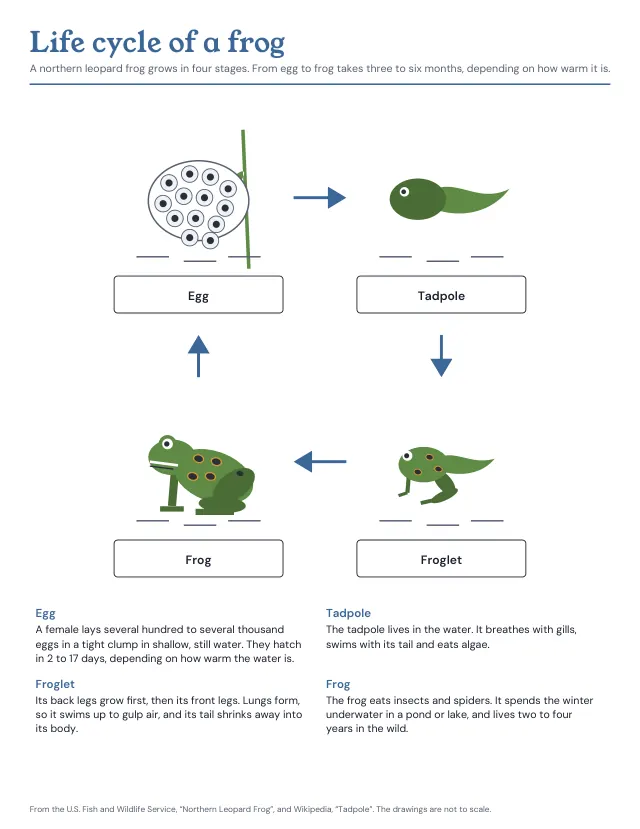
The four stages of a northern leopard frog drawn in a cycle, egg, tadpole, froglet and frog, with an arrow from each to the next and what happens at each stage. Print it labelled, to label with a word bank, or with the four pictures to cut out and glue in order; the answer key follows.
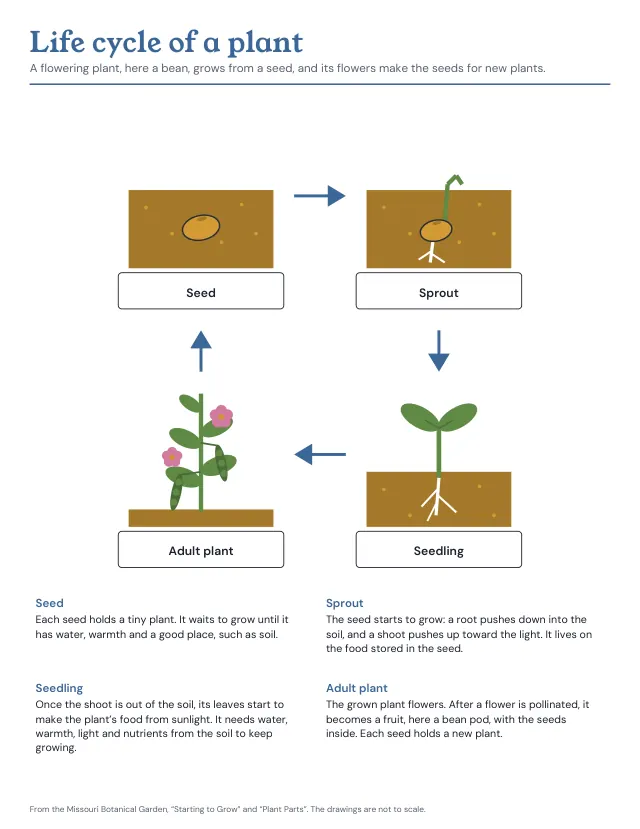
The life cycle of a flowering plant, a bean, drawn in four stages, seed, sprout, seedling and adult plant with its flowers and pods, with an arrow from each to the next and back to the seed. Print it labelled, with what happens at each stage, to label with a word bank, or to cut and glue in order; the answer key follows.
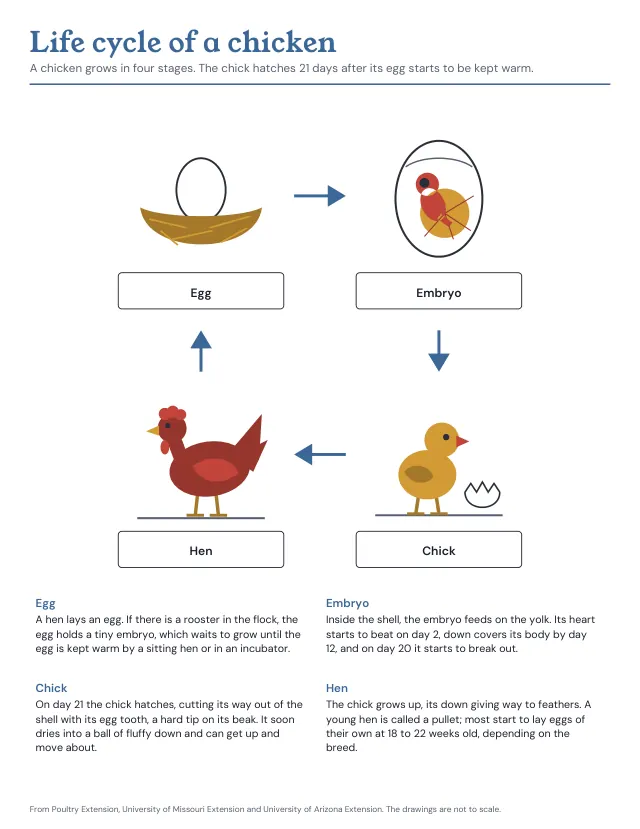
The four stages of a chicken drawn in a cycle, egg, embryo, chick and hen, with an arrow from each to the next and what happens at each stage, the days counted from the egg. Print it labelled, to label with a word bank, or with the four pictures to cut out and glue in order; the answer key follows.
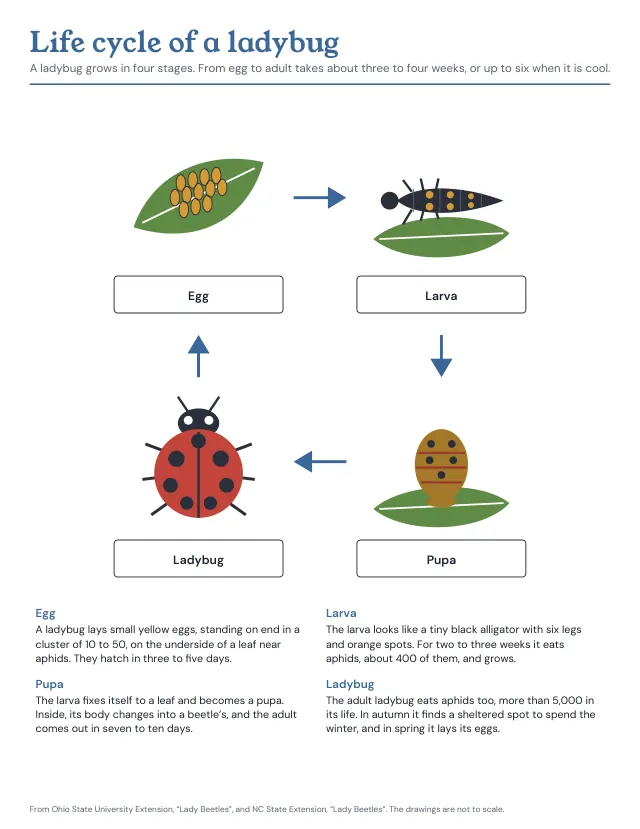
The four stages of a ladybug drawn in a cycle, eggs, larva, pupa and adult, with an arrow from each to the next and what happens at each stage. Print it labelled, to label with a word bank, or with the four pictures to cut out and glue in order; the answer key follows.
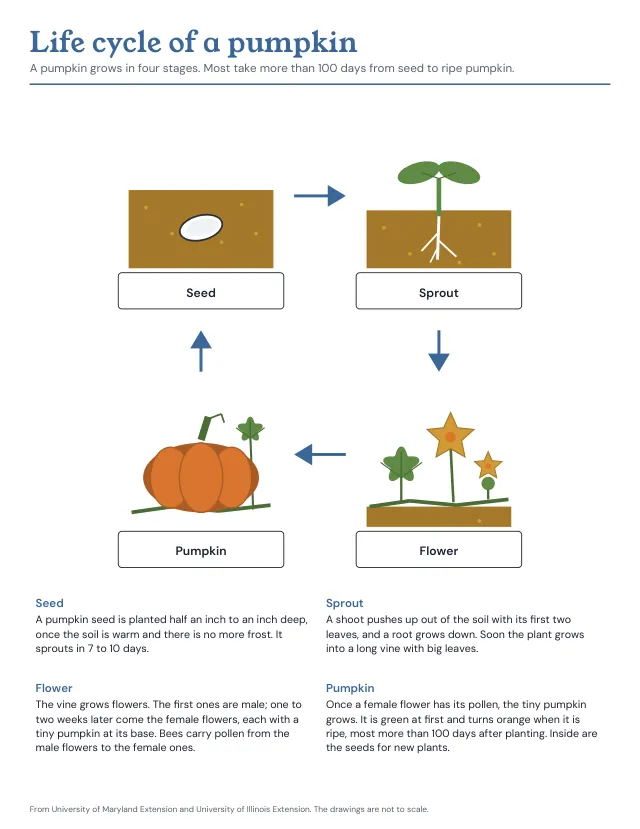
The four stages of a pumpkin drawn in a cycle, seed, sprout, flower and pumpkin, with an arrow from each to the next and back to the seed. Print it labelled, with what happens at each stage, to label with a word bank, or with the four pictures to cut out and glue in order; the answer key follows.
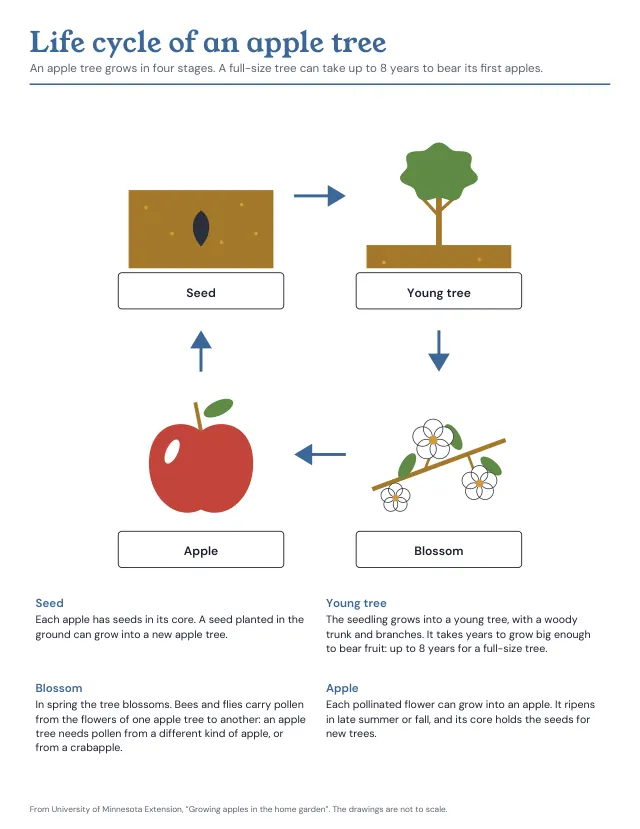
The four stages of an apple tree drawn in a cycle, seed, young tree, blossom and apple, with an arrow from each to the next and back to the seed. Print it labelled, with what happens at each stage, to label with a word bank, or with the four pictures to cut out and glue in order; the answer key follows.
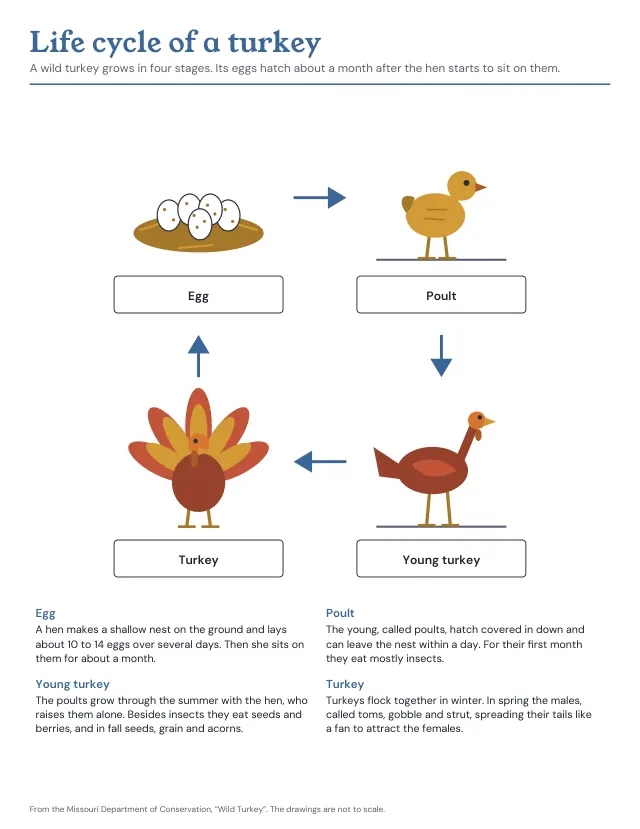
The four stages of a wild turkey drawn in a cycle, eggs in a nest, poult, young turkey and a tom with his tail spread, with an arrow from each to the next and what happens at each stage. Print it labelled, to label with a word bank, or with the four pictures to cut out and glue in order; the answer key follows.
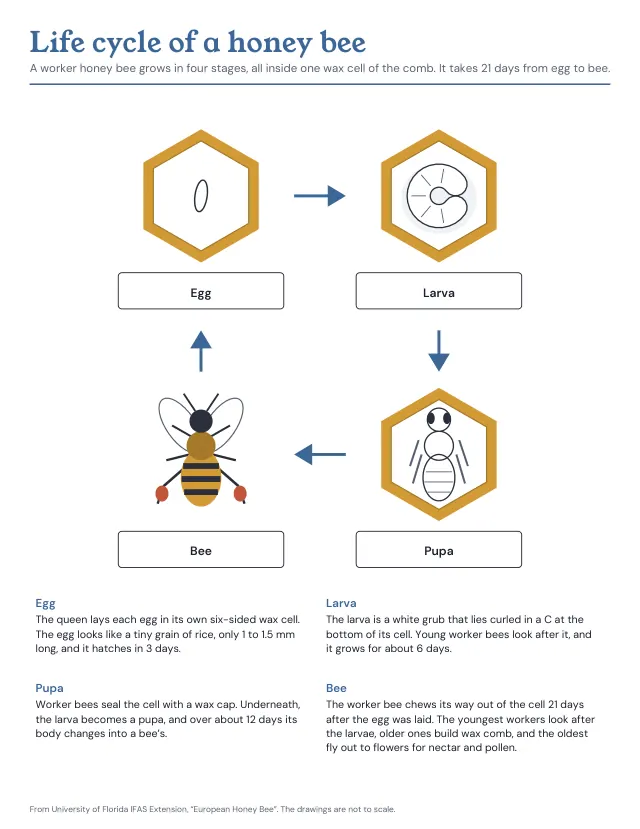
The four stages of a worker honey bee drawn in a cycle, egg, larva, pupa and bee, each in its wax cell, with an arrow from each to the next and what happens at each stage. Print it labelled, to label with a word bank, or with the four pictures to cut out and glue in order; the answer key follows.
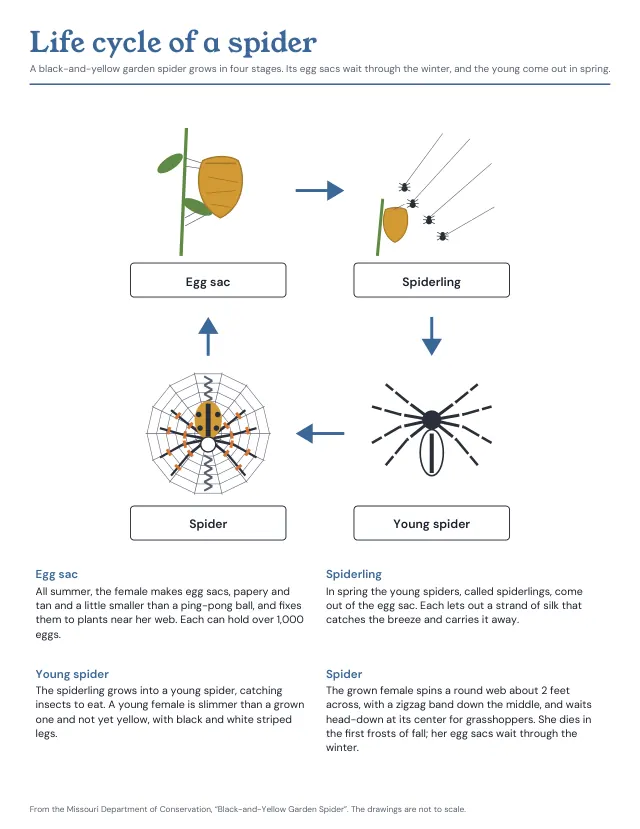
The four stages of a black-and-yellow garden spider drawn in a cycle, egg sac, spiderling, young spider and the grown spider on her web, with an arrow from each to the next and what happens at each stage. Print it labelled, to label with a word bank, or with the four pictures to cut out and glue in order; the answer key follows.
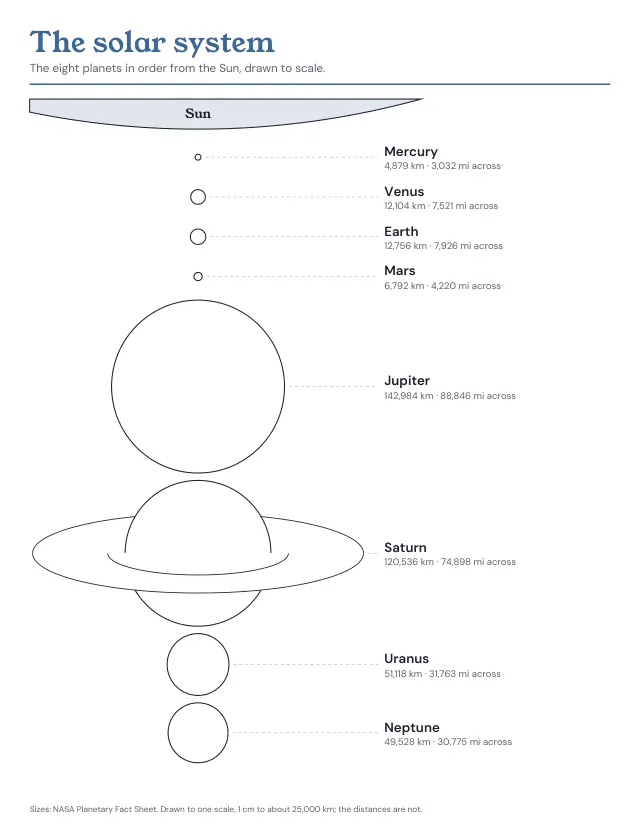
The eight planets in order from the Sun, drawn to one scale down the page, with the edge of the Sun across the top. Print them named with their sizes, with a table of facts, or with the names to write in and an answer key; the planets are left white to colour.
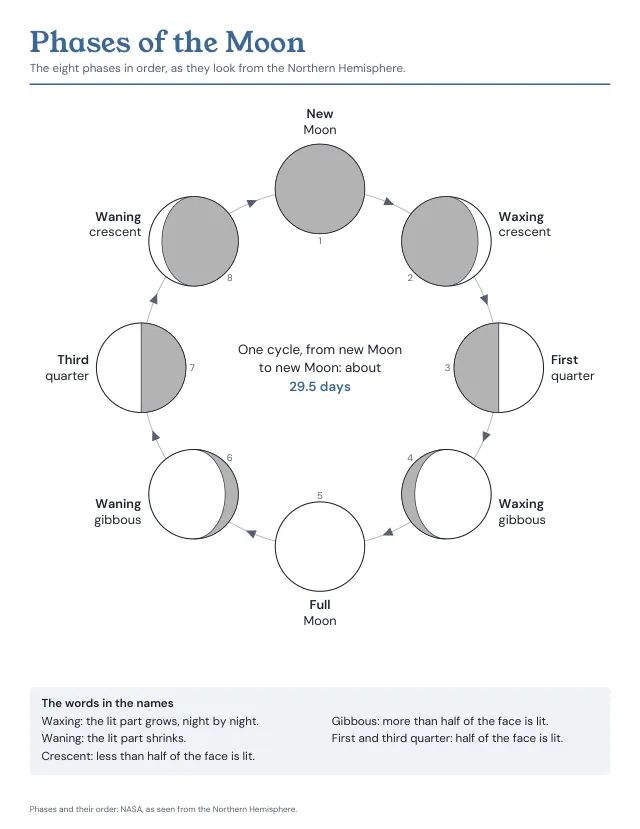
The eight phases of the Moon in order round a ring, from the new Moon to the waning crescent, with the 29.5 days one cycle takes in the middle. Print them named, to name with a word bank and an answer key, or to shade, or print a Moon journal to draw the real Moon on 30 nights.
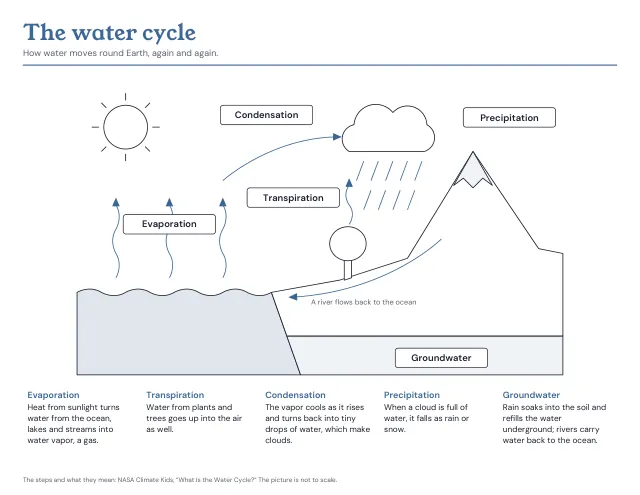
A picture of the water cycle to print: the ocean, the land, a tree, a mountain, a cloud and the Sun, with evaporation, transpiration, condensation, precipitation and groundwater marked on it and what each step means under it. Print it labelled, or with empty boxes and a word bank, and the labelled one after it as the answer key.
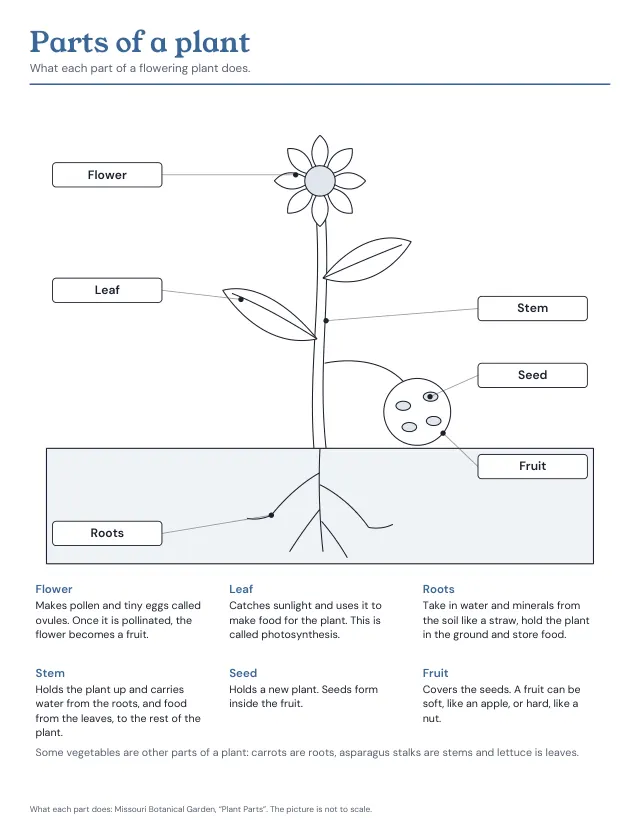
A flowering plant to label and colour: the flower, a leaf, the stem and the roots, and a fruit cut open to show its seeds. Print it labelled, with what each part does, or with empty boxes and a word bank, and the labelled sheet after it as the answer key.
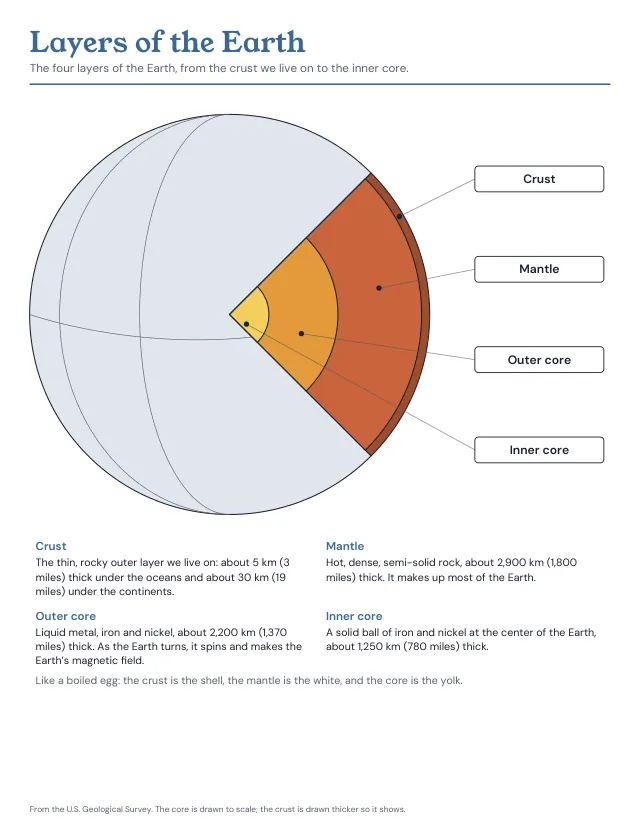
The Earth cut open to show its four layers, the crust, the mantle, the outer core and the inner core, with the core drawn to scale. Print it labelled, with what each layer is and how thick, or with empty boxes and a word bank, and the labelled sheet after it as the answer key. For grades 6 to 8, the same sheets come with six layers, the lithosphere and the asthenosphere added.
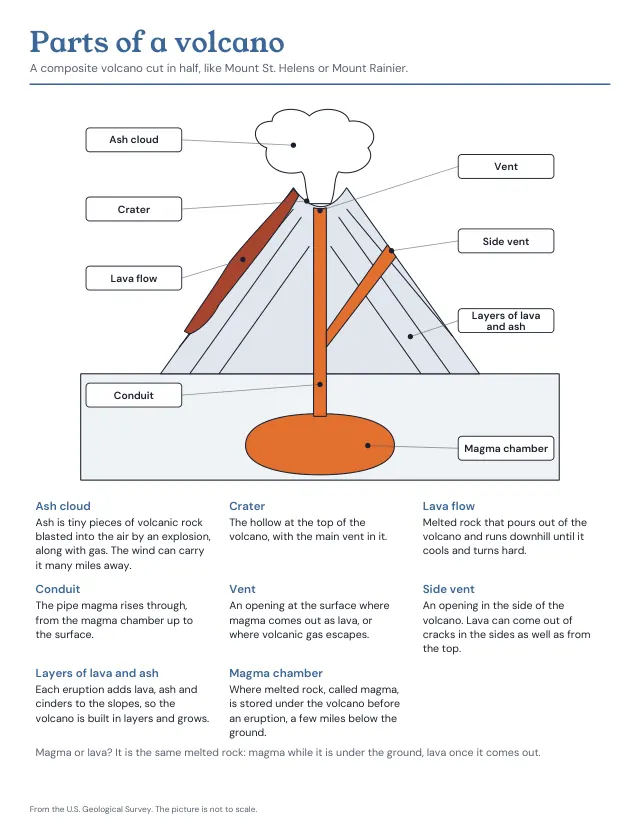
A volcano cut in half to show its eight parts: the magma chamber, the conduit, the vent and the crater, a side vent, a lava flow, the ash cloud and the layers it is built of. Print it labelled, with what each part is, or with empty boxes and a word bank, and the labelled sheet after it as the answer key. A second sheet draws the four kinds of volcano side by side: a cinder cone, a composite volcano, a shield volcano and a lava dome.
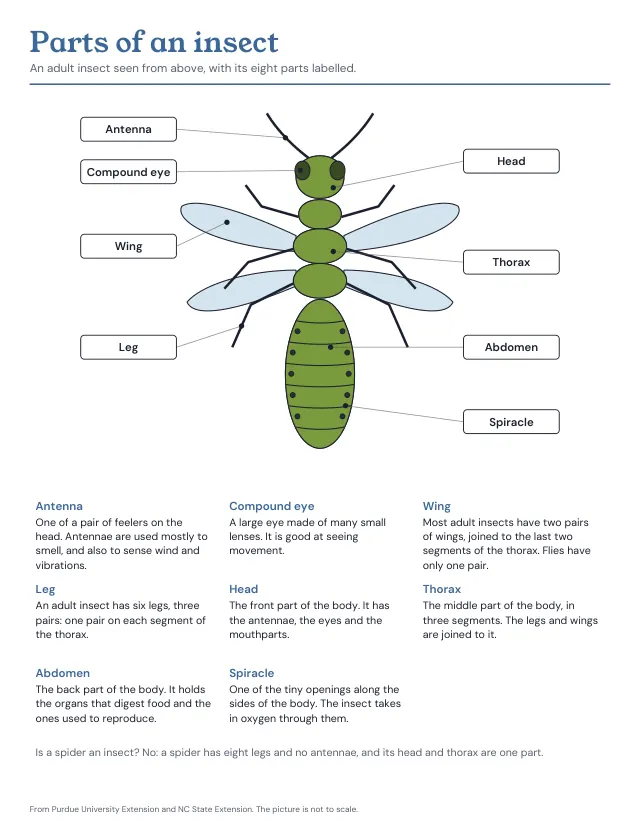
An adult insect seen from above, with its eight parts to learn: the head, an antenna, a compound eye, the thorax and the abdomen, a leg, a wing and the spiracles it breathes through. Print it labelled, with what each part is, or with empty boxes, a word bank and three questions, and the labelled sheet after it as the answer key.
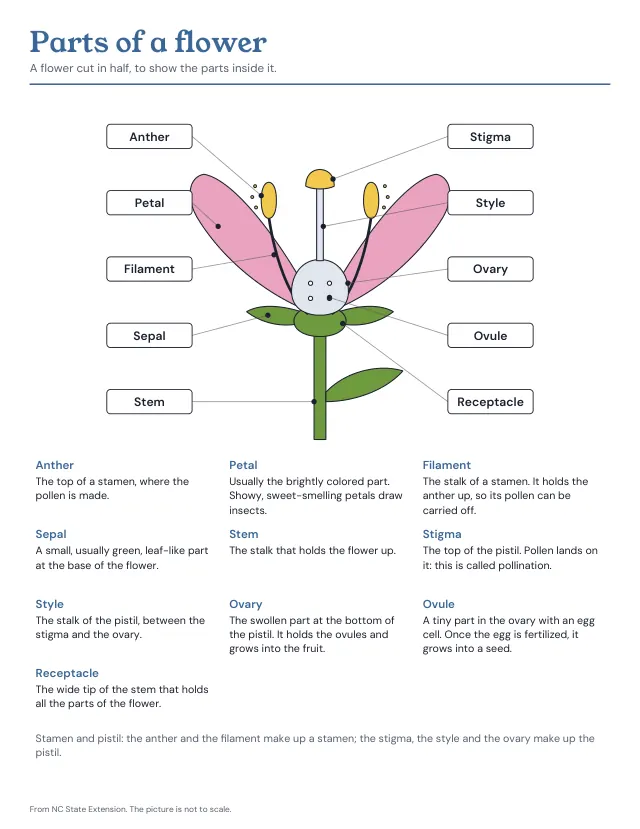
A flower cut in half to show its ten parts: the petal, the sepal, the anther and the filament of a stamen, the stigma, the style and the ovary of the pistil, the ovules inside it, the receptacle and the stem. Print it labelled, with what each part is, or with empty boxes, a word bank and four questions, and the labelled sheet after it as the answer key.
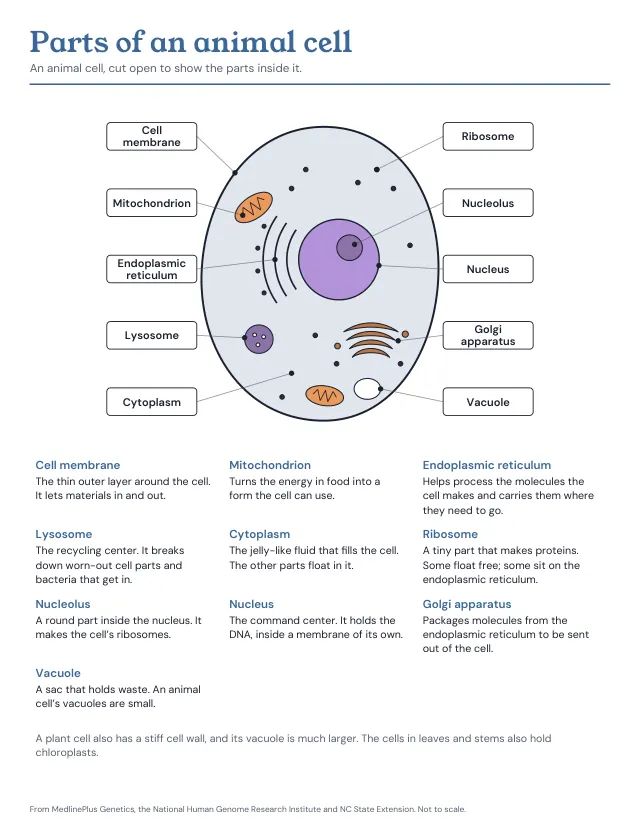
An animal cell and a plant cell, each cut open to show ten parts. Both have a cell membrane, cytoplasm, a nucleus, mitochondria, ribosomes, the endoplasmic reticulum, the Golgi apparatus and a vacuole; the animal cell also shows the nucleolus and a lysosome, the plant cell its cell wall and chloroplasts. Print either one labelled, with what each part is; to label, with empty boxes, a word bank and three questions; or with the names to cut out and glue in. The labelled sheet follows as the answer key.
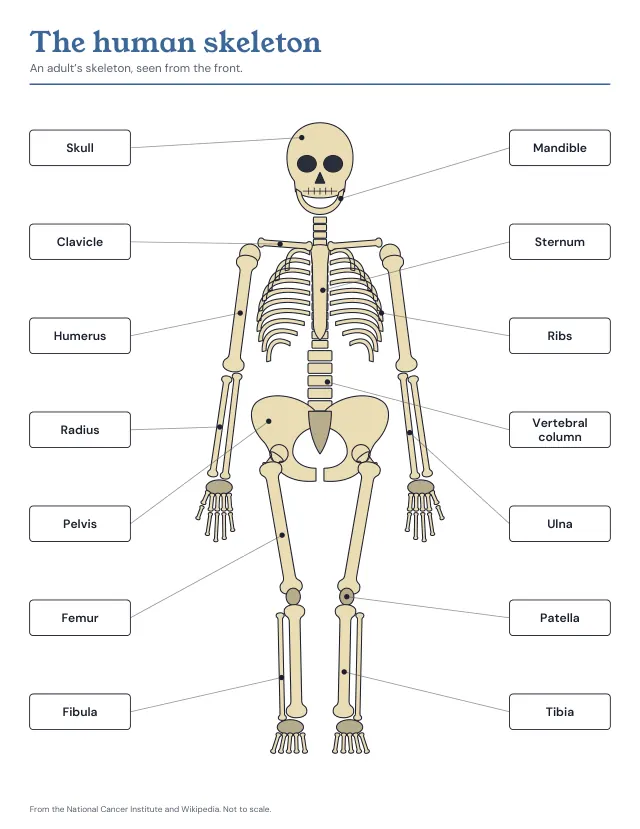
An adult’s skeleton seen from the front, with fourteen bones to name: the skull and the mandible; the clavicle, the sternum and the ribs; the vertebral column and the pelvis; the humerus, the radius and the ulna in the arm; and the femur, the patella, the tibia and the fibula in the leg. Print it labelled, with what each bone is; to label, with empty boxes, a word bank that gives each bone’s everyday name and three questions; or with the names to cut out and glue in. The labelled sheet follows as the answer key.
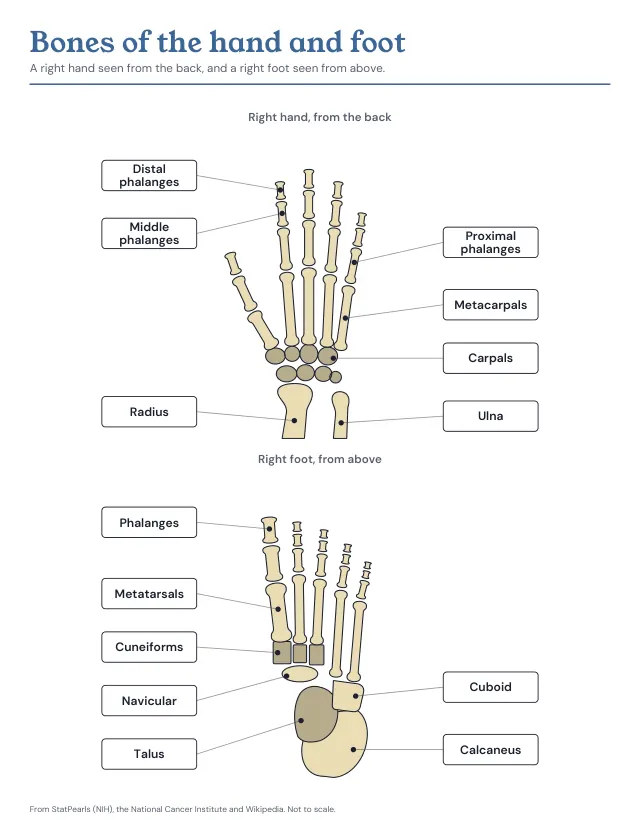
A right hand seen from the back and a right foot seen from above, with fourteen bones and groups of bones to name, from the fingertips to the heel bone. Print it labelled, to label with a word bank, or to cut and glue; the labelled sheet is the answer key.
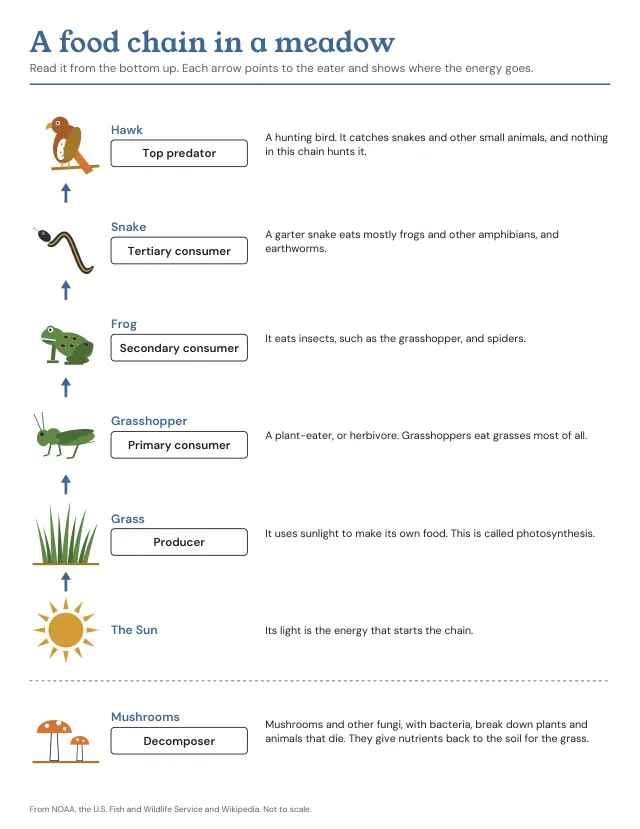
Two food chains, each read from the bottom up. In a meadow: the Sun, grass, a grasshopper, a frog, a snake and a hawk, with the mushrooms that break down whatever dies. In a kelp forest: the Sun, kelp, sea urchins and sea otters, with bacteria. Print either one labelled; to label, with a word bank and three questions; or to cut and glue in order. The labelled sheet follows as the answer key.
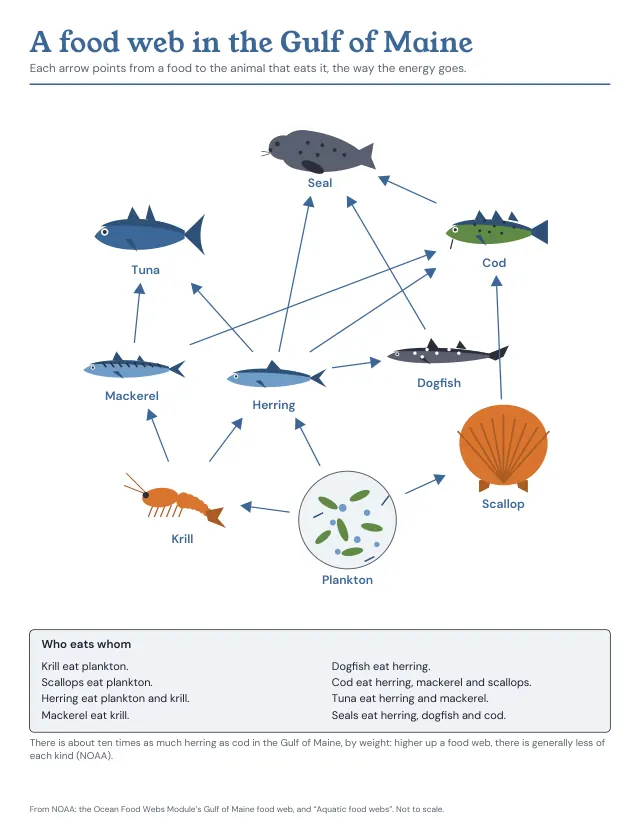
NOAA’s food web for the Gulf of Maine: plankton, krill, scallops, herring, mackerel, dogfish, cod, tuna and seals, each arrow from a food to the animal that eats it. Print it labelled, with five questions, or with the arrows left out to draw from the clues. The labelled sheet is the answer key. Or draw your own web, from a place you know.
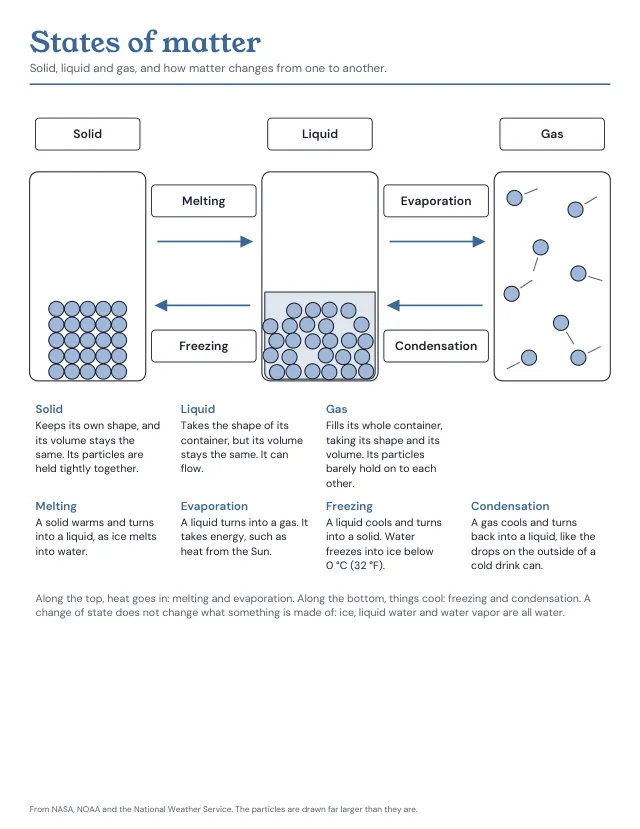
A solid, a liquid and a gas, each drawn with its particles in the same closed container, and the four changes between them. Print it labelled, to label, to cut and glue, or to sort twelve everyday things, each with its key.
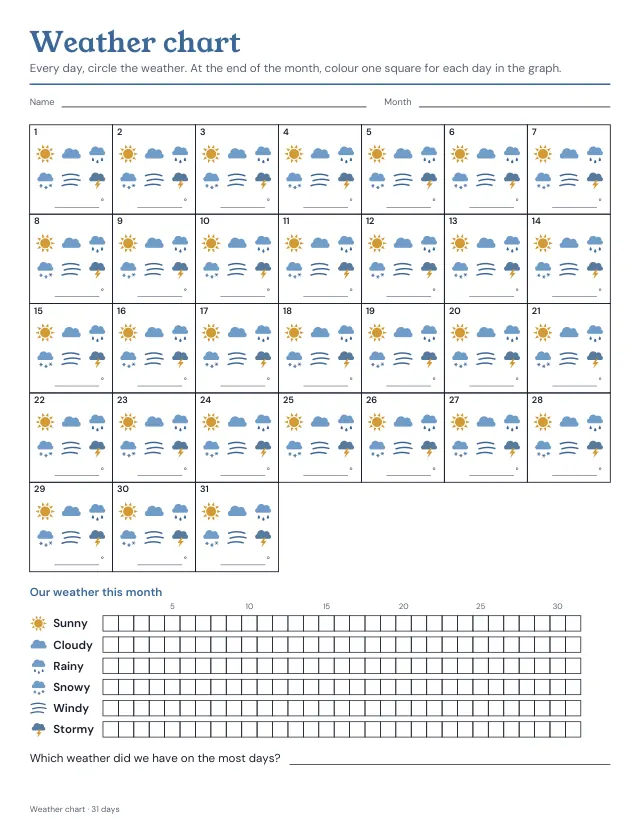
Five weather sheets for young children: a chart to circle the weather every day for a month, or every school day, with a graph at the foot to count it up; a year of weather, a square to colour for every day; today’s weather, with a thermometer to colour; and the weather words to match to their pictures, with the answer key.
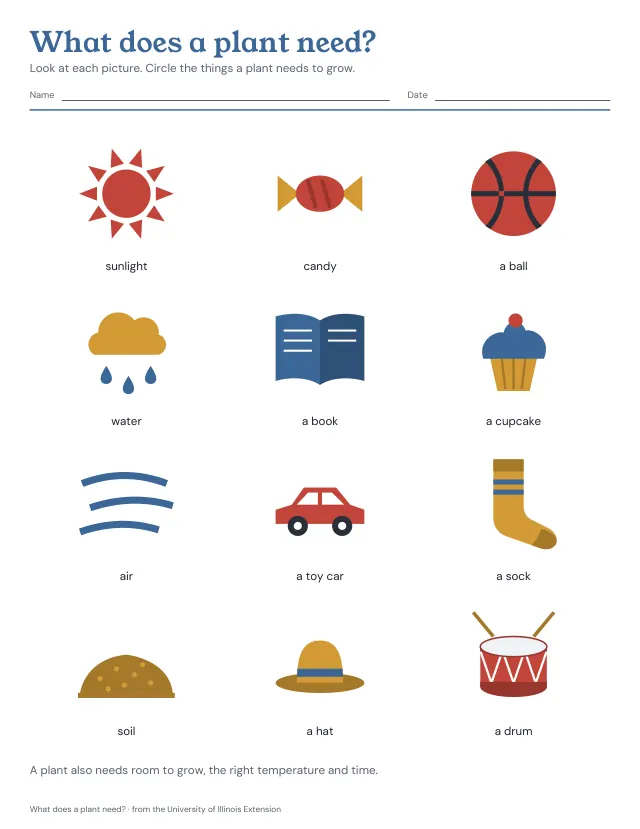
What a plant needs to grow, three ways: twelve pictures to circle the things a plant needs, with the key; the seven needs round a seedling in its pot, labelled or to label; and a two-week test of whether a plant needs light.
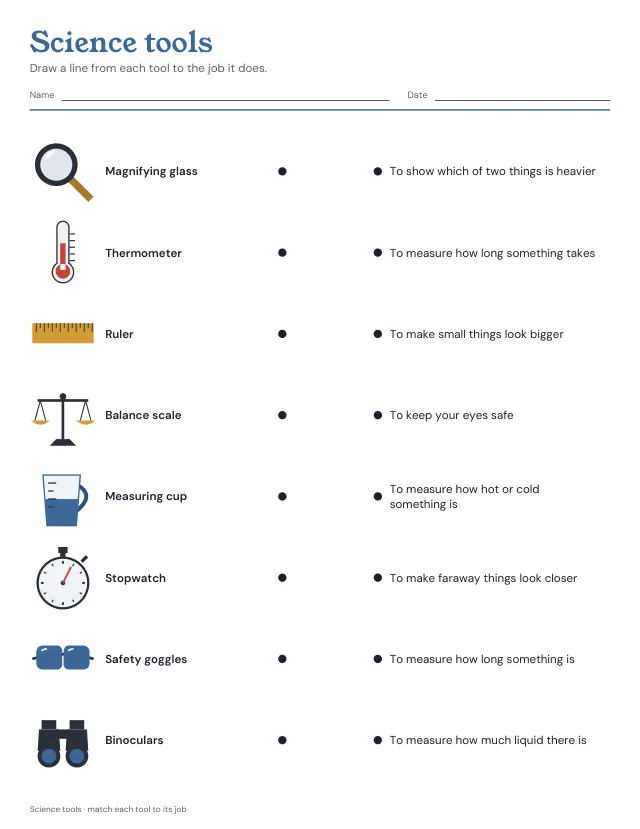
Eight tools a young scientist uses, from a magnifying glass to a balance scale and a stopwatch: match each tool to its job, write each tool’s name from a word bank, or print the chart of all eight with what each is for. Answer keys follow.
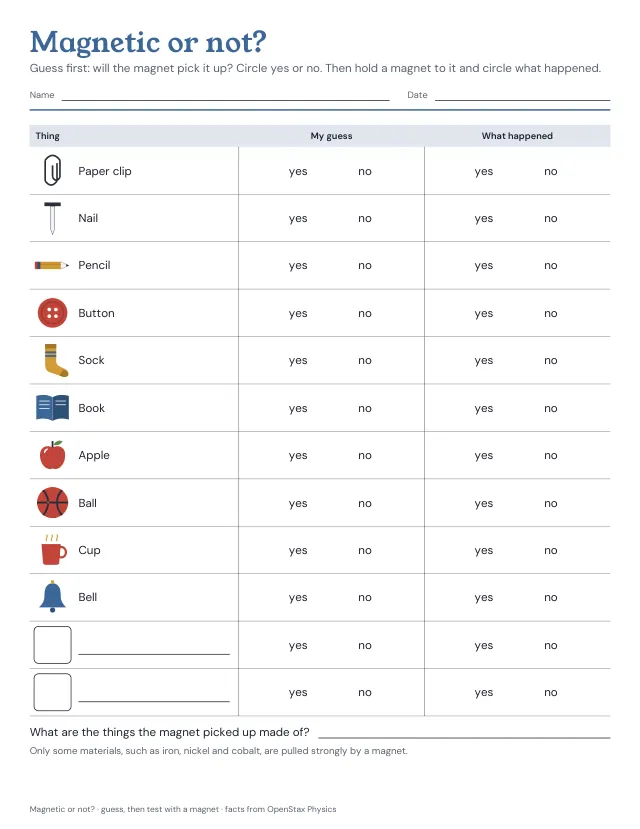
Three magnet sheets: things to guess about and then test with a magnet; pairs of bar magnets to mark attract or repel, with the answer key; and a bar magnet with its poles, its field lines and the paper clips at its ends, labelled or to label.
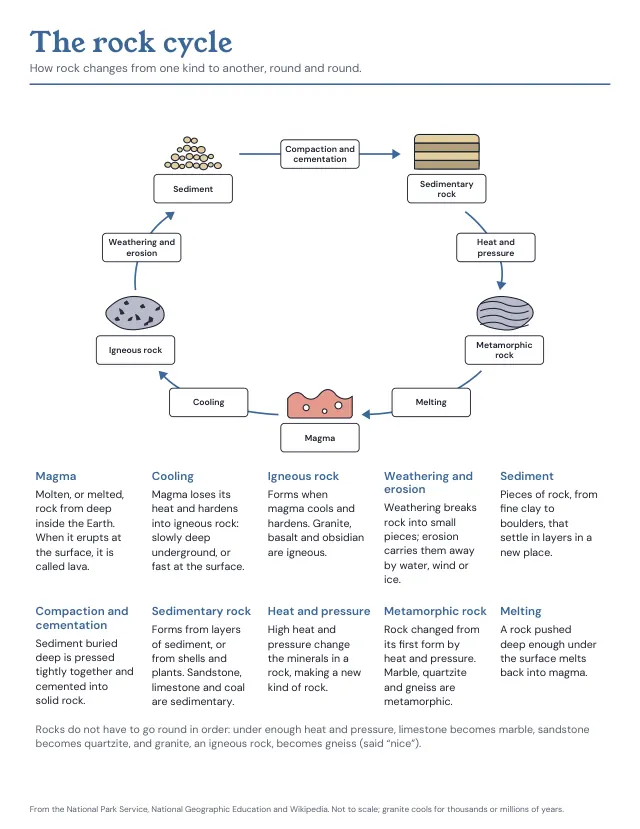
Magma, igneous rock, sediment, sedimentary rock and metamorphic rock round one loop, with the change between each on its arrow. Print it labelled, to label, to cut and glue, or to sort, each with its key.
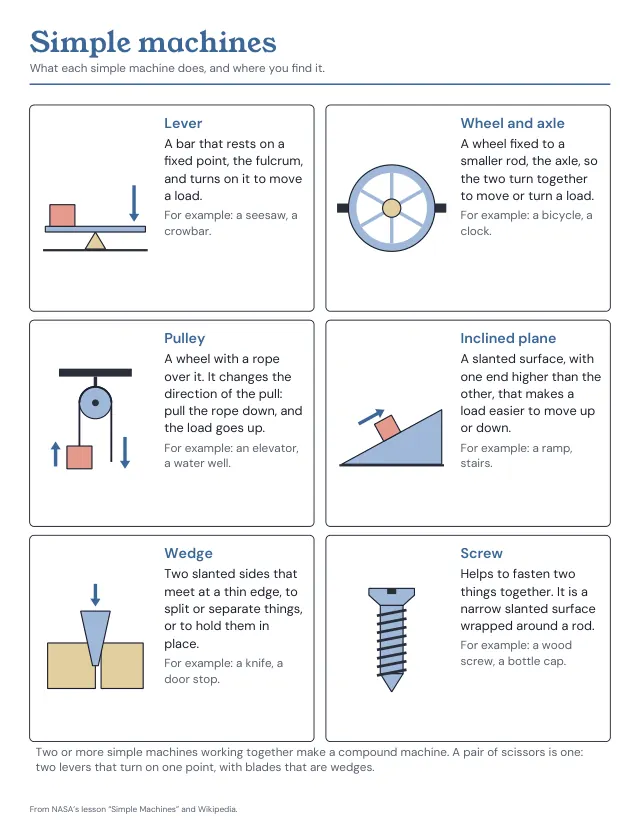
The lever, wheel and axle, pulley, inclined plane, wedge and screw, each drawn to show how it works, with what it does and where you find it. Print the chart, the sheet to label or to match, each with its answer key, or a hunt for one of each at home or at school.
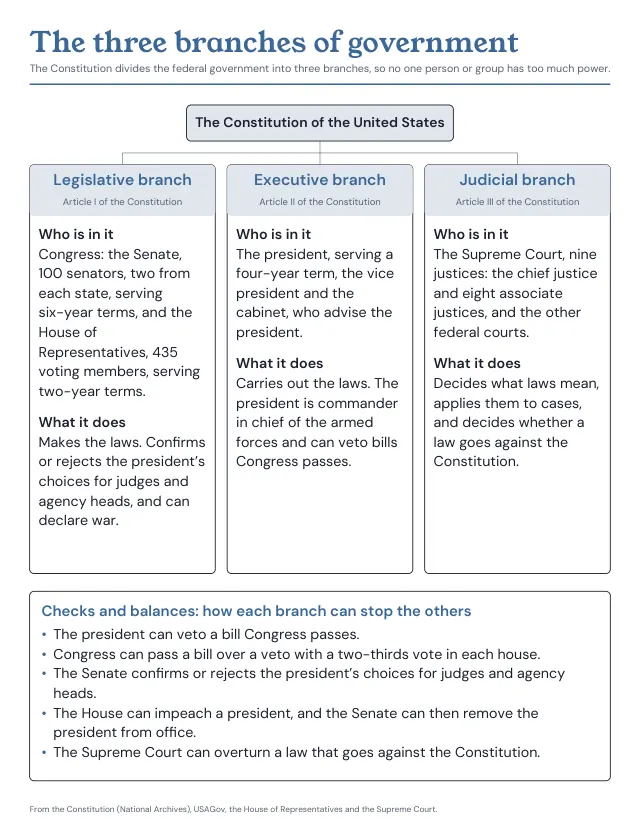
The legislative, executive and judicial branches under the Constitution, each with the article that sets it up, who is in it and what it does, and the checks each branch holds on the others. Print the chart, or the worksheet with a word bank and the chart after it as the answer key.
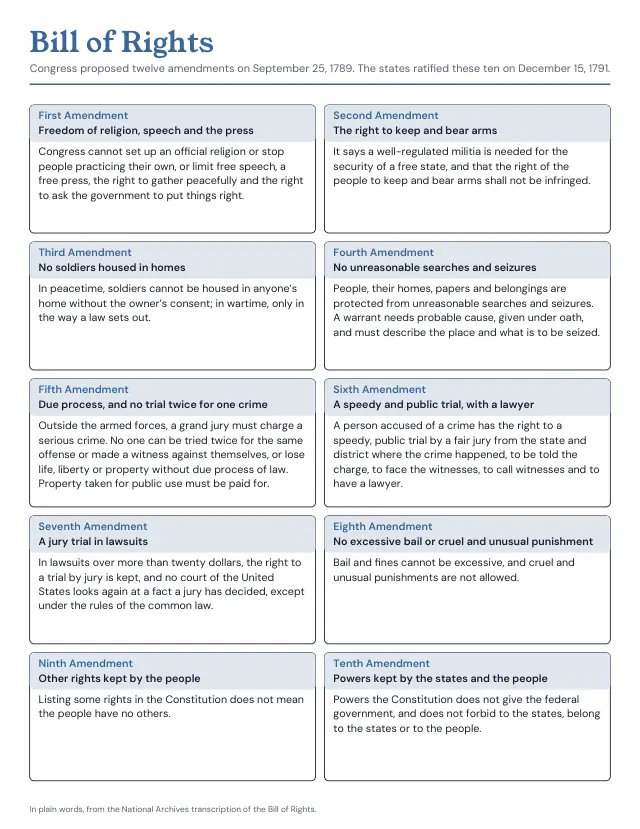
The first ten amendments to the Constitution, each with what it protects and what it says in plain words. Print the chart, the worksheet with a word bank and the chart after it as the answer key, or a sheet to put each amendment in your own words.
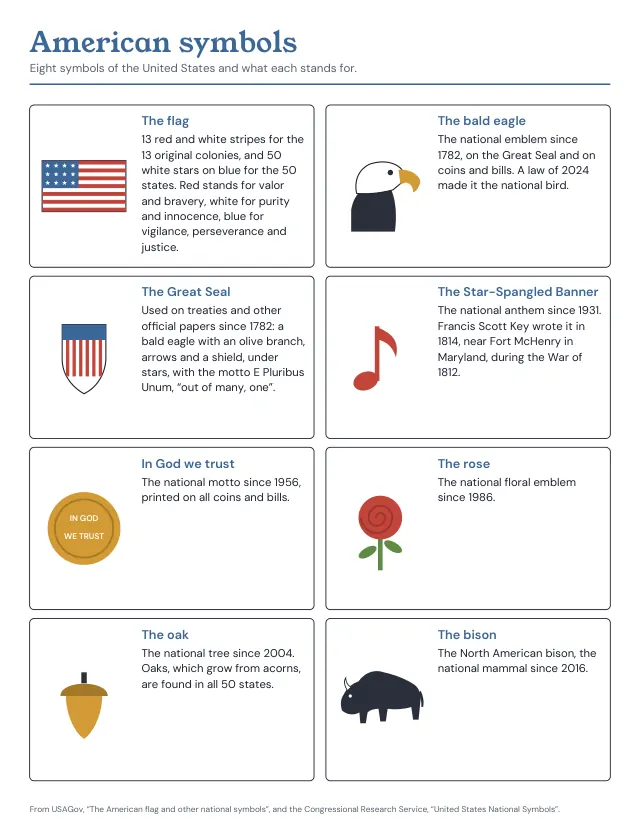
Eight symbols of the United States, each drawn here with what it stands for: the flag, the bald eagle, the Great Seal, the national anthem, the motto, the rose, the oak and the bison. Print the chart, or the matching worksheet with the chart after it as the answer key.
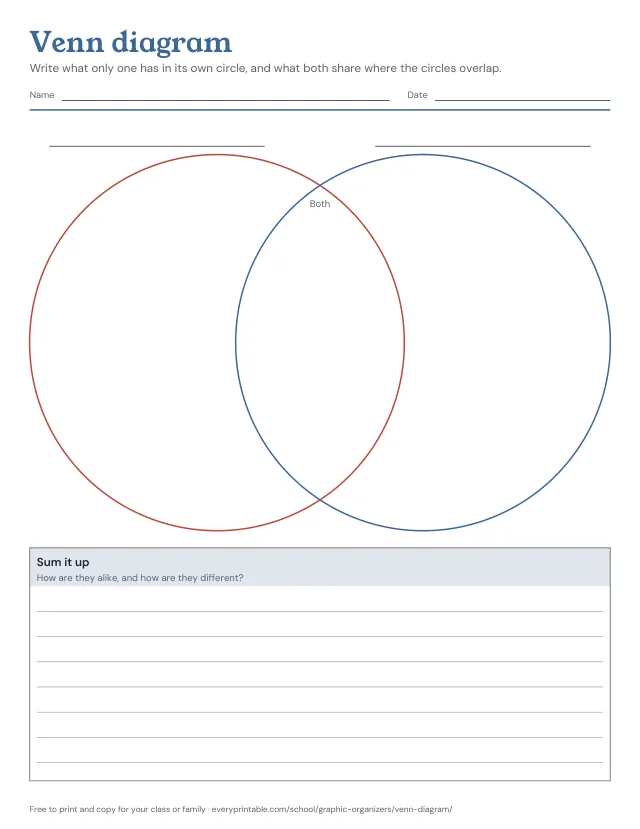
Two overlapping circles to compare two things: what only one has goes in its own circle, what both share goes where they overlap. Or three circles for three things. Type the names, or leave lines to write them on.
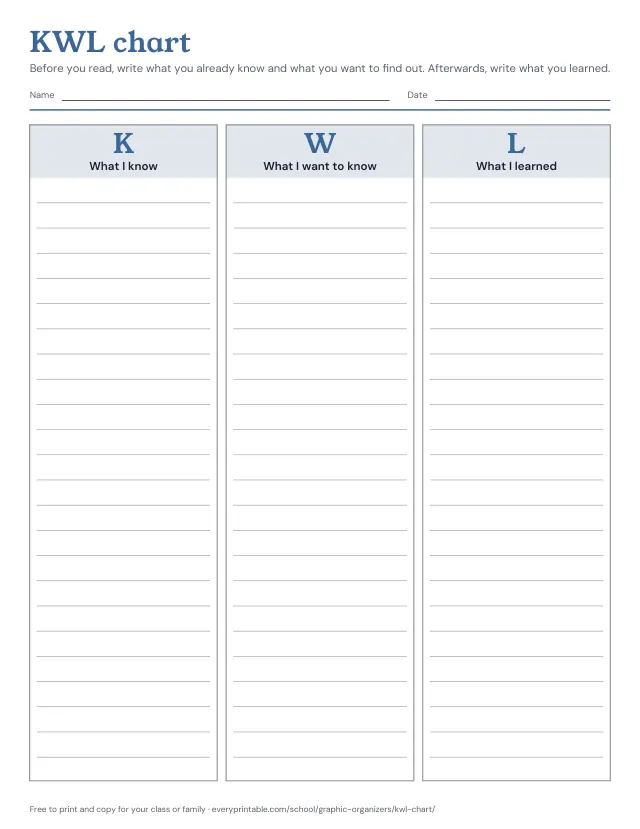
Three columns for a topic: what the reader already knows (K), what they want to find out (W) and, after reading, what they learned (L).
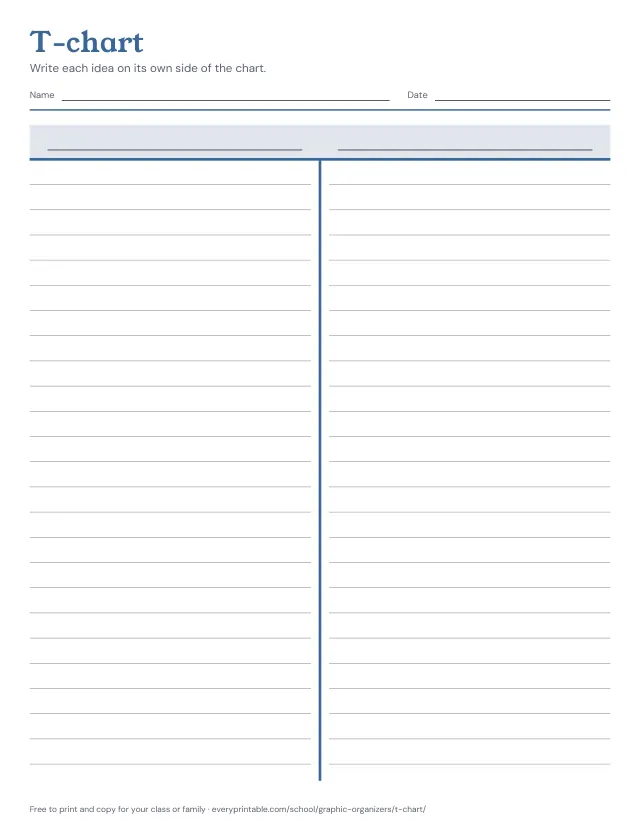
A T-chart splits the page into two columns under two headings, to sort ideas side by side: pros and cons, facts and opinions, before and after.
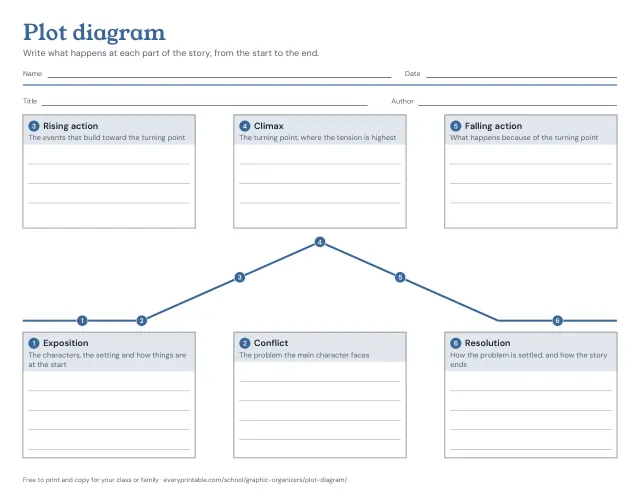
The plot of a story drawn as a mountain: the exposition and the conflict, the rising action, the climax at the top, the falling action and the resolution, each with its own box to write in.
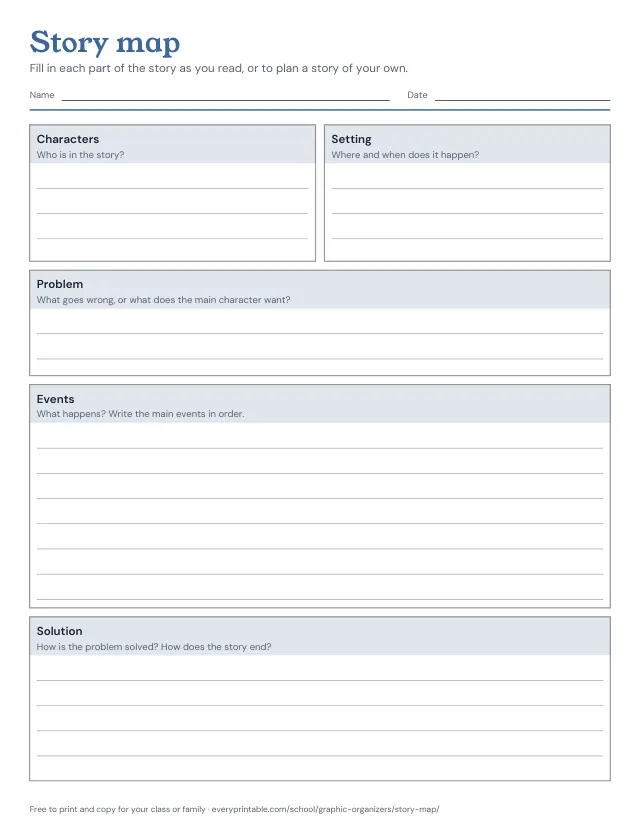
The parts of a story on one page: who is in it, where and when it happens, the problem, the main events and how it ends. For younger readers, beginning, middle and end, each with a box to draw in.
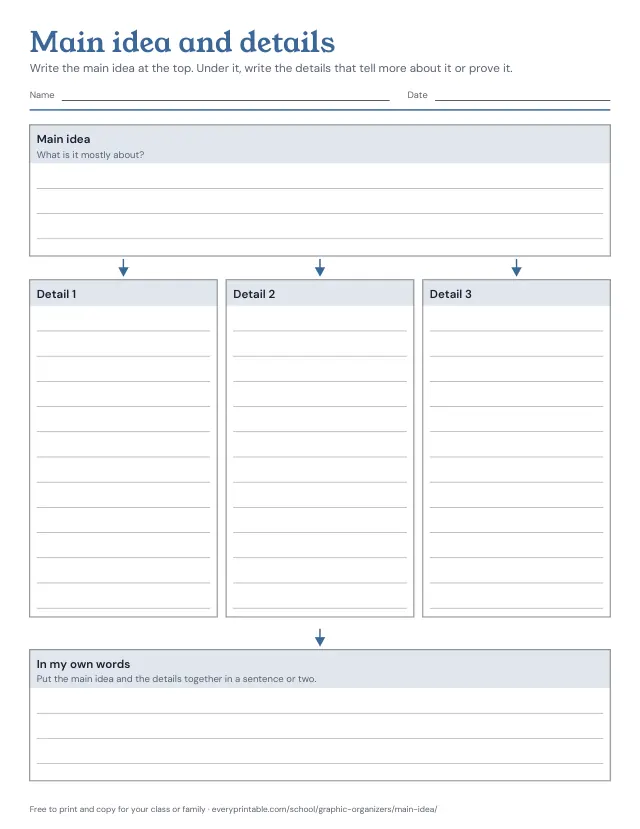
The main idea in a box at the top, the details that support it underneath, and room at the bottom to put it all in your own words.
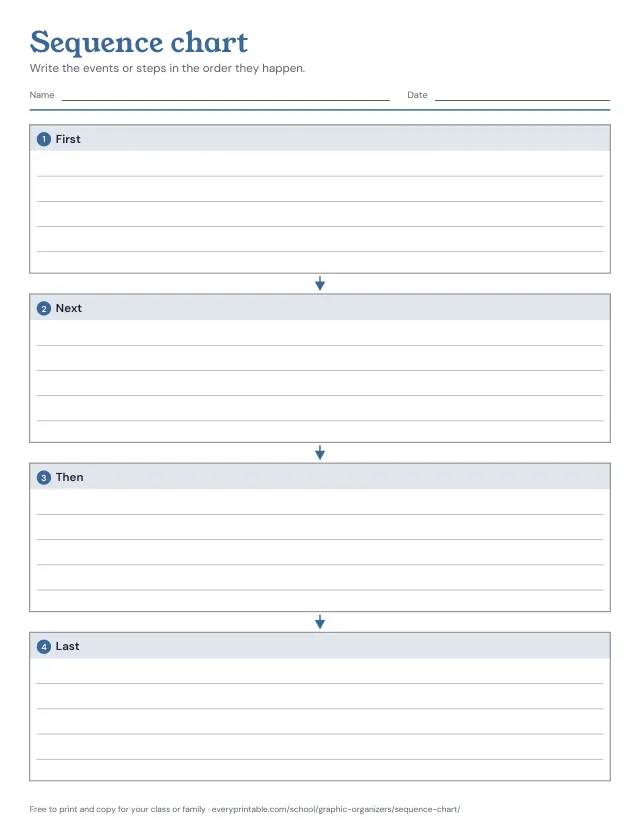
Boxes joined by arrows for events or steps in order: first, next, then, last, or five or six numbered steps.
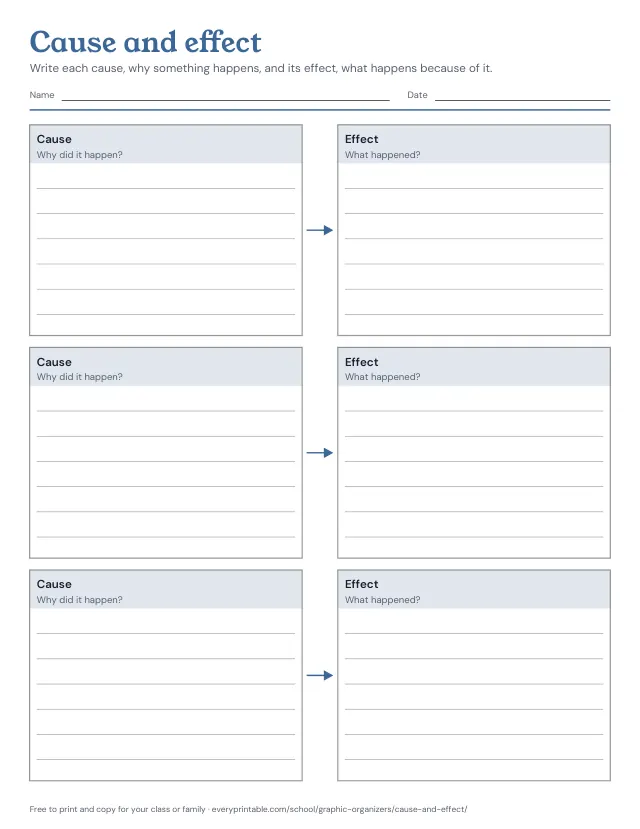
Boxes joined by arrows for what happened and why: three causes each with its effect, one cause with three effects, or three causes of one effect.
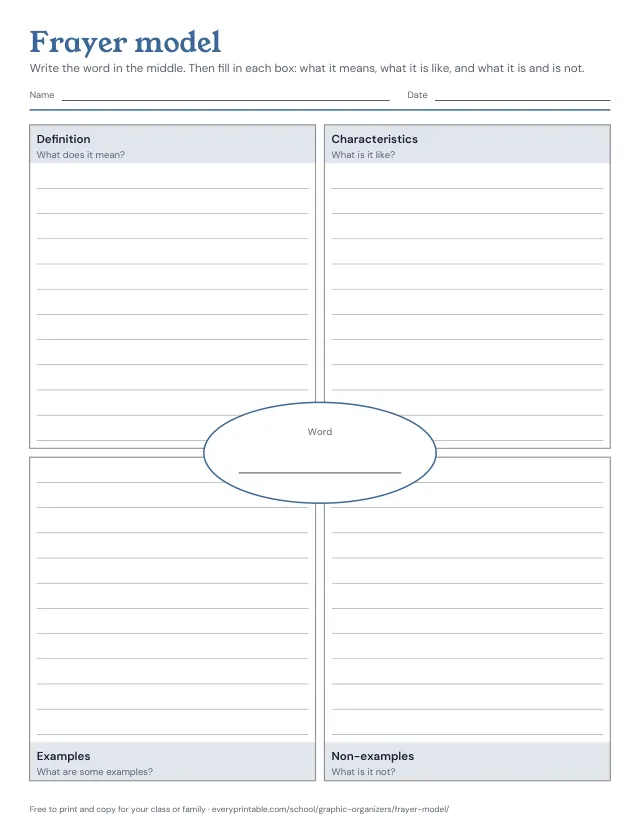
A vocabulary organizer: the word in the middle, and four boxes for what it means, what it is like, examples and non-examples.
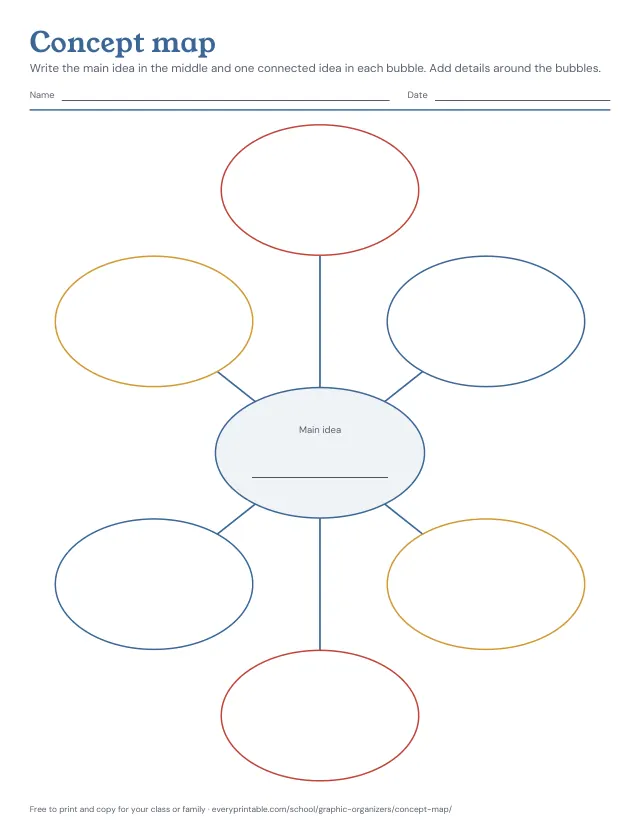
A main idea in the middle, joined to four, six or eight bubbles for the ideas connected to it: for brainstorming, planning a piece of writing or reviewing a topic.
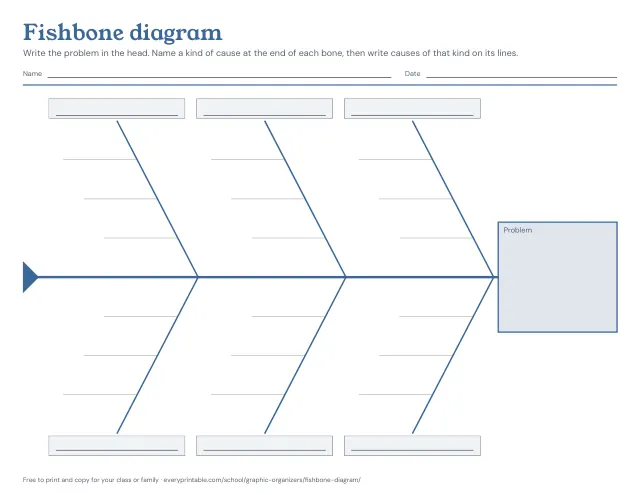
A fishbone (Ishikawa) diagram for finding the causes of a problem: the problem in the head, a kind of cause at the end of each bone and the causes along it.
No sheets match that. Try a shorter word.