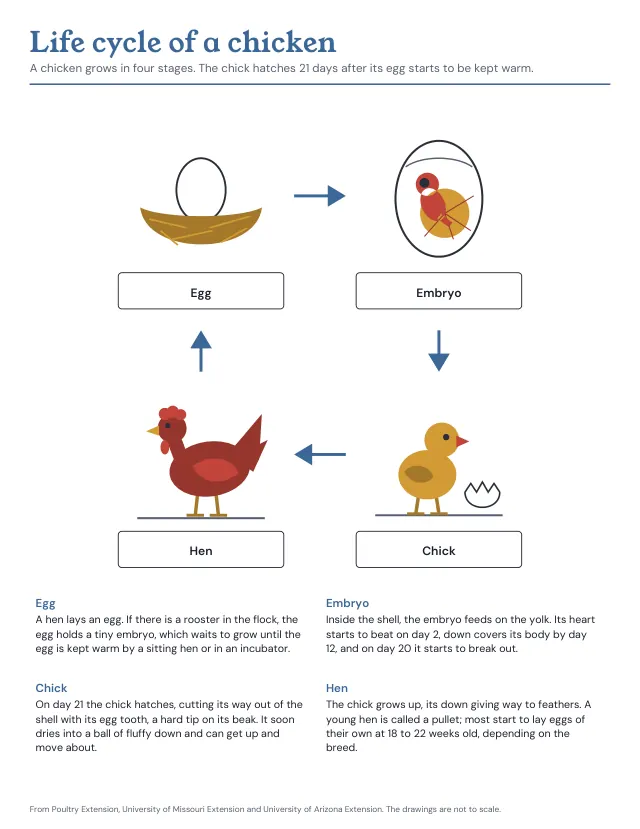
The four stages of a chicken drawn in a cycle, egg, embryo, chick and hen, with an arrow from each to the next and what happens at each stage, the days counted from the egg. Print it labelled, to label with a word bank, or with the four pictures to cut out and glue in order; the answer key follows.
What you will print
215.9 mm · 8.5 in279.4 mm
1 page · US Letter · Portrait
US Letter · 1 page
Free, with no account, email or watermark. Print at 100% or Actual size.
Make it yours
Paper size, margins and lines
Add to a planner refill
Opens the refill builder with this sheet in your page order, at your planner size.
The labelled sheet explains the four stages and when each comes. To label, a child writes egg, embryo, chick or hen in each box, with the word bank under the pictures. To cut and glue, the child cuts out the four pictures and glues them in order, following the arrows from the egg in box 1: a good first sheet for a child who is not yet writing. To cut and glue prints the labelled sheet after it as the answer key, and so does To label, then the answer key. The hatch log is for a class hatching eggs: a row for each of the 21 days, with a box for each turn, the temperature, and what is forming inside the egg that day.
Hatching eggs in class
Eggs from a grocery store are no good for hatching: most are not fertile, because a hen lays fertile eggs only when there is a rooster in the flock. A chicken egg takes 21 days to hatch, sometimes a few hours more, and 21 days is exactly three weeks, so eggs set in the incubator on a Monday are due on a Monday, not over a weekend. Wash hands after touching the eggs or the chicks. This follows University of Missouri Extension and Poultry Extension.
Turning the eggs
If the incubator does not turn the eggs, mark each one with an X on one side and an O on the other, so you can see which way up it is. Turn them at least three times a day: first thing in the morning, last thing at night, and once or twice in between, an odd number of times if you can; on Letter or A4 the hatch log has a box for each of five turns. Stop on day 18, when the chick starts to move into place to hatch. This follows Poultry Extension and University of Missouri Extension.
The last days before the hatch
On day 17 or 18, three or four days before the hatch, candle the eggs: shine a flashlight through each one, and take out any that are not growing. Keep the humidity at 60 to 65 percent through day 18, then raise it to 70 percent for the last three days, and open the incubator as little as you can while the chicks hatch. The hatch log prints both reminders under the table. This follows University of Missouri Extension.
Beside the frog and the butterfly
All three start as an egg. A tadpole and a caterpillar hatch looking nothing like their parents and change as they grow; a chick does its changing inside the shell and hatches as a small chicken in down, ready to get up and move about.
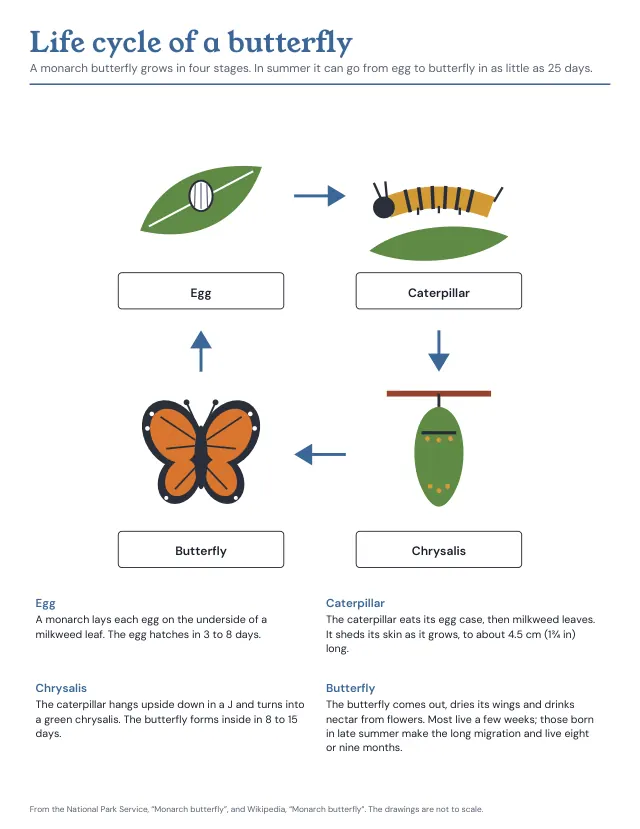
The four stages of a monarch butterfly drawn in a cycle, egg, caterpillar, chrysalis and butterfly, with an arrow from each to the next and what happens at each stage. Print it labelled, to label with a word bank, or with the four pictures to cut out and glue in order; the answer key follows.
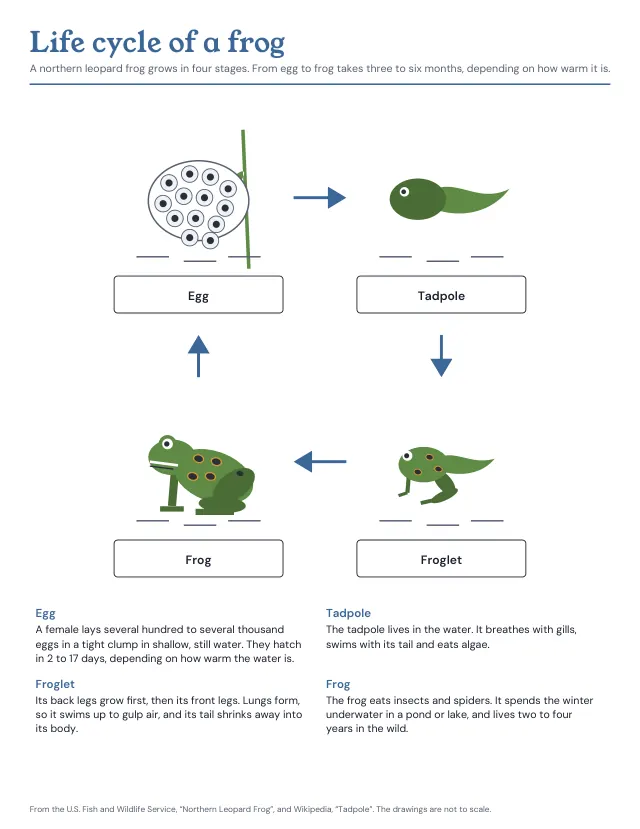
The four stages of a northern leopard frog drawn in a cycle, egg, tadpole, froglet and frog, with an arrow from each to the next and what happens at each stage. Print it labelled, to label with a word bank, or with the four pictures to cut out and glue in order; the answer key follows.
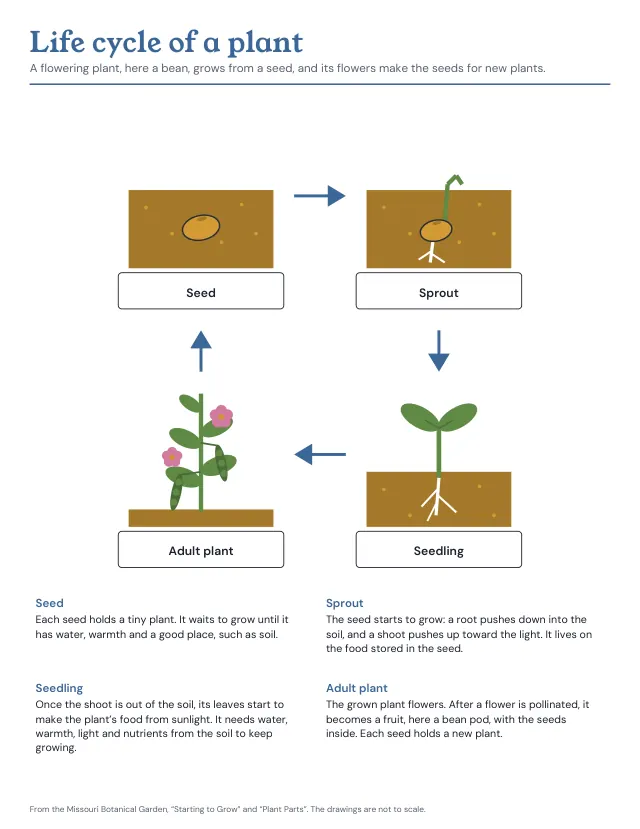
The life cycle of a flowering plant, a bean, drawn in four stages, seed, sprout, seedling and adult plant with its flowers and pods, with an arrow from each to the next and back to the seed. Print it labelled, with what happens at each stage, to label with a word bank, or to cut and glue in order; the answer key follows.
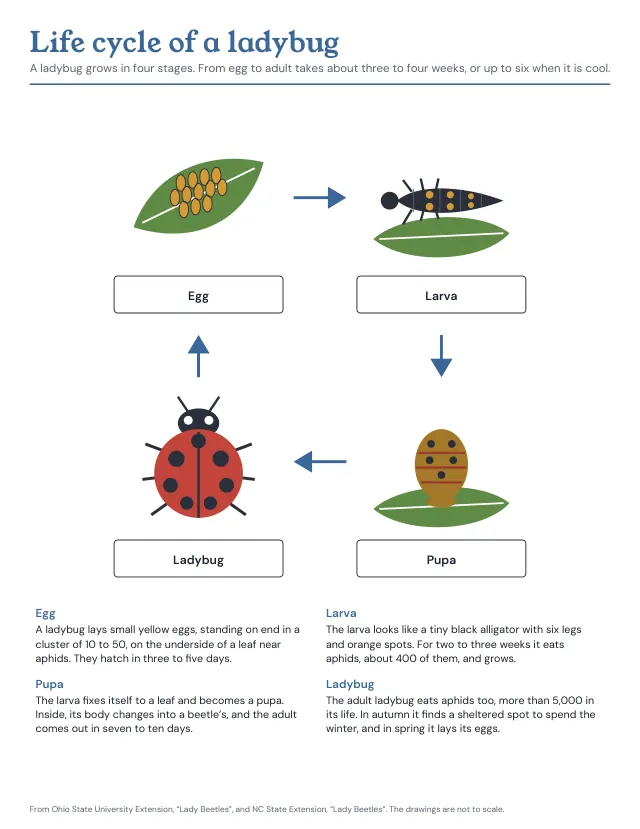
The four stages of a ladybug drawn in a cycle, eggs, larva, pupa and adult, with an arrow from each to the next and what happens at each stage. Print it labelled, to label with a word bank, or with the four pictures to cut out and glue in order; the answer key follows.
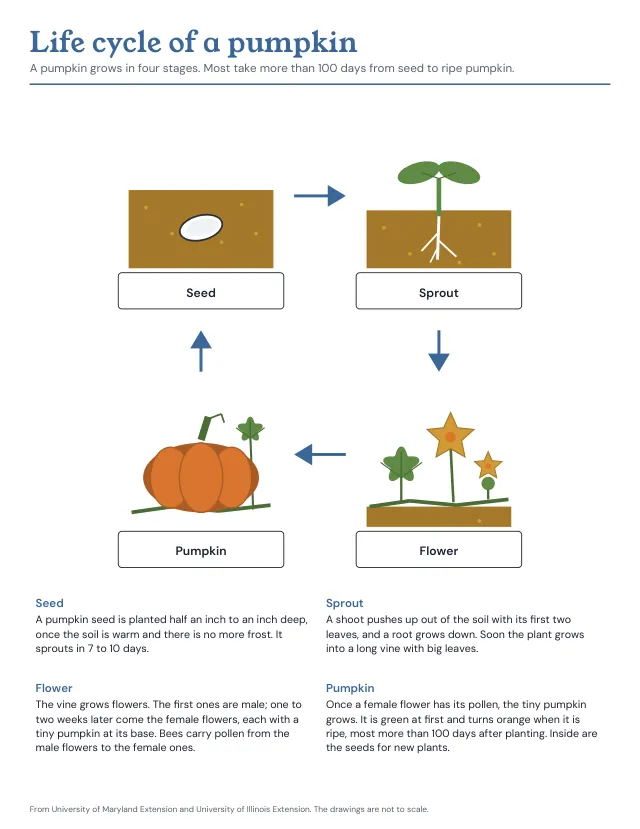
The four stages of a pumpkin drawn in a cycle, seed, sprout, flower and pumpkin, with an arrow from each to the next and back to the seed. Print it labelled, with what happens at each stage, to label with a word bank, or with the four pictures to cut out and glue in order; the answer key follows.
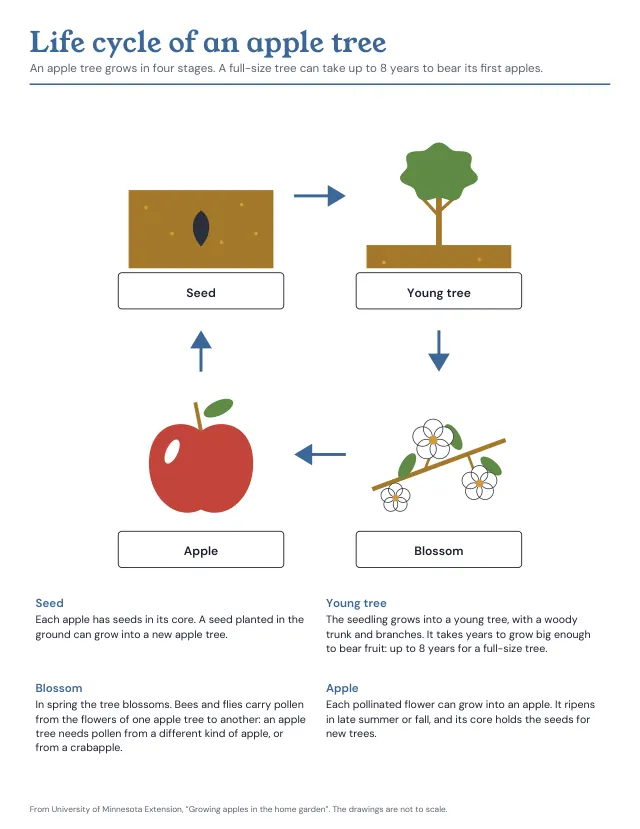
The four stages of an apple tree drawn in a cycle, seed, young tree, blossom and apple, with an arrow from each to the next and back to the seed. Print it labelled, with what happens at each stage, to label with a word bank, or with the four pictures to cut out and glue in order; the answer key follows.
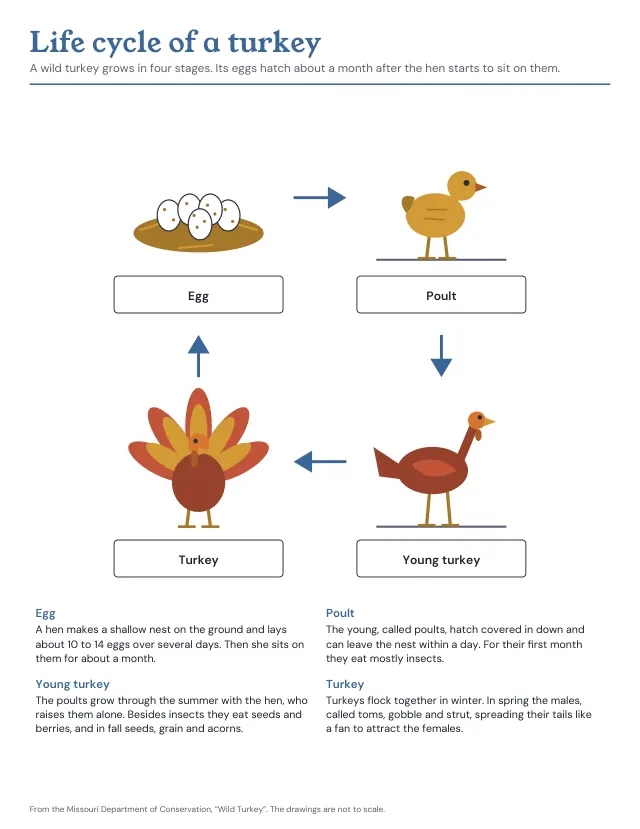
The four stages of a wild turkey drawn in a cycle, eggs in a nest, poult, young turkey and a tom with his tail spread, with an arrow from each to the next and what happens at each stage. Print it labelled, to label with a word bank, or with the four pictures to cut out and glue in order; the answer key follows.
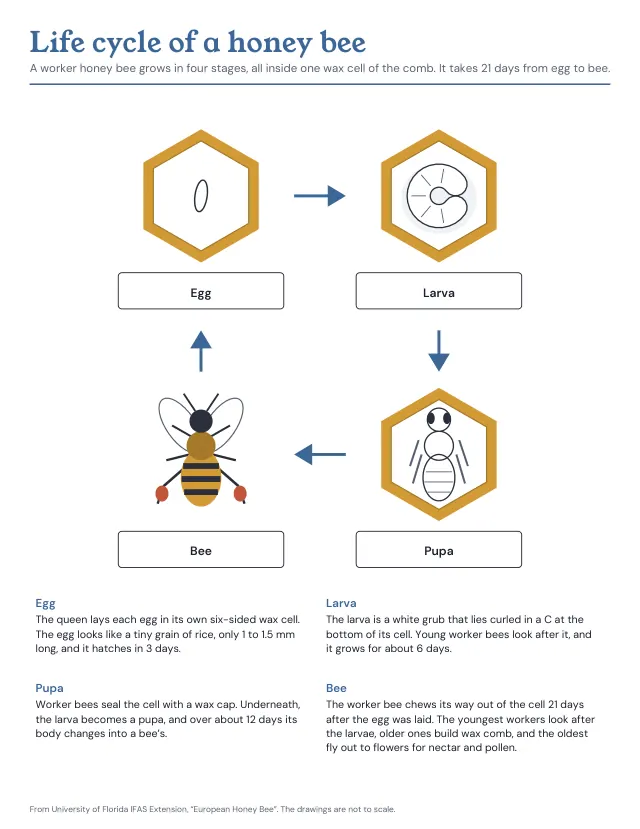
The four stages of a worker honey bee drawn in a cycle, egg, larva, pupa and bee, each in its wax cell, with an arrow from each to the next and what happens at each stage. Print it labelled, to label with a word bank, or with the four pictures to cut out and glue in order; the answer key follows.
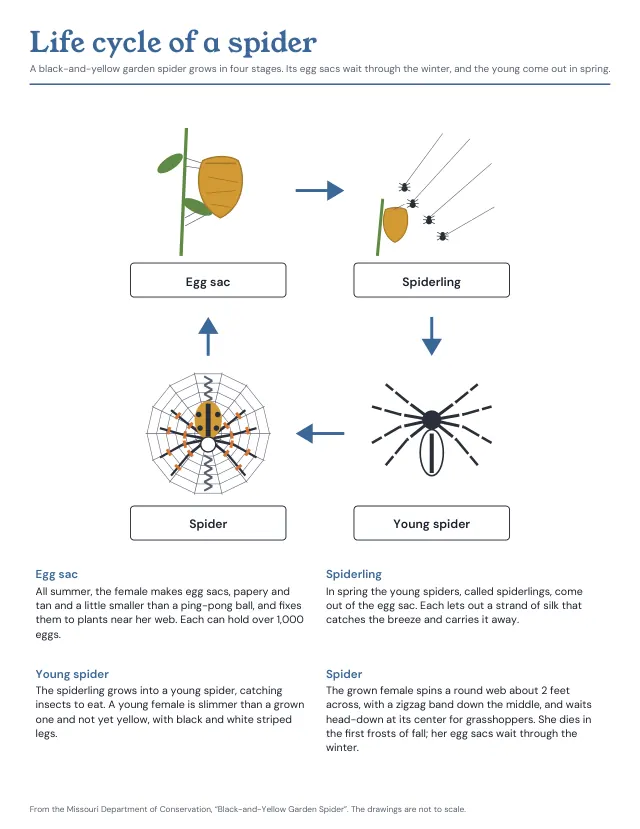
The four stages of a black-and-yellow garden spider drawn in a cycle, egg sac, spiderling, young spider and the grown spider on her web, with an arrow from each to the next and what happens at each stage. Print it labelled, to label with a word bank, or with the four pictures to cut out and glue in order; the answer key follows.
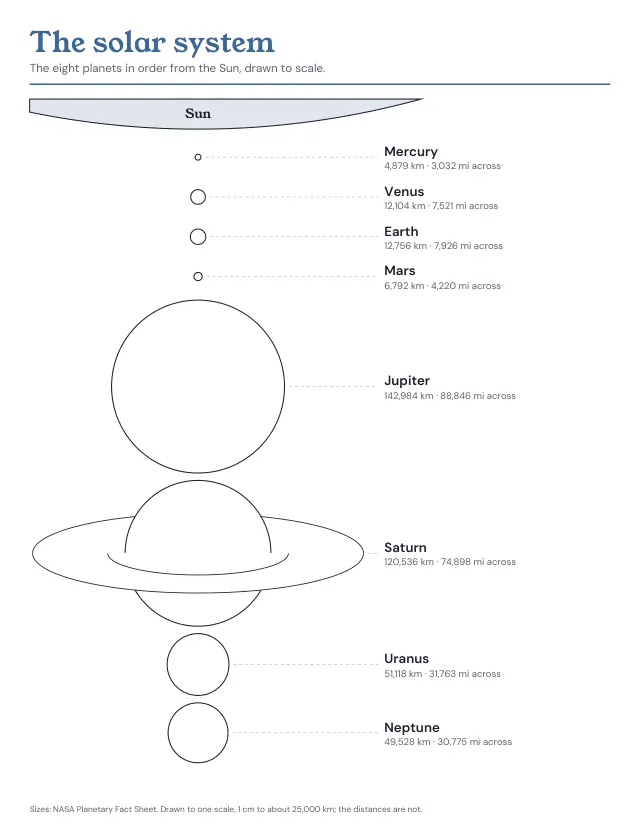
The eight planets in order from the Sun, drawn to one scale down the page, with the edge of the Sun across the top. Print them named with their sizes, with a table of facts, or with the names to write in and an answer key; the planets are left white to colour.
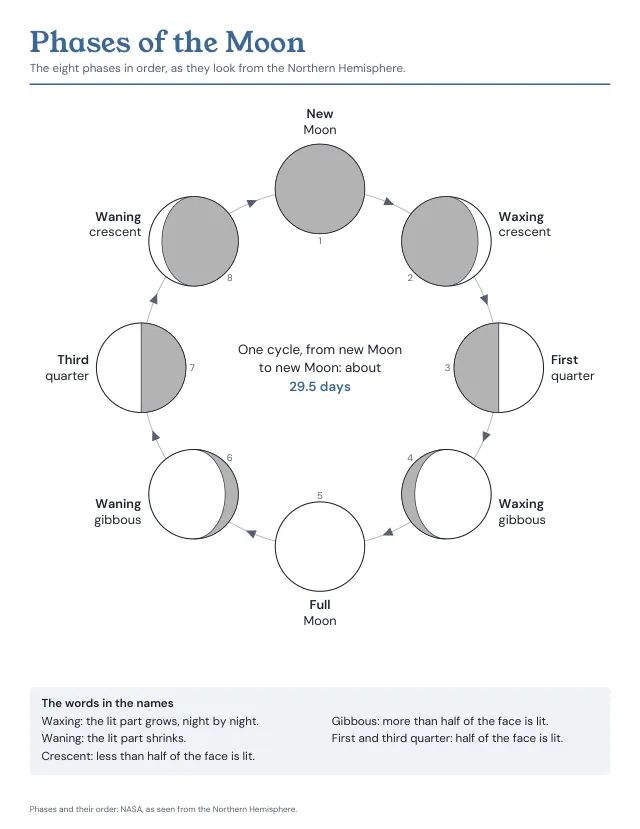
The eight phases of the Moon in order round a ring, from the new Moon to the waning crescent, with the 29.5 days one cycle takes in the middle. Print them named, to name with a word bank and an answer key, or to shade, or print a Moon journal to draw the real Moon on 30 nights.
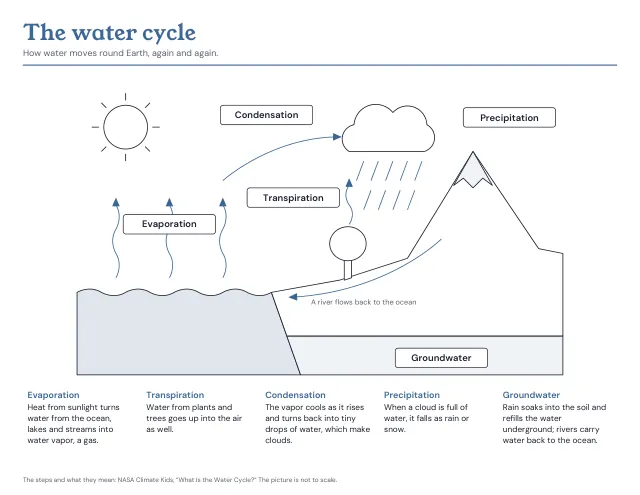
A picture of the water cycle to print: the ocean, the land, a tree, a mountain, a cloud and the Sun, with evaporation, transpiration, condensation, precipitation and groundwater marked on it and what each step means under it. Print it labelled, or with empty boxes and a word bank, and the labelled one after it as the answer key.