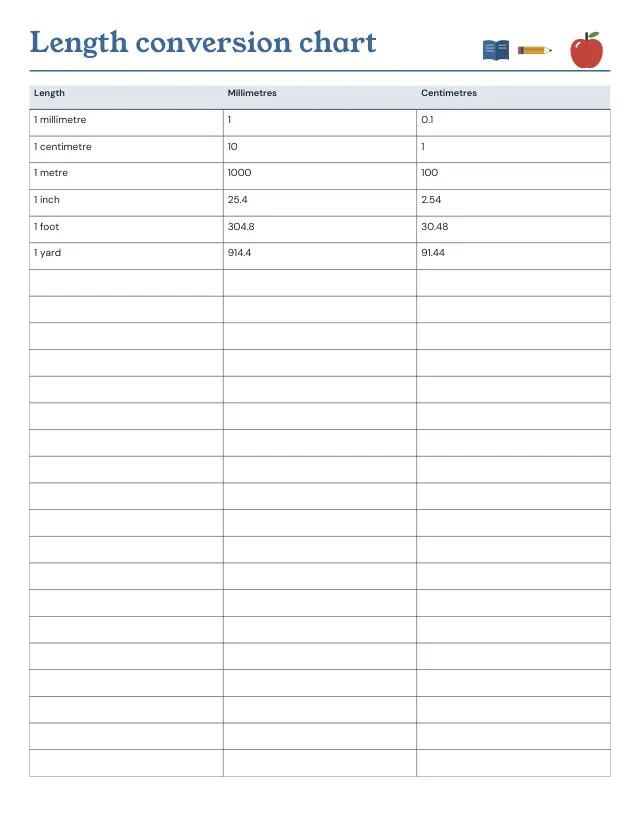
Length conversion chart
Compare millimetres, centimetres, inches, feet and yards. The sheet uses the international foot.
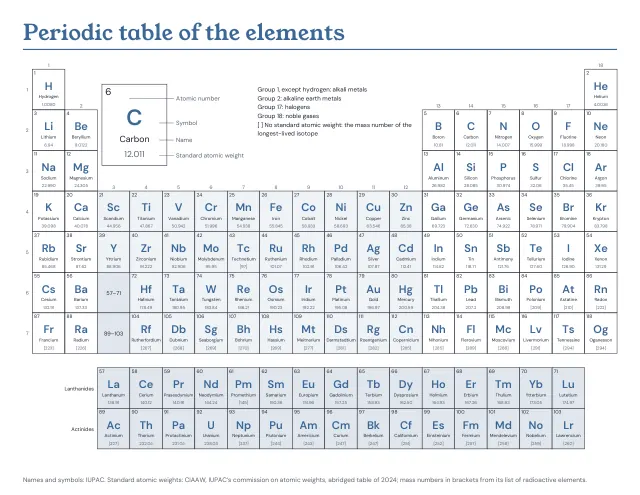
All 118 elements on one landscape page, each with its atomic number, symbol, name and atomic weight, the weights as IUPAC’s commission on atomic weights gives them. Print it in full, without the weights, or with only the numbers to fill in, and the full table after it as the answer key.
1 page · US Letter · Landscape
Free, with no account, email or watermark. Print at 100% or Actual size.
Ready-made PDF (Letter) · Free to print and share copies · Check your print size
Names and atomic weights is the table for chemistry class: each box gives the element’s atomic number, symbol, name and standard atomic weight. Names, no weights prints the symbols and names larger, for younger students learning them. Numbers only, to fill in keeps the boxes and the atomic numbers, for the symbols and names to be written in, and To fill in, then the answer key adds the full table as a second page. On Tabloid or A3 paper the full table prints large enough for a classroom wall. On A5 or Half Letter the boxes are too small for the names and weights to be read, so those papers print each element’s number and symbol only.
Each row is a period and each column a group, numbered 1 to 18 across the top, and the elements in a group behave alike: group 1, apart from hydrogen, holds the alkali metals, group 17 the halogens and group 18 the noble gases. The two rows at the foot, the lanthanides and the actinides, belong in group 3 of periods 6 and 7 and are printed below so the table fits the page. An element with no standard atomic weight, such as technetium or plutonium, is radioactive; the number in brackets is the mass number of its longest-lived isotope. American and IUPAC spelling differ only in aluminum and cesium (aluminium and caesium) and in lanthanides and actinides, which IUPAC calls lanthanoids and actinoids. The ready Letter and Tabloid files use the American spelling and the A4 and A3 files IUPAC’s; the Spelling choice sets either on any paper.
Compare millimetres, centimetres, inches, feet and yards. The sheet uses the international foot.
No sheets match that. Try a shorter word.
Use the same paper size in the PDF and printer settings. Choose Actual size or 100%. Print a sample before making copies.