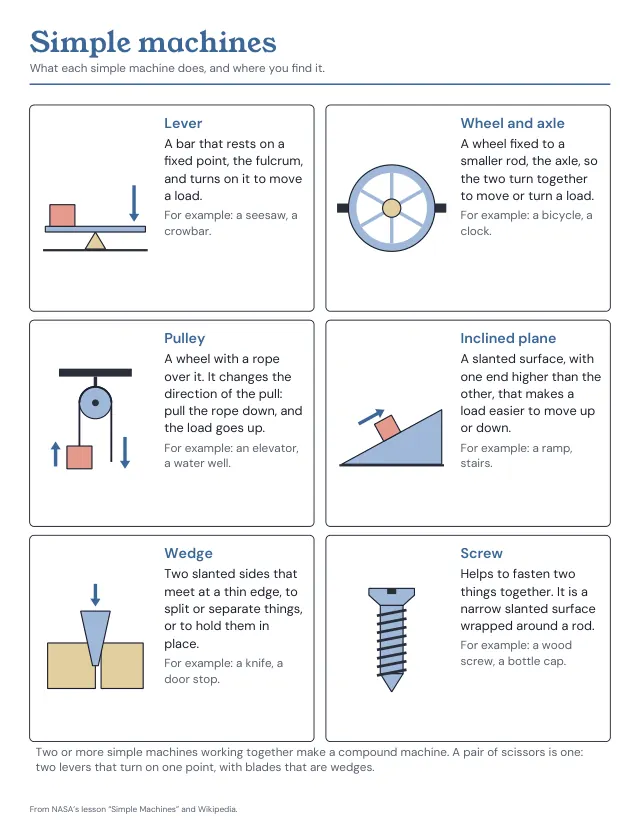
The lever, wheel and axle, pulley, inclined plane, wedge and screw, each drawn to show how it works, with what it does and where you find it. Print the chart, the sheet to label or to match, each with its answer key, or a hunt for one of each at home or at school.
What you will print
215.9 mm · 8.5 in279.4 mm
1 page · US Letter · Portrait
US Letter · 1 page
Free, with no account, email or watermark. Print at 100% or Actual size.
Make it yours
Paper size, margins and lines
Add to a planner refill
Opens the refill builder with this sheet in your page order, at your planner size.
The six machines, explained is the chart: each machine drawn, with its name, what it does and two everyday examples, and a line on compound machines under them. To label puts a numbered, empty box under each drawing and the names in a word bank, and on Letter and A4 upright asks three questions that the answer key answers. To match puts the six machines down the left and six everyday things down the right in another order, to join with a line; the answer key draws the lines. Hunt for them follows NASA’s lesson, which sends a class round the room to look for an example of each machine: the six are drawn, each with a line for what the child found and one for where. Where the page has room, two more lines ask for a compound machine and the simple machines in it, the lesson’s task for home. This sheet has no answer key: every answer is the child’s own. Ink saver prints the drawings as outlines, to colour in.
Two families of machines
The lever, the wheel and axle and the pulley all turn: a lever turns on its fulcrum, and a wheel and axle can be seen as a kind of lever, Wikipedia’s article explains, with the axle’s bearing as its fulcrum. The inclined plane, the wedge and the screw are all slopes: a wedge is two slopes that meet at one edge, and a screw is a narrow slope wrapped around a rod. That is why the sheets list the three that turn first, then the three slopes.
What is a compound machine?
Two or more simple machines working together make a compound machine, NASA’s lesson says, and it names a crane, a bulldozer, clippers and a pencil sharpener you turn by hand. A pair of scissors is one a class can hold: Wikipedia lists scissors among its levers, the two halves turning on one point, and among its wedges, the blades that separate what they cut. NASA’s lesson asks a class which two machines make scissors; the sheet to label asks it too.
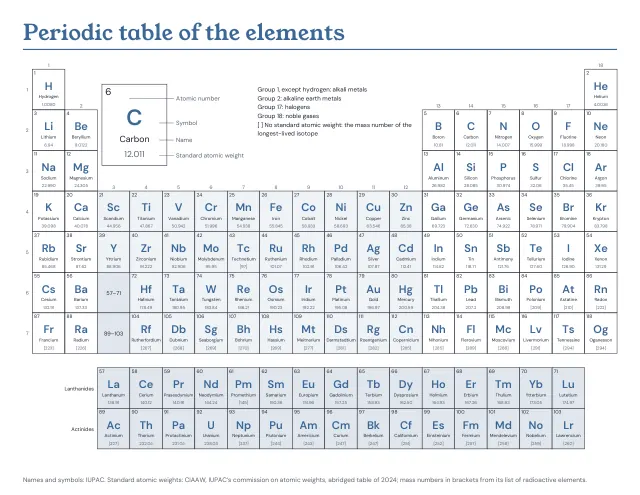
All 118 elements on one landscape page, each with its atomic number, symbol, name and atomic weight, the weights as IUPAC’s commission on atomic weights gives them. Print it in full, without the weights, or with only the numbers to fill in, and the full table after it as the answer key.
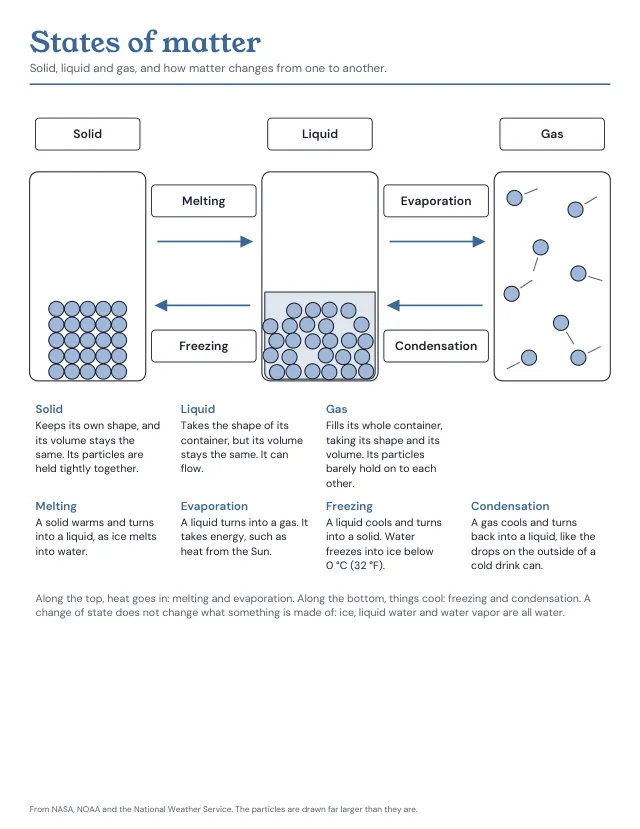
A solid, a liquid and a gas, each drawn with its particles in the same closed container, and the four changes between them. Print it labelled, to label, to cut and glue, or to sort twelve everyday things, each with its key.
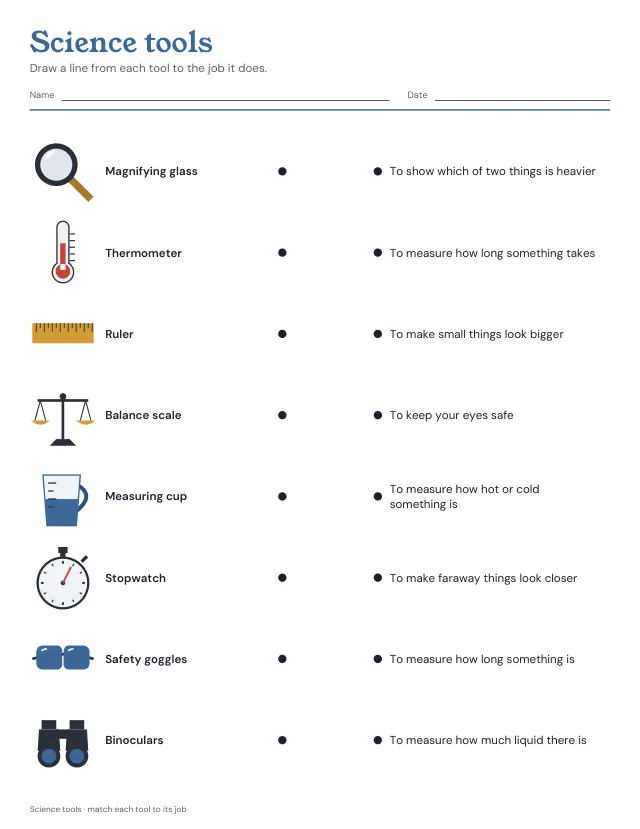
Eight tools a young scientist uses, from a magnifying glass to a balance scale and a stopwatch: match each tool to its job, write each tool’s name from a word bank, or print the chart of all eight with what each is for. Answer keys follow.
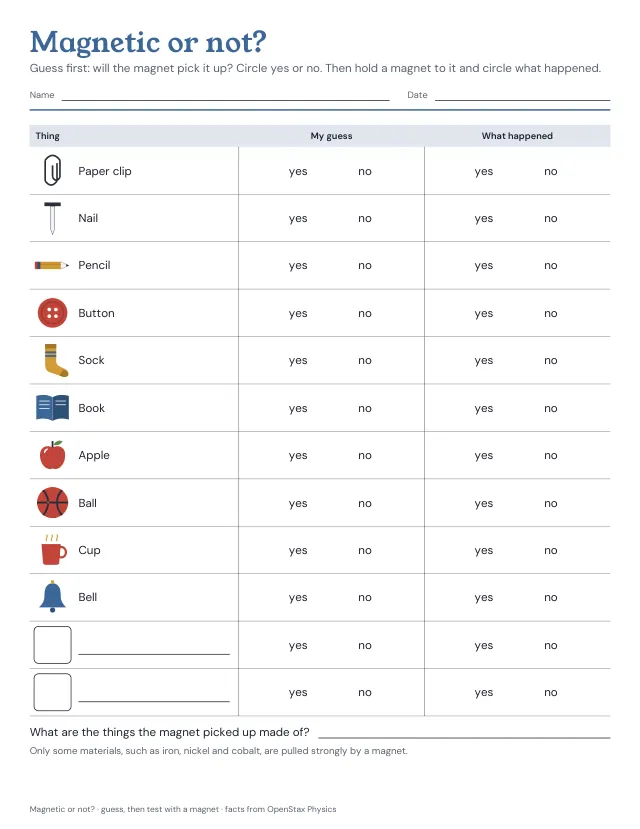
Three magnet sheets: things to guess about and then test with a magnet; pairs of bar magnets to mark attract or repel, with the answer key; and a bar magnet with its poles, its field lines and the paper clips at its ends, labelled or to label.
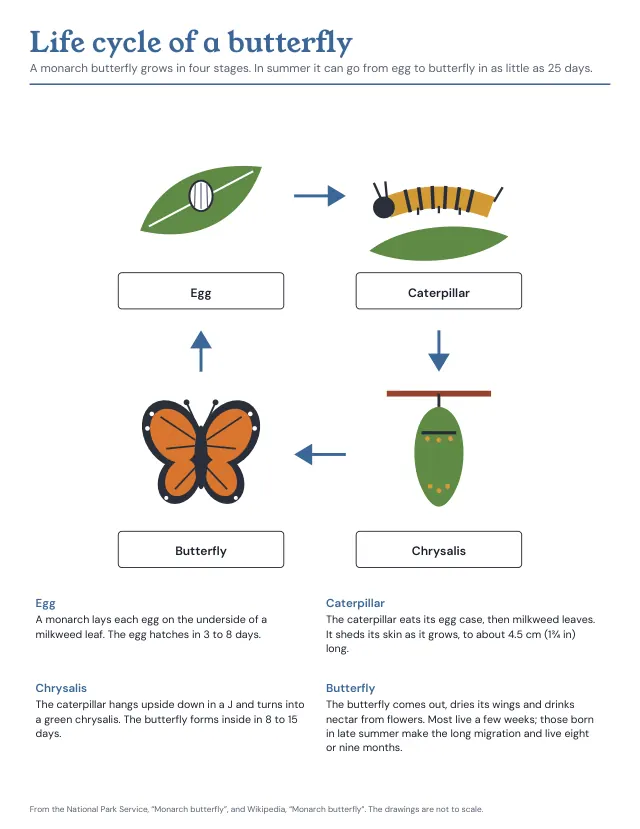
The four stages of a monarch butterfly drawn in a cycle, egg, caterpillar, chrysalis and butterfly, with an arrow from each to the next and what happens at each stage. Print it labelled, to label with a word bank, or with the four pictures to cut out and glue in order; the answer key follows.
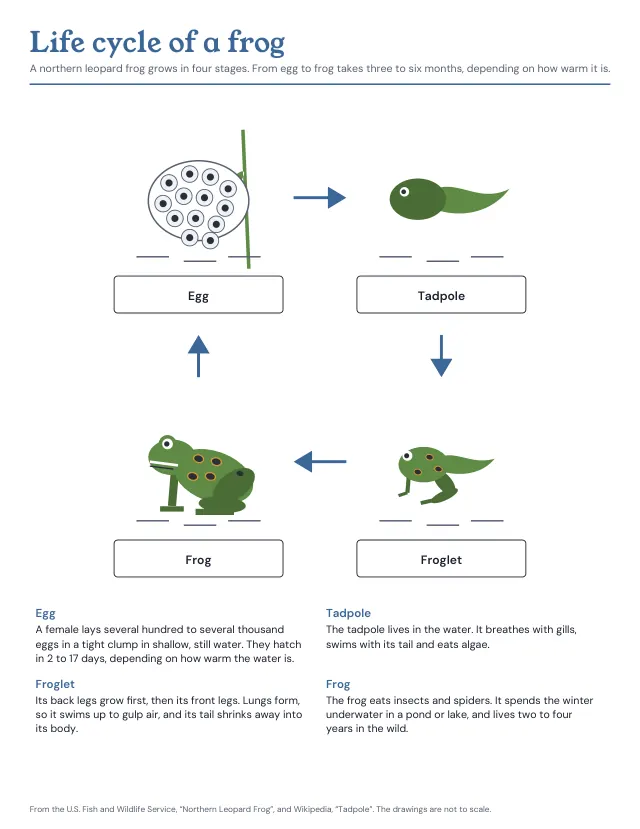
The four stages of a northern leopard frog drawn in a cycle, egg, tadpole, froglet and frog, with an arrow from each to the next and what happens at each stage. Print it labelled, to label with a word bank, or with the four pictures to cut out and glue in order; the answer key follows.
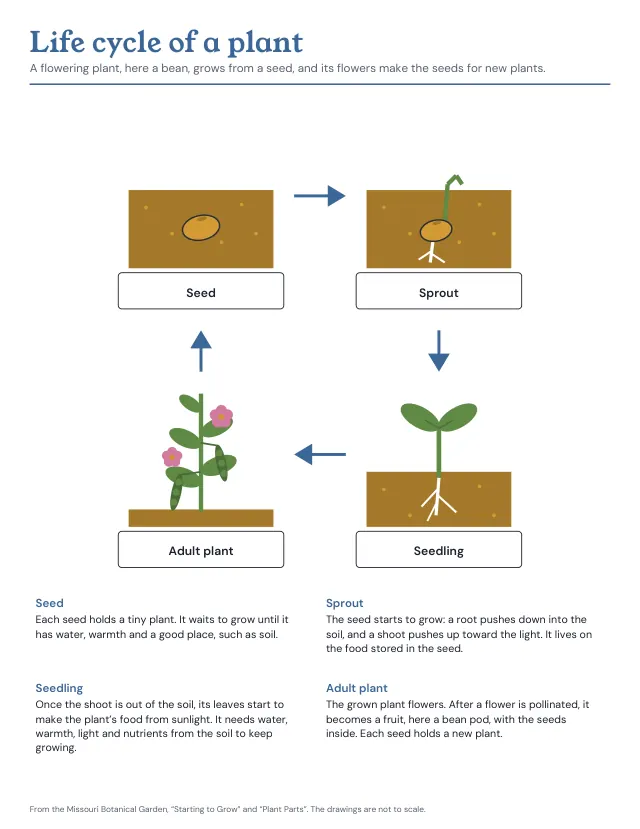
The life cycle of a flowering plant, a bean, drawn in four stages, seed, sprout, seedling and adult plant with its flowers and pods, with an arrow from each to the next and back to the seed. Print it labelled, with what happens at each stage, to label with a word bank, or to cut and glue in order; the answer key follows.
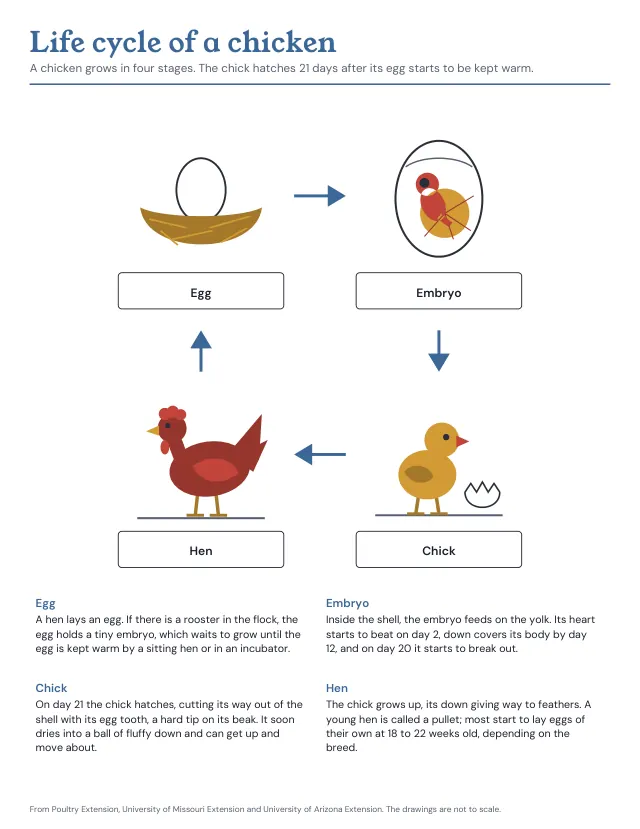
The four stages of a chicken drawn in a cycle, egg, embryo, chick and hen, with an arrow from each to the next and what happens at each stage, the days counted from the egg. Print it labelled, to label with a word bank, or with the four pictures to cut out and glue in order; the answer key follows.
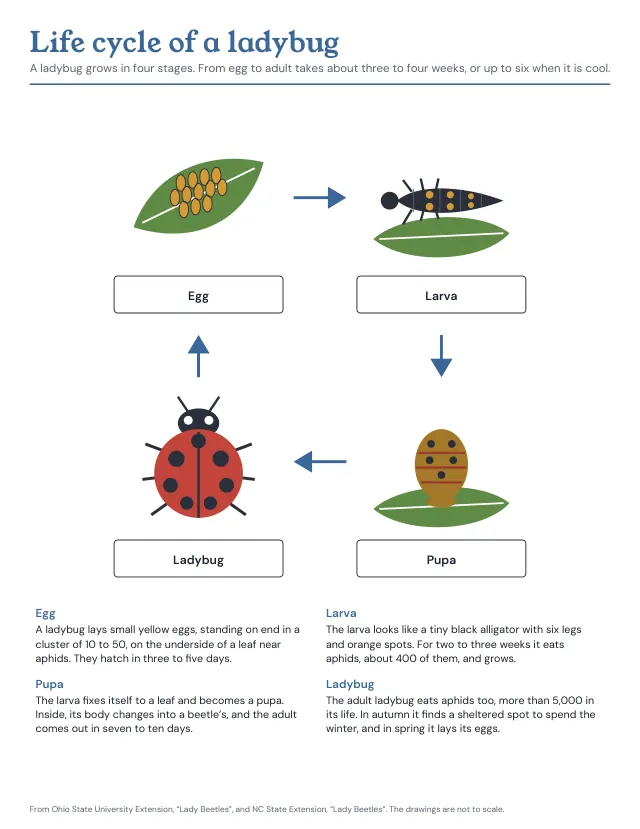
The four stages of a ladybug drawn in a cycle, eggs, larva, pupa and adult, with an arrow from each to the next and what happens at each stage. Print it labelled, to label with a word bank, or with the four pictures to cut out and glue in order; the answer key follows.
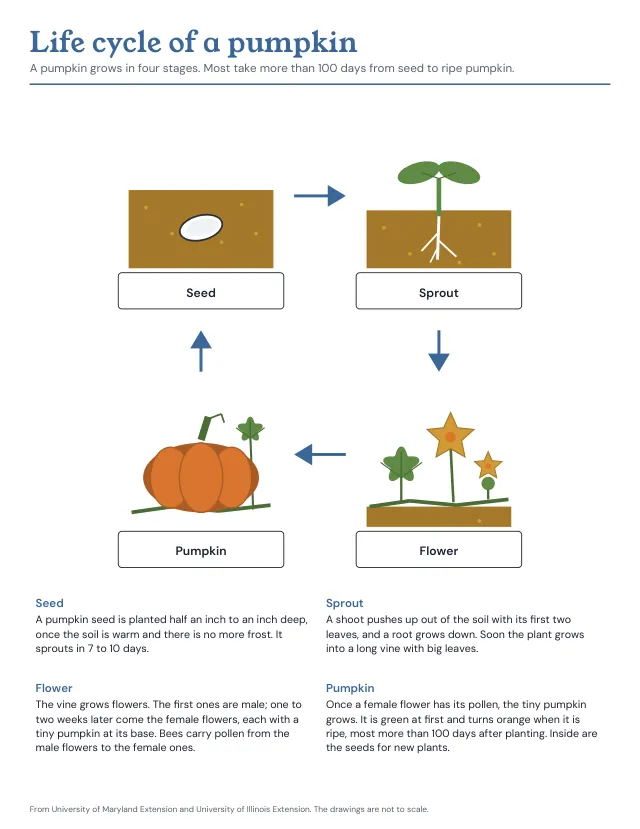
The four stages of a pumpkin drawn in a cycle, seed, sprout, flower and pumpkin, with an arrow from each to the next and back to the seed. Print it labelled, with what happens at each stage, to label with a word bank, or with the four pictures to cut out and glue in order; the answer key follows.
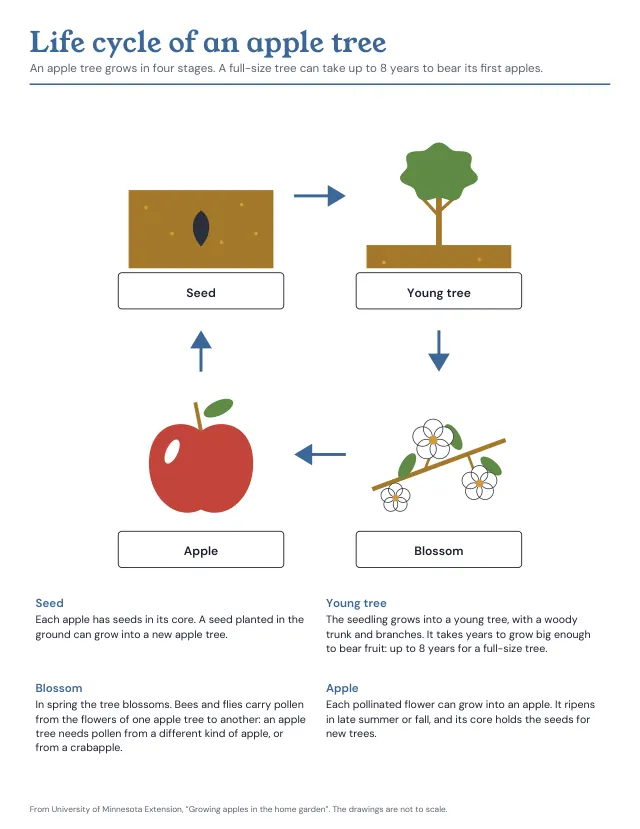
The four stages of an apple tree drawn in a cycle, seed, young tree, blossom and apple, with an arrow from each to the next and back to the seed. Print it labelled, with what happens at each stage, to label with a word bank, or with the four pictures to cut out and glue in order; the answer key follows.
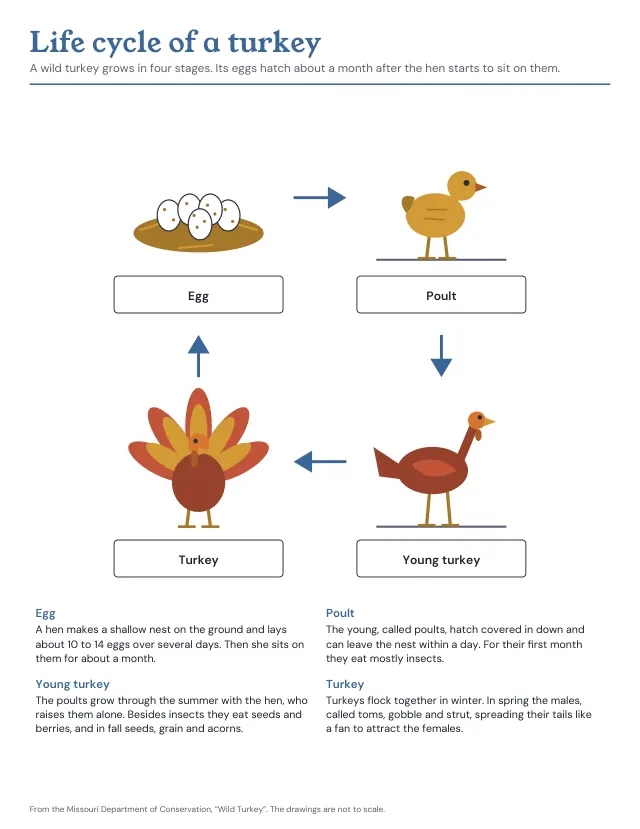
The four stages of a wild turkey drawn in a cycle, eggs in a nest, poult, young turkey and a tom with his tail spread, with an arrow from each to the next and what happens at each stage. Print it labelled, to label with a word bank, or with the four pictures to cut out and glue in order; the answer key follows.